




Why Pakistan’s Military Switched From the US-Owned GPS To The Chinese Bei Dou Navigation System? – Global Village Space

March 22, 2022

Written by Editor

Image: Shutterstock

Blog Editor’s Note: An interesting article showing how China is continuing to erode US and GPS leadership.

Bei Dou does have a number of features that GPS does not as indicated in the chart from Mitre below.
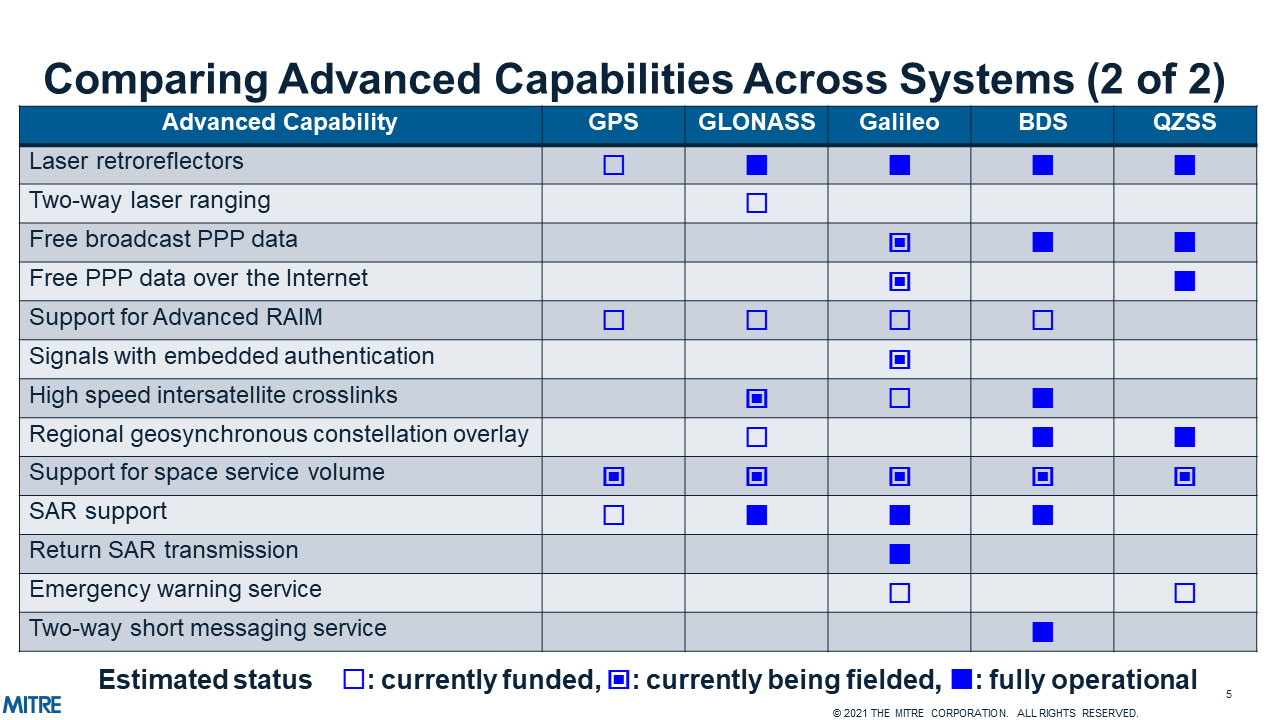
But we think that a lot of the reasons given in the article below for Pakistani forces switching from GPS to Bei Dou are spurious. 

The real reason for the switch is that China recognizes PNT is an instrument of national power and the US does not. So China spends time and effort to get other nations to use their system and we don’t do the same for ours. Neither do we offer US solutions or alternatives when other nations make GPS users look silly by jamming or spoofing them.



Why Pakistan’s Military Switched From the US-Owned GPS To The Chinese BeiDou Navigation System?


For a long time, all the three defense services of Pakistan were using the US-owned and controlled GPS system for the military applications mentioned above. Keeping in view the vulnerability of our military assets, planning, and operations due to the unreliable nature of the Pak- US relationship, the Pakistan military had been contemplating for quite some time to switch over from GPS to a more reliable navigation system.

A satellite navigation system uses satellites to provide autonomous geospatial positioning. It gives information helpful in navigation or for tracking the position of something fitted with a receiver (also called satellite tracking). US military was the first to realize the need to have an independent military navigation capability as early as the 1960s. As a result, in 1964 it deployed the world’s first military satellite navigation system known as NAVSAT.

The system was based on the Doppler Effect and provided location information and navigation to missiles, submarines, and surface ships. NAVSAT was also used for hydrographic and geodetic surveys by the US Navy and Army respectively.


READ MORE

What Can YOU Do? How Can YOU Help?

PNT is the quiet backbone of everything but too many leaders still don’t see the risk.

But you do. You understand the systems, the dependencies, the failure chains. That insight is rare — and it’s exactly what your country needs right now. Contact your government leaders and industry decision-makers and tell them resilient PNT isn’t a feature — it’s the foundation everything else depends on.

Start the Conversation

Use our Resilient PNT Key Talking Points to make the case.

U.S. Advocates

Find your representatives at Congress.gov, then use our email template to reach them in minutes.

When you get a response, let us know. Every conversation strengthens the mission.

More PNT News

“We can track Starlink users…” – Fast Company

“We can track Starlink users…” – Fast Company

Image: Shutterstock What's new: A report that multiple companies are offering governments the ability to geolocate Starlink terminals.  Why it's important: Security concerns - an adversary could target, kidnap, kill, etc. users. Privacy concerns - user location data...

Honeybees teach drones how to navigate without GPS – Cybernews

Honeybees teach drones how to navigate without GPS – Cybernews

Image: Shutterstock What's new: An interesting form of autonomous navigation based on nature. Why it's important: Autonomous systems have an important place in an overall PNT architecture. For some applications they are the best/only method. This system uses just 42...

PNT cyber guidance update – NIST wants your input

PNT cyber guidance update – NIST wants your input

Image: RNT Foundation What's new: Draft updated PNT cyber guidance from NIST. They are seeking public comment and input. Why it's important: PNT and cyber are well intertwined. PNT is an essential tech infrastructure so protecting it from malicious cyber effects is...

GPS Is Not Guaranteed: Impact on ports (Webinar 21 May)

GPS Is Not Guaranteed: Impact on ports (Webinar 21 May)

Image: Shutterstock What's new: A webinar featuring our colleague Matt Shirley. Matt is a professional port pilot and has some interesting insights on maritime reliance on GPS/GNSS, how things could go wrong without resilient PNT, and how things could go better with...

Intl Airline Pilots Assn calls for changes & GPS backup

Intl Airline Pilots Assn calls for changes & GPS backup

Image: Aircraft near Delhi, India being spoofed 5 Nov 2025 - GPSWise What's new: The International Federation of Air Line Pilots’ Associations (IFALPA) called for actions to combat GNSS disruption from ICAO, nations, air navigation service providers, manufacturers,...

Get PNT News in Your Inbox