



Image: RNT Foundation
What’s new: It has been six years since the FCC ruled in favor of Ligado. Now Ligado wants to change almost everything about the bargain it struck with the commission.
Why it’s important: Use of some of the frequencies Ligado was granted could interfere with reception of GPS.
What else to know: Shortly after its 2020 ruling the FCC received eight petitions for reconsideration, including one from the RNT Foundation. In the six years since, no action to deny or approve any of the petitions has been taken.

Dana Goward: Why the FCC Must Reject Ligado’s Latest Plan
Bigger threat, this time from space, the author writes

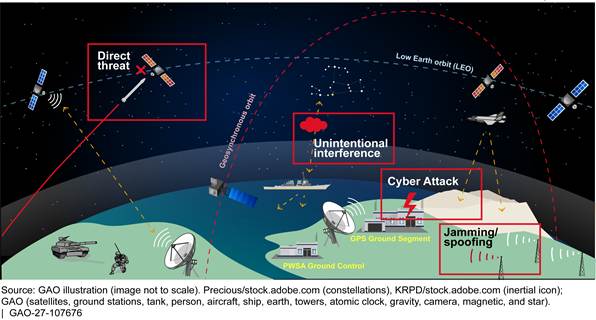
And it is increasingly under attack—not just in war zones. Aviation spoofing incidents rose 500 percent in 2024 and continue to climb. A trend International Air Transport Association Director General Willie Walsh has called “unacceptable and irresponsible.”
Against that backdrop, it is almost unbelievable that six years ago this April, the Federal Communications Commission approved a plan from Ligado Networks that was opposed by virtually every GPS-dependent industry and the entire executive branch, including the Departments of Defense and Transportation. Ligado’s own inability to get its proposed terrestrial network off the ground is the only thing that has spared GPS from harmful interference. But now the company is pivoting, and it wants the FCC to approve a new “partnership” with AST SpaceMobile that poses additional risks.
The new plan abandons the terrestrial deployment entirely. Instead, Ligado proposes to host its L-band payload on AST SpaceMobile’s planned 96-satellite low-Earth orbit constellation. The company calls this a ”modification” of its license for its singular, aging, decades-old GSO satellite. That characterization grossly understates the change. This is a fundamentally different deployment—far more transmitters, in different orbits, with potentially higher aggregate power, broadcasting into the same L-band that GPS depends on.
Much of the risk lies in what we don’t know. And Ligado has done nothing to alleviate the uncertainty. It has not shared the technical information that affected parties need to assess interference risks. It told the FCC it had completed coordination with Inmarsat, a claim Inmarsat directly contradicted in sworn declarations filed in federal bankruptcy court. Six years on, Ligado hasn’t changed one bit. It is the same company, in the same spectrum, posing the same threat of interference, with the same refusal to be transparent. All that has changed is the orbit and new threats of interference layered on.
Consider the environment in which Ligado is submitting this plan. A 2022 study by the National Academies of Sciences, mandated by Congress, found the company’s terrestrial proposal inadequate to protect incumbent users. GPS jamming in Ukraine, the Baltic and Persian Gulf have become a daily reality. Lawmakers across both parties are calling for GPS to be made more resilient and for complementary technologies. FCC Chairman Carr himself has cited the need for systems to complement and backup GPS.
And as GPS comes under greater pressure, its importance to every aspect of the economy has only grown.
Despite all of that, Ligado wants the FCC to approve a plan that could cause more interference with GPS. At least the jamming and spoofing by Russia and Iran has the excuse of being war-related.
None of this is to say Ligado has no legitimate interests. It is a debt-saddled company in the process of emerging from its second bankruptcy and still pursuing a $39 billion claim against the U.S. government for the alleged “taking” of its spectrum. After warehousing valuable L-band spectrum for over two decades and failing to successfully build the mobile satellite service business it was originally authorized to provide, it is understandable that Ligado is looking for any revenue source it can find.
But spectrum policy should not concern itself with the financial woes of any particular company. The job of the federal government is to protect the hundreds of millions of Americans and critical safety services and users that depend on GPS—not to subordinate that interest to a private company’s creditors.
There is a clear path for the FCC to do exactly that. It can grant the eight petitions for reconsideration that have been pending since the 2020 Order. It can revoke Ligado’s existing terrestrial authorization, given that the company missed every FCC-imposed deadline to bring services to market and its new plan effectively voids its terrestrial authority.
And it can turn the page on this long-running saga, so that the agency, the affected industries, and the public can focus on policies that actually serve American consumers.
What the FCC must not do is let Ligado leverage its missed deadlines into a new deployment that threatens GPS—and, by extension, every sector of the economy that depends on it. Congress and the National Academies spoke years ago when they found Ligado’s terrestrial proposal unworkable. Now Ligado is asking the FCC to take it on faith that a 96-satellite constellation broadcasting in the same spectrum neighborhood will be just fine. The answer to this new scheme should be a definitive “no.”
Ligado’s proposal failed on its merits in 2020, yet it was approved by the FCC. Since then, more evidence of that failure has emerged. Ligado’s new proposal, based on available information, also fails on its merits. It would be even worse for our national and economic security.
Every American depends on GPS in more ways than they can imagine. Every American should hope “the merits” of an argument still matter. And every American should urge the commission to reject Ligado’s latest plan.
Dana Goward is co-founder and President of the Resilient Navigation and Timing Foundation, a public benefit charity advocating for policies and systems to protect GPS satellites, signals, and users. This Expert Opinion is exclusive to Broadband Breakfast.