



Image: Copilot AI
What’s new: Another report about Todd Humphreys’ efforts, though this one has a bit more of the backstory about how this was discovered.
Why it’s important: We hope this helps raise awareness about threats and risks.
What else to know:
- Regrettably, the NYT article we posted last week made it seem like this was an issue for Europe. It is a concern for everywhere and everyone.
- Another report, with yet another slightly different take, was in INSIDE GNSS on Friday.

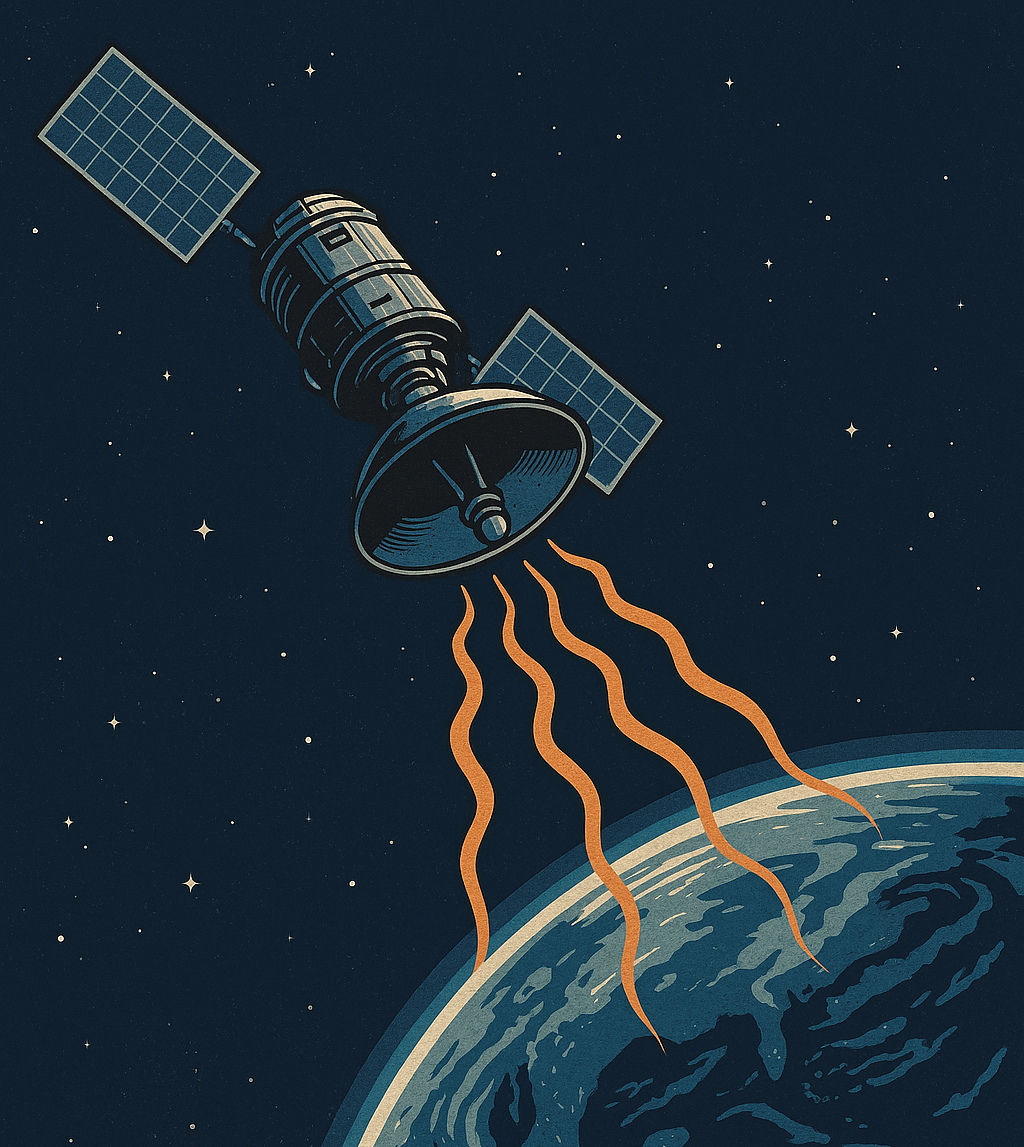
Russia is jamming GPS from space
The revelation came as a result of a SpaceNews opinion article.
“America is at risk of high impact GPS jamming and spoofing from space” was the title of my SpaceNews opinion article in October 2024. Little did I know that its publication would set into motion a series of events that ended up proving Russia has been jamming GPS from space since 2019.
In the 2024 article, I quoted remarks at a conference by Professor Todd Humphreys from the University of Texas Radionavigation Lab. I included additional speculation by Todd, me and my colleague General William Shelton, USAF (ret), one time commander of Air Force Space Command, about China’s and Russia’s space-based capabilities.
Shortly after it was published, I was surprised to be contacted by a researcher in the United Kingdom. He said that interference from space was more than a possibility — he had observed it.
Examining data from terrestrial reference stations operated by the International Global Navigation Satellite System (GNSS) Service, he had noticed instances in which GPS signal strength had decreased markedly. In each case it was for less than ten seconds, but the events had been recorded by stations across a very broad section of northern Europe.
While he did not want to be publicly identified, the researcher did agree to the Resilient Navigation and Timing Foundation putting him in touch with others who could confirm his findings and perhaps discover more.
He also agreed to General Shelton and I giving his data to officials in the United States government. We did that in November 2024 in multiple meetings with the administration and one with an interested congressional staff member.
Of the other researchers we contacted, Humphreys and his team at the University of Texas were particularly interested. Eventually they were able to use data from 165 reference stations across Europe, Greenland and Canada to independently verify the UK researcher’s findings. The University of Texas team identified 75 instances of interference between 2019 and 2026 in which there were significant decreases in carrier to noise ratio (CNR) of 5dB or more.
A year after being put onto the scent, Humphreys and his research student Zach Clements had confirmed the interference was coming from space and presented a paper with their findings, published September 2025 in the journal Proceedings of the 38th International Technical Meeting of the Satellite Division of the Institute of Navigation. But they had not been able to identify which of numerous possible satellites were responsible.
In preprint research paper released in May, “Chasing Lightning: Detecting, Characterizing, and Identifying a Powerful Space-Based GNSS Interference Source,” Humphreys and Clements at Texas, and Argyris Kriezis from Stanford, explain how they found the culprit — a small constellation of Russian early warning satellites in Molniya (lightning) orbits.
Humphreys is confident that the interference is purposeful, not hardware malfunctions or accidental emissions.
“The pattern is far too consistent for this to be accidental. In fact, our data shows it has to be intentional,” he said.
The interference:
- Has almost always been on a weekday — usually Tuesday through Thursday,
- Events are not regularly spaced out and are transient (less than 10 seconds) rather than periodic or continuous as would be expected from an equipment malfunction,
- Events are quite powerful. CNR drops of up to 10 dB have been observed in some cases, and
- Impacts are to the most commonly used GPS frequency, L1, but don’t affect other GPS bands like L5.
Also, the signals interfering with GPS are not exactly astride the L1 frequency but are slightly offset. They are centered at 1577.5 MHz, about 2 MHz above the GPS L1 center frequency. This is likely in an effort to test the capability while avoiding detection.
Perhaps most damning, Humphreys’ team has found that the same Russian constellation has been impacting signals from China’s Bei Dou satellite navigation system in an almost identical way since June 2020.
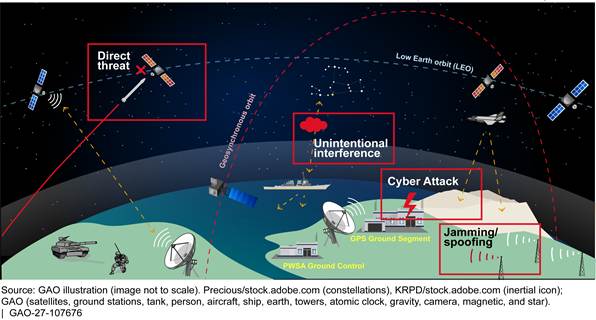
It is clear that one of this Russian constellation’s primary capabilities is disruption and denial of America’s GPS and China’s Bei Dou navigation systems, should the Kremlin decide to do so. A slight change in frequency and an increase in transmitted power is all that is needed to prevent reception of one or both systems across continental size areas.
The new paper reveals a significant threat to GPS and other GNSS that has heretofore been unknown to the general public. Awareness is rapidly increasing, though. Humphreys’ findings have been reported by the New York Times and a video about the discovery has been posted to YouTube by the science education channel Veritasium.
This revelation should also greatly increase awareness and concern on the part of U.S. government leadership. The vulnerability of GPS and other GNSS signals is regularly used as a tool in great power competition
In a 2024 paper for the National Security Space Association, now Assistant Secretary of War for Space Policy, Marc Berkowitz, wrote “A space-based EW (electronic warfare) weapon could have devastating impacts to the U.S. homeland.”
Russia has been particularly overt using GPS interference from terrestrial sources to punish its neighbors in the Baltic and eastern Europe for growing closer to the West.
And it engaged in the first public attempt at GPS blackmail.
In November 2021, as it prepared to invade Ukraine, Russia shot down one of its defunct satellites with a ground-based missile. The following day state-sponsored media threatened that if NATO got in its way in Ukraine, Russia would shoot down all 32 GPS satellites.
While Russia may not have really had the capability to destroy all GPS satellites, it is now clear they were able to prevent reception of signals across very wide areas of the globe at will.
It is unknown how or if Russia’s threat influenced the West’s actions in Ukraine. And we can’t know how Russia’s ability to turn off reception of GPS and other GNSS with the flip of the switch will impact international relations and actions in the future.
What we do know is that Russia and China have terrestrial systems to back up and complement GNSS that minimize the impact of interference, regardless of the source. This gives them huge tactical and strategic advantages over the U.S. and the West.
Concerned about this imbalance, the United Kingdom and France are following South Korea and Saudi Arabia’s lead and building terrestrial systems to protect their national and economic security.
Unfortunately, concern in the U.S. to date has only resulted in rhetoric.
GPS is an amazing and priceless asset. Yet without the protection of a robust and resilient complementary and backup system it remains, as a member of the National Security Council once said, “a single point of failure” for America.
Dana A. Goward is a retired from the U.S. Senior Executive Service and a retired U.S. Coast Guard Captain.