





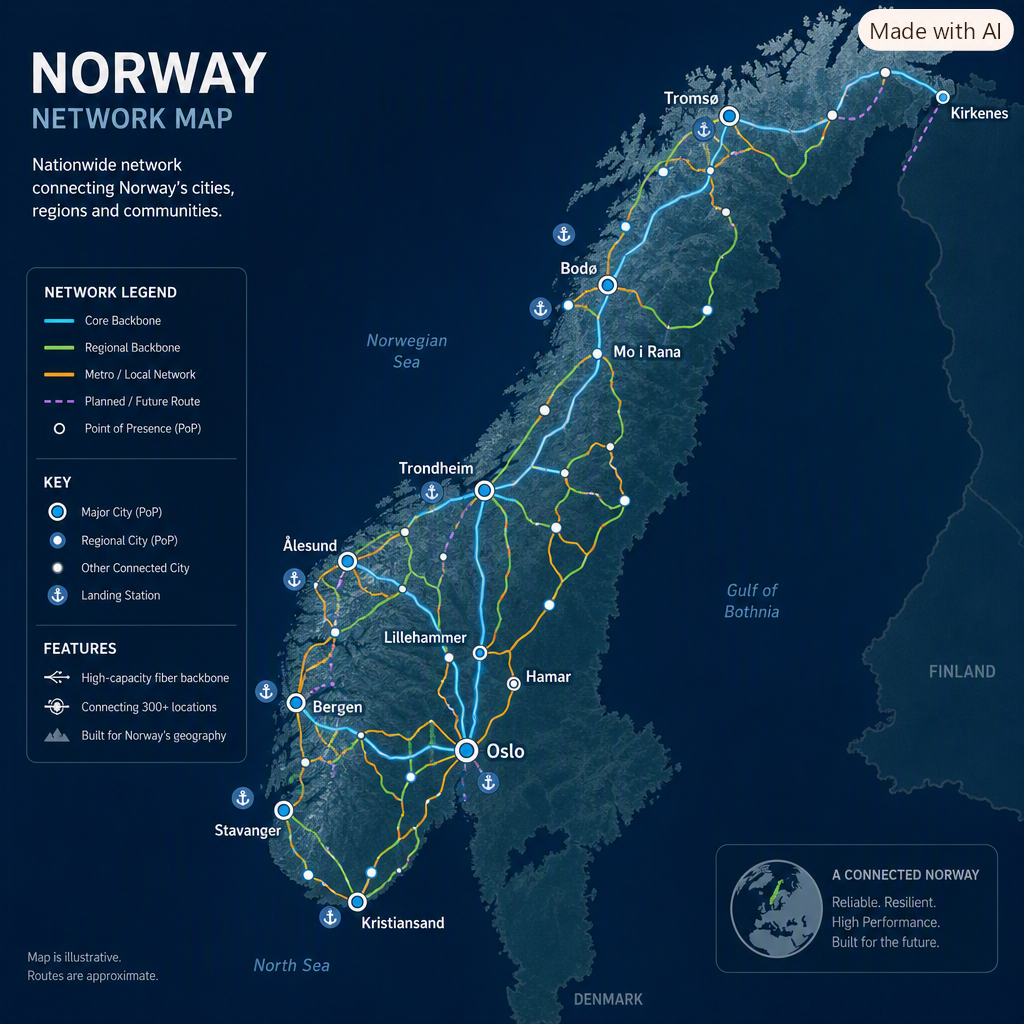
Image by Copilot AI – For illustration only, not representative of a plan or proposal.
What’s new:
- A report from Norway’s defense establishment research arm, FFI, that the country is highly vulnerable to loss of GNSS (we are shocked, SHOCKED!)
- A report from NRK that the Norwegian government is budgeting around $10M USD for a sovereign clock capability.
Why it’s important:
- Resilient PNT is essential for every nation’s defense and economy. Disruptions can be devastating.
- Norway is in Russia’s neighborhood. Russia jams and spoofs Norway’s northern region, Finnmark, regularly.
- Russia could easily jam GNSS across all of Scandinavia from space.
What else to know:
- Norway’s Ministry of Trade, Industry, and Fisheries issued a report on the impacts of losing GNSS earlier this year.
- Two Norwegian government agencies proposed a national clock network in January of this year.
- Southern Norway will should be able to use the UK’s eLoran network for navigation and a larger section of Norway will be able to benefit from UK eLoran timing. We expect if Norway added two or three eLoran transmitting sites the entire nation and its sea lanes would have full terrestrial broadcast PNT.
- Norway terminated its Loran system in 2015 at the same time as other European nations. The public justification was that it was not needed because Galileo would soon be operational. EU tech leaders knew GNSS signals were vulnerable and easy to jam and spoof. But politicians did not want inexpensive Loran systems to be around and perhaps impact funding for the very expensive Galileo constellation.
- $10M USD does not seem like it is enough to establish a national time standard, let alone a clock network as proposed earlier this year. But, as the article says – it is getting things started.
- The graphic with this post is illustrative, was made by AI, and does not represent any plan or proposal.

NEWSROOM / SPACE / NORWAY
FFI report warns satellite-navigation failures threaten Norway’s total defence
A new report from Norway’s defence research institute FFI warns that the loss of satellite-based navigation and timing signals (GNSS) could seriously weaken Norway’s total defence. FFI proposes six measures, including ground-based backup systems and national robustness standards, which will now form the basis for an updated national strategy.
Norway’s Defence Research Establishment, FFI, has published a report on the risks of losing satellite-based positioning, navigation and timing signals, known as PNT. It concludes such failures could seriously weaken Norway’s total defence. The Ministry of Trade, Industry and Fisheries commissioned the report.
FFI mapped GNSS dependency across nine critical functions, including power supply, telecommunications, transport, payment systems, food distribution and emergency services. Most sectors carry medium vulnerability, FFI found. Emergency services face medium-to-high risk, since they rely on GNSS for localisation, navigation and resource management.
FFI describes GNSS signals as “weak and highly vulnerable to electromagnetic interference,” both natural and man-made. It singles out spoofing, feeding false position or timing data into a receiver, as more dangerous than jamming, because it is harder to detect and can disrupt operations immediately.

Will spend almost one hundred million on a national “super clock” to strengthen preparedness
Norway currently lacks a national clock to share precise time. The Minister of Trade and Industry today presented a clear leak from the state budget.
– The fact that the clock is correct and traceable is absolutely crucial for many socially critical functions in Norway and the rest of Europe, says Minister of Trade and Industry Cecilie Myrseth (Labour Party).
On Tuesday, she released a budget leak that shows that the government wants to unite the entire country around a common goal.
The research network of Sight will make the clock, and the bill of 94 million kroner will be taken over by the state budget.