




Image: RNT Foundation
What’s New: The UK government’s Council for Science and Technology (CST) provided advice on “Priorities for Strengthening the UK’s Sovereign Space Capability.” PNT was first on the list and included:
“...the UK should develop a spectrum of sovereign owned technologies which augment or supplement our access to Global Navigation Satellite Systems, as well as discrete terrestrial technologies to provide back-up timing and positioning capability that do not rely on space-based systems.”
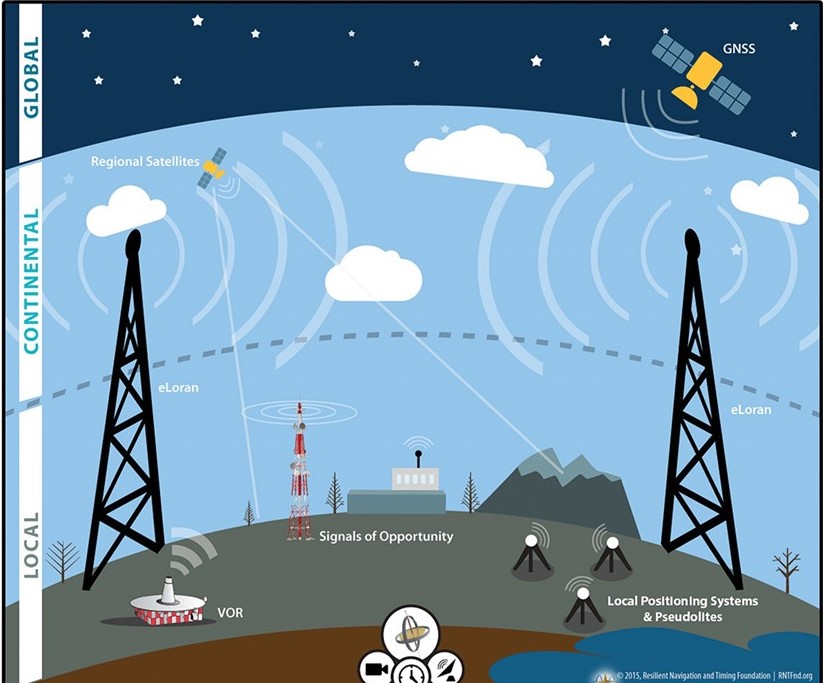
Why It’s Important: It reinforces the idea that terrestrial systems to supplement/complement those in space are essential to sovereignty in space and overall national sovereignty.
What Else to Know:
- The advice preceded and supported the recent UK government plan for resilient PNT.
- Of the four recommendations in the CST advice, PNT was first and the one the government seems to be acting the most aggressively upon.
- “The Council for Science and Technology (CST) advises the Prime Minister on science and technology policy issues across government. The council is an expert committee, which works with the Department for Science, Innovation and Technology.”

PRIORITIES FOR STRENGTHENING THE UK’S SOVEREIGN SPACE CAPABILITY
[Excerpt]1. Position, Navigation, and Timing (PNT)
The European Union, Russia, China, India, Japan, and USA own and operate sovereign PNT systems. PNT, specifically highly-accurate timing, is integral to the operation of all 13 Critical National Infrastructure (CNI) sectors (8). To mitigate the extensive social and economic impacts arising from a loss of PNT, the UK should develop a spectrum of sovereign owned technologies which augment or supplement our access to Global Navigation Satellite Systems, as well as discrete terrestrial technologies to provide back-up timing and positioning capability that do not rely on space-based systems. We recommend the government prioritises investing in advanced timing technologies, particularly atomic clocks. This should include both terrestrial and space-based clocks, such as those deployed in geosynchronous equatorial orbits (GEO). Additionally, we suggest exploring the possibility of supporting these technologies in low Earth orbit (LEO) or as hosted payloads on LEO and medium Earth orbit (MEO) communications constellations.
The UK should work with partners, and help enable industry, to investigate, invest in, and develop other technologies to maintain accurate timing and positioning in the event of denial of space by accidental or hostile action. These technologies could include, but are not limited to, smart antennas, quantum-enabled navigation, sources to continue localised broadcasting of position information, and technologies to detect the source of interference to PNT. These measures would help to ensure access to robust PNT services during times of threat to space-based infrastructure. The development of the National Timing Centre (hosted by the National Physical Laboratory) is an opportunity to build our own cutting-edge capabilities so that the UK can provide secure, resilient, and terrestrial Timing Signals domestically that do not solely rely on space-based systems.
8 National Protective Security Authority (2023) Critical National Infrastructure. Available at: https://www.npsa.gov.uk/critical-nationalinfrastructure-0