




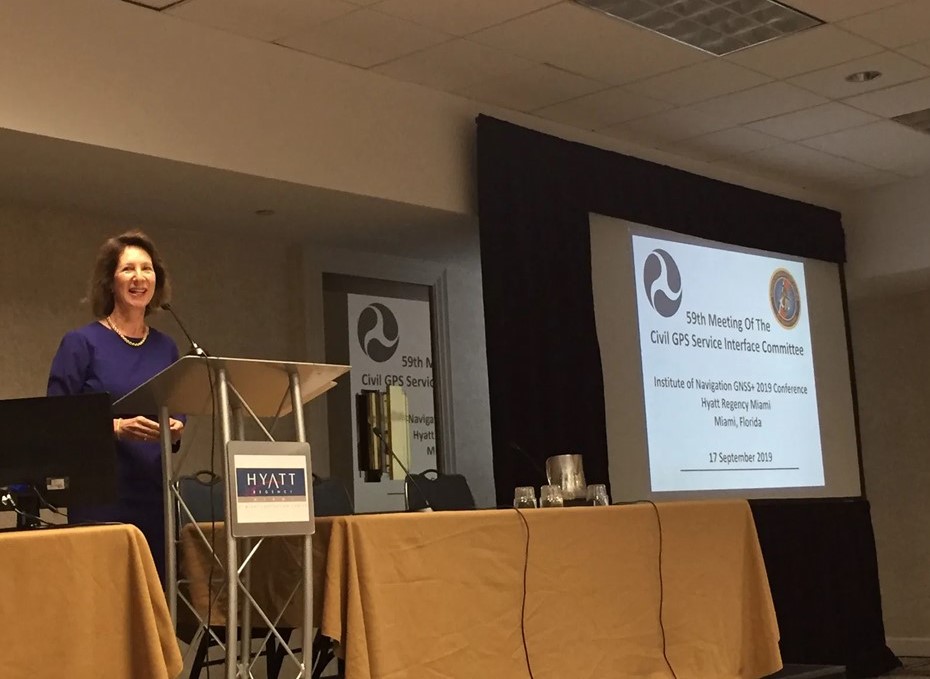
[Diana Furchtgott-Roth, DOT deputy assistant secretary for research and technology, speaks to the Civil GPS Service Interface Committee (CGSIC) meeting in Miami. Photo: Dee Ann Divis]
Blog Editor’s Note: Another step in the process of the U.S. acquiring the backup for GPS mandated by Presidential Order and law.
Note that the law requiring a system to backup GPS timing by December 2020 requires a terrestrial system. The one mandating a demonstration of GPS backup technologies does not require those tested to be terrestrial.
While other space systems can and do augment GPS/GNSS, all space systems tend to share the same set of vulnerabilities from jamming, coronal mass ejections, etc.
In the words of a friend of ours at a government space organization “It doesn’t make sense to backup space with space.”
11 Firms Chosen to Demonstrate GPS Backup Technologies
The Department of Transportation (DOT) selected 11 firms to demonstrate technologies that could be used to back up the services provided by GPS should GPS signals be jammed, spoofed or unavailable.
DOT did not specify how much each firm was awarded. The total amount allocated to the 11 companies was $2,507,500, making the average level of the contracts to each firm $230,000. The government had said in late September that it might award up to 20 contracts for demonstrations.
DOT did not specify what each firm would do. See further below in this story for a list of the firms and some of their published capabilities.
The mix of capabilities provided by the firms on the list is not an accident.
“We are seeking the best solutions to ensure that America has a combination of PNT systems which, when used together, will be difficult to disrupt,” said Diana Furchtgott-Roth, DOT deputy assistant secretary for research and technology. “This effort will inform implementation of a system that is, to the maximum intent possible, required to be terrestrial, wireless, have wide area coverage, be difficult to disrupt and capable of expansion to provide positioning and navigation services. We might not be able to do all those things but we are very much going to try our best possible.”
DOT’s Volpe National Transportation Systems Center (Volpe Center) will support the demonstration that will take place this March, according to Furchtgott-Roth. She spoke to the September meeting of the Civil GPS Service Interface Committee (CGSIC) in Miami.
Each selected technology had to be at readiness level 6 or higher, meaning a prototype has been tested in a simulated environment. The firms also had to provide either timing information, position information or both, and be capable of operating in the absence of GPS/GNSS broadcast signals. Solutions in the demonstrations must provide more than just interference mitigation of GPS/GNSS broadcast signals or provide resiliency to those specific signals.
On the business side, the technologies chosen for demonstration had to be:
• capable of interfacing with specific government data collection systems,
• able to meet regulatory compliance and
• without any proprietary licensing agreement restrictions.
Finally, national defense reasons could not limite= disclosure of the information from the technologies demonstrated.
The selectees: