



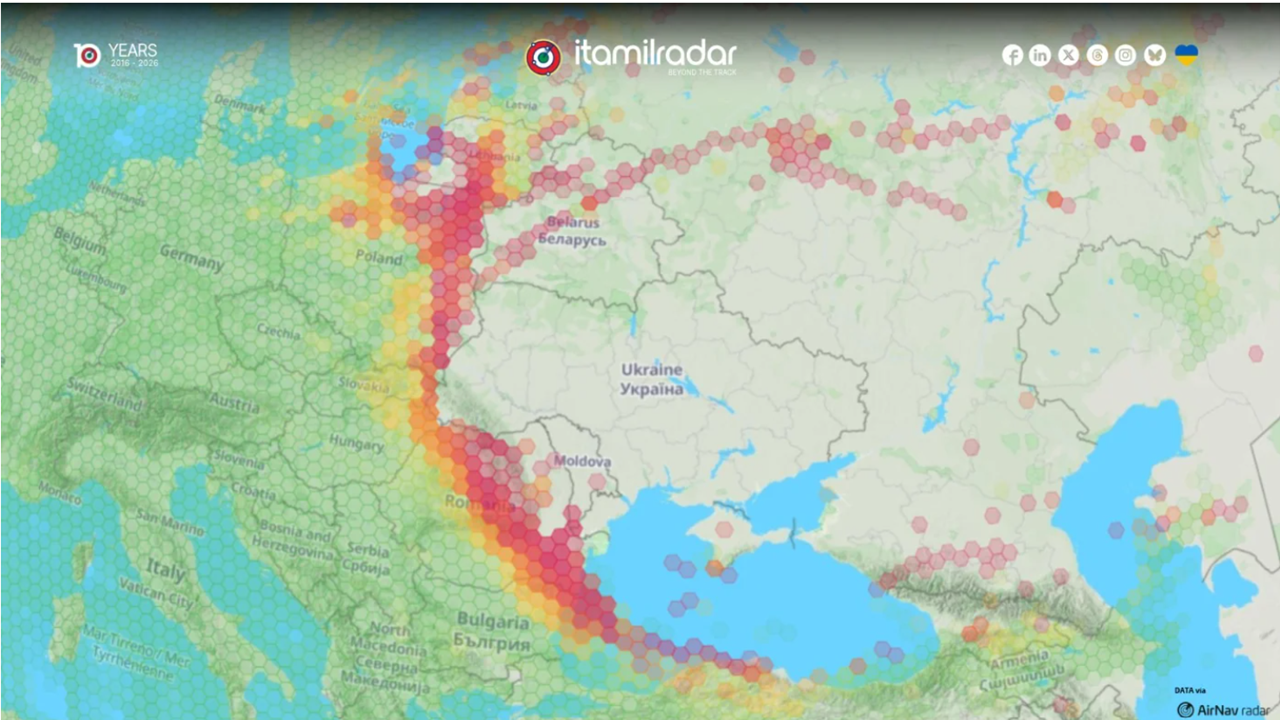
Image: Italmilradar.com powered by AirNav
What’s new: Increased, perhaps more comprehensive, jamming in eastern Europe. The visual looks like a new version of the Berlin Wall. But this one extends across Russia’s entire western frontier with Ukraine, Moldova, and parts of Romania on the wrong side of it.
Why it’s important: There are two ways of looking at this image, both of which are true, we think.
Mr. Putin and his allies:
- Are poking at NATO, especially Russia’s neighbors to the immediate west who have been growing closer to the west, making things less safe and interfering in some ways with daily life. It is a demonstration of power and, gratifyingly for Putin, NATO and its members have been unable to do anything about it.
- Have put up an electronic barrier – a bigger and electronic version of the Berlin wall – designed to separate Russia and the rest of the world.
What else to know:
- It is tempting for many to shrug this interference off since “nothing really bad has happened.” It is just an inconvenience.
- Yet there are broad, though often minor, losses in efficiency across sectors, and safety margins are reduced. Lives have been lost in aircraft crashes, ships have collided and gone aground, all as a consequence of interference with GPS signals.

GPS jamming hits almost all of NATO’s eastern flank in one day
Satellite navigation interference hit almost the entire length of NATO’s eastern border on Nov. 3, according to a map of aircraft data published by the Italian flight-tracking project ItaMilRadar. The heaviest disruption ran in a nearly continuous band from the southern Baltic Sea through Lithuania, eastern Poland, Romania and Bulgaria to the western Black Sea.
“Yesterday’s jamming map is particularly interesting. Virtually the entire eastern flank of NATO is affected by strong, geographically concentrated jamming along the eastern border,” ItaMilRadar said in a post on Nov. 4.
The map, built with data from AirNav Radar, shows where aircraft reported degraded GPS and other satellite navigation signals during the day. The densest areas sat over the Baltic coast near Russia’s Kaliningrad exclave, along Poland’s border with Belarus and Ukraine, over Romania and Moldova, and along Bulgaria’s Black Sea coast. Lighter interference showed up along air routes across Belarus and western Russia, around Crimea and in the Caucasus.