



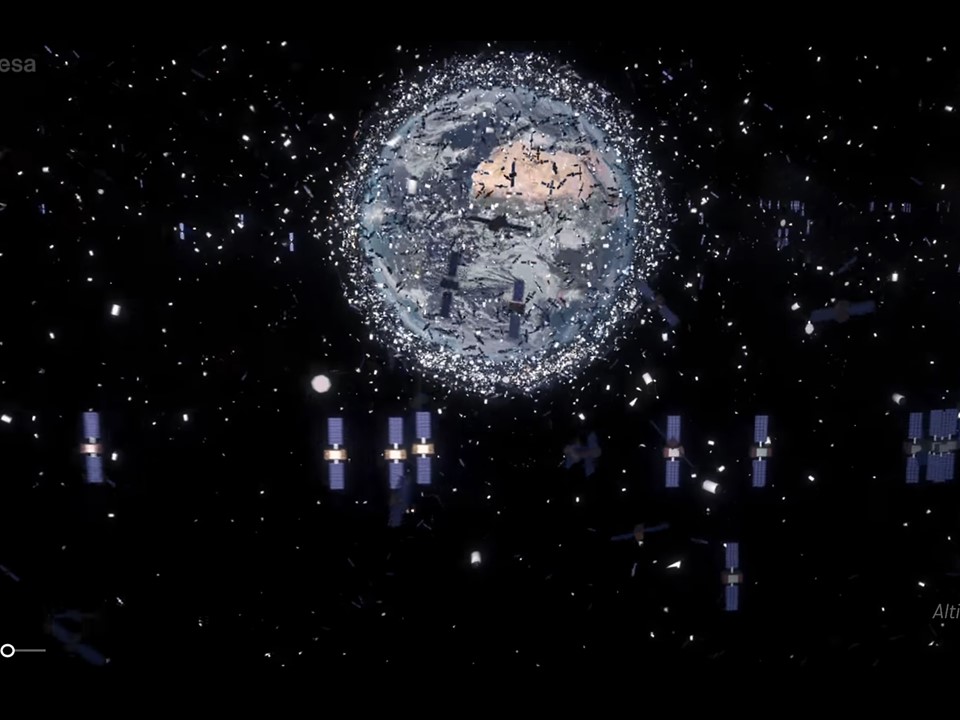
Image: European Space Agency
What’s new: A reminder about the dangers of space debris, congestion, and the threat of the Kessler Syndrome.
Why it’s important:
- We depend upon space-based for many everty-day services. The U.S. has more satellites and is more dependent than any other nation.
- The Kessler Syndrome – in which debris collides with satellites, creating more debris cascading through low earth orbit, could destroy all or most satellites. The orbit could be unusable. It could also make LEO very dangerous to transit to get to MEO, HEO, and beyond.
What else to know:
- While Kessler is less likely in MEO and impacting GNSS, it is not impossible. Also, Kessler in LEO could make it impassible and GPS and other GNSS unsustainable. It could also interfere with signals from GNSS.
- All projections are for tens of thousands more satellites in LEO.
- In the early days of aviation the ‘big sky’ theory was used to explain there was no real need to worry about mid-air collisions. The sky was so big and and airplanes comparatively so small, the chances of two aircraft coming together was highly unlikely. Except… most airplanes fly between a limited number of airports, so most of the big sky is not used. The first recorded mid-air was in 1910. Since then, of course, there have been hundreds.

SpaceX and Rivals Dodge Traffic as Satellites, Debris Crowd Low-Earth Orbit
The proliferation of man-made material circling the planet raises concerns over potential collisions
By
Aug. 29, 2026 8:00 pm ET
It’s getting busy up there.
Nearly 70 years after the Soviet Union launched the first satellite, there is more man-made material in space than ever before.
The increasing quantity of satellites and debris in low-Earth orbit—roughly 100 to 1,200 miles above the planet—is raising concerns of collisions that could damage or destroy spacecraft and satellites. One worst-case fear is that debris could set off a chain reaction of crashes, leaving parts of low-Earth orbit unusable.