



Image: Jeremy Bennington
What’s new: An important opinion piece on LinkedIn by RNTF member Jeremy Bennington at Spirent about intentional GPS disruption and aviation safety.
Why it’s important: People’s lives are at stake. False contacts, bad locations, relying on making visual contact with other aircraft in congested airspace to avoid mid-air collisions… All degrade safety and endanger lives.
What else to know:
- The U.S. military has a legitimate need to conduct jamming exercises. This always conflicts with the country’s very busy commercial air traffic system.
- If the U.S. had a more robust and resilient national core PNT architecture, these kinds of problems would be greatly reduced. Unfortunately we don’t seem to be moving much in that direction.

Jeremy Bennington
VP of Position, Navigation, & Time (PNT) Strategy & Innovation at Spirent Communications | MBA in Finance & Strategy
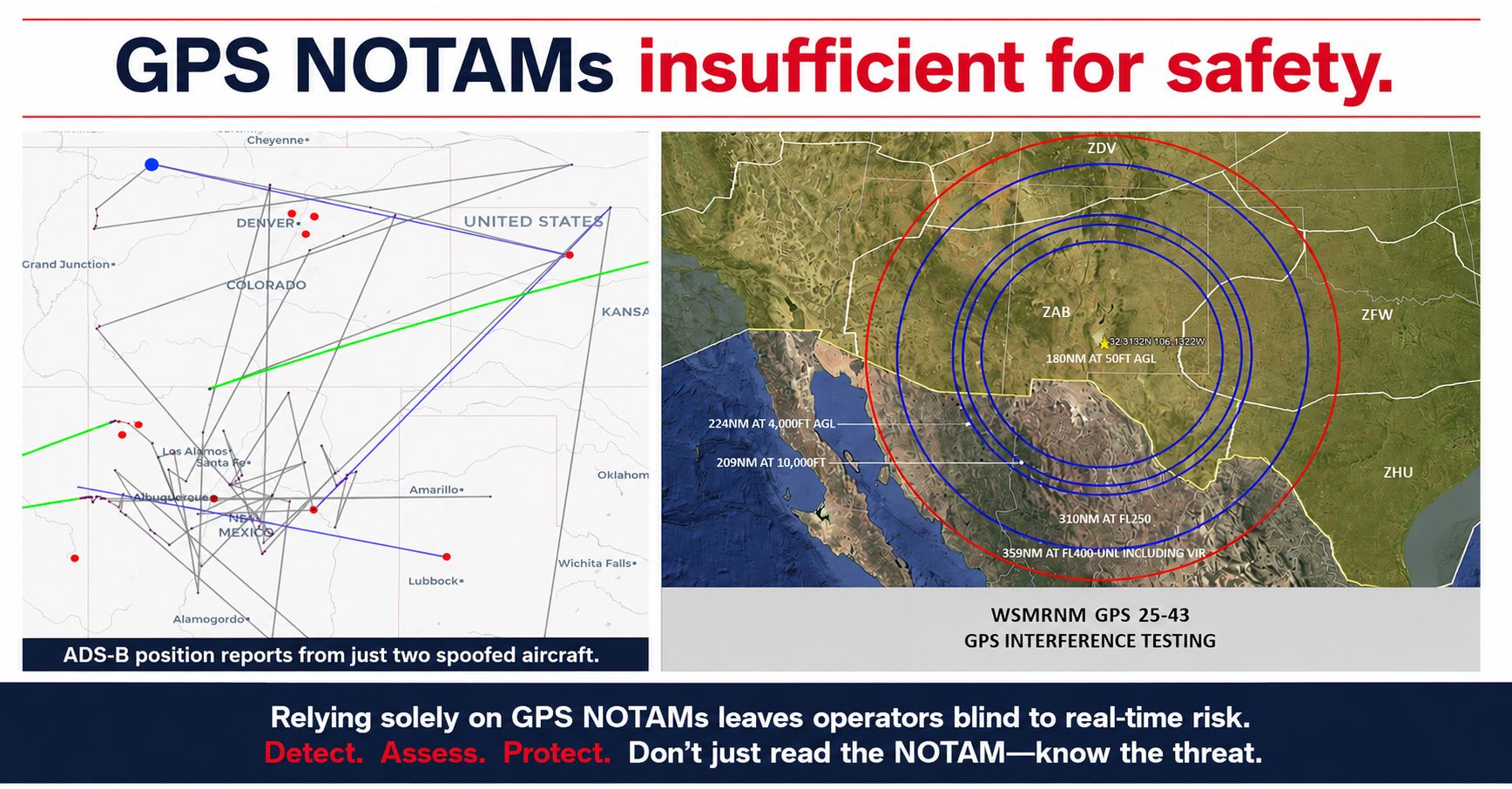
GPS spoofing doesn’t just disrupt navigation — it can create dangerous false ADS-B traffic outside the NOTAM’d area.
In recent observations, spoofed aircraft generated phantom ADS-B position reports hundreds of miles away from their actual locations. And OUTSIDE THE NOTAM area! To pilots, these false targets can appear completely legitimate on cockpit traffic displays and EFB applications.
That creates a serious safety concern:
• Pilots using ADS-B for traffic awareness and collision avoidance may react to aircraft that do not actually exist in that location.
• Meanwhile, the real aircraft position may disappear entirely from ADS-B surveillance.
• Without radar coverage, the only remaining detection method may be visual acquisition.
At lower altitudes — especially in dense General Aviation environments and emerging drone operations — this becomes a very real operational risk.
GPS NOTAMs alone are not enough. While it is important for aircraft to know if they will be spoofed in the NOTAM’d area, the impact of the GPS Spoofing goes far beyond that area. Operators need real-time detection, validation, and situational awareness tools that can identify spoofing before it creates confusion in the airspace.