



What’s new: An ESA/ Eurocontrol plan for dealing with GNSS RFI in aviation over the short, medium, and long term.
Why it’s important:
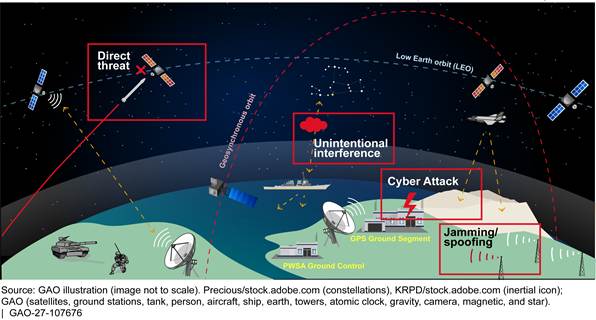
- Interference with GNSS reduces safety margins by increasing pilot workload and disabling some systems like collision and terrain avoidance.
- Interference reduces the efficiency of the aviation system. It can cause flight delays, and longer, more expensive routes.
What else to know:
- European air traffic has been particularly impacted because of the wars in Ukraine and middle east, and Russian interference in the Baltic.
- While the plan is about GNSS, the only constellation authorized for use by commercial passenger aircraft is GPS.
- The plan contains 22 action items, many of which are procedural.
- One action item hints at complementing and backing up GNSS –
Assessment and possible deployment of a resilient GNSS infrastructure for timing and positioning, subject to available funding, including complementary infrastructure in case of GNSS unavailability (e.g. LEO PNT, LDACS, reference time distribution systems, etc).
- In 2018 EUROCONTROL, DLR and others published an IEEE paper about this:

Research on alternative positioning navigation and timing in Europe
Abstract:
The development of multi-constellation, multi-frequency GNSS is ongoing, with the aim to enable a robust and reliable navigation and approach service to airspace users. While this will greatly reduce vulnerability to space weather, unintentional interference and constellation weakness, some residual vulnerabilities will remain. In the current, predominantly GPS L1 GNSS environment, aviation has accepted that alternate positioning, navigation and timing capabilities based on terrestrial systems remain necessary. These reversionary area navigation capabilities are based primarily on DME/DME, while still providing some residual VOR/DME services. However, this reversionary capability has not been demonstrated to support the stringent RNP requirements that GNSS can support. Also, DME is criticized as being spectrum inefficient, and aviation-internal and aviation-external pressures to share the DME band with other services are increasing significantly. A key question for the future evolution of Communication, Navigation and Surveillance systems is what type of a reversionary capability will be needed in the future (terrestrial or space based), and what performance levels it needs to provide. To answer this question, supported by specific technology options, a project under the SESAR Horizon 2020 Framework (PJ14-03-04) is working on this topic under the title “Alternative Positioning, Navigation and Timing, A-PNT”. A-PNT is a complex, multi-disciplinary topic, with technical and operational aspects going across the CNS domains, and spectrum concerns being an underlying driver. The research activities in PJ14-03-04 are covering a selected set of potential technical solutions: take full advantage of the actual DME performance, DME enhancements (ensuring compatibility with legacy systems), LDACS NAV function and eLORAN. This paper will focus the discussion on the performance levels achievable by each of these technologies and their major advantages and drawbacks. The concept of a modular approach will be introduced as well (which allows the computation of a position solution with integrity based on inputs from various types of sensors). The paper includes contributions from the following SESAR partners: EUROCONTROL, DLR, Thales Avionics, Thales Air Systems and Honeywell Aerospace.
European Aviation Action Plan for Ensuring Safe Operations during GNSS Interferences
GNSS RFI Action Plan
Thanks to RNT Foundation member Mitch Narins for bringing this plan to our attention!