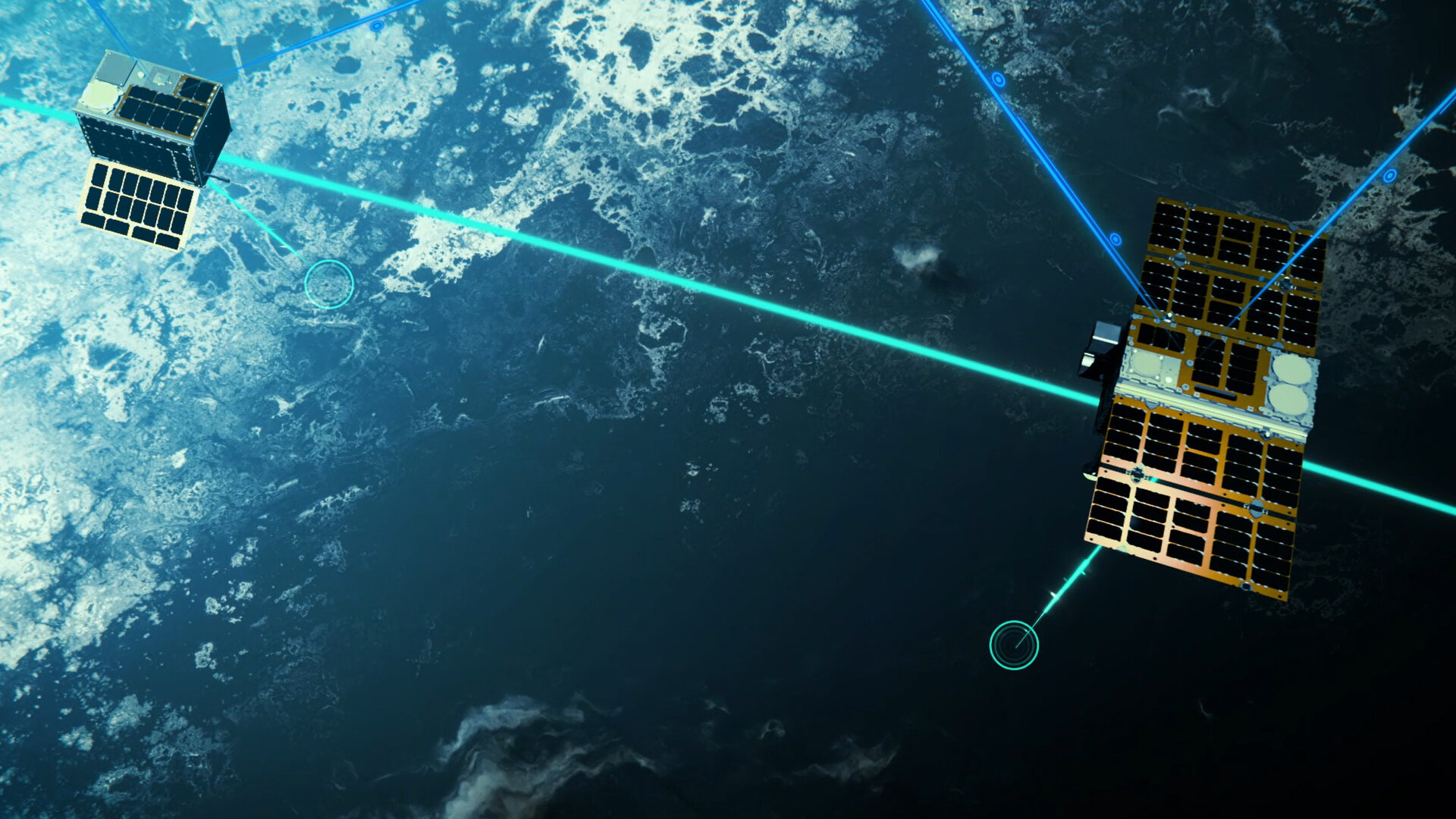




What’s new:Space Development Agency seems to be backing off its plans for LEO PNT.
Why it’s important:
This could signal SDA and DOD de-emphasizing PNT overall. Note that Space Force’s R-GPS is not yet a program.
On the other hand, the “D” in SDA stands for “development.” This announcement could be a recognition by SDA that LEO PNT is already being done by others, including commercial interests. For example, RNT Foundation members Trustpoint and Xona are well on their ways to establishing constellations. So, perhaps there is no need for SDA to develop something also.
What else to know:LEO PNT is an increasingly popular pursuit. We have lost count of the number of government and commercial initiatives around the world. Just yesterday, for example, we saw an announcement by a company in India that they will establish a service.

Space Development Agency pauses plans to provide PNT capabilities
SDA was looking to build out PNT capabilities in the Tranche 3 transport layer of the Proliferated Warfighter Space Architecture, which the Department of the Air Force is considering canceling.

NATIONAL HARBOR, Md. — The Space Development Agency is reconsidering whether or not it will further develop position, navigation and timing (PNT) capabilities as part of its mega-constellation of satellites in low-Earth orbit.
SDA was looking to build out additional PNT capacity in the Tranche 3 transport layer of the Proliferated Warfighter Space Architecture (PWSA) — which will comprise hundreds of satellites providing data relay and missile warning and tracking capabilities to warfighters. But because the agency did not include funding for the Tranche 3 transport layer in its budget request for fiscal 2026, its plans to flesh out PNT in future PWSA tranches are effectively on hold.
PNT is the quiet backbone of everything but too many leaders still don’t see the risk.
But you do. You understand the systems, the dependencies, the failure chains. That insight is rare — and it’s exactly what your country needs right now. Contact your government leaders and industry decision-makers and tell them resilient PNT isn’t a feature — it’s the foundation everything else depends on.
Image: Shutterstock What's new: The annual "Global Counterspace Capabilities Report" from our friends at the Secure World Foundation (SWF) Why it's important: More and more things depend upon space. This means that adversaries have more and more reasons to interfere...
Image: Shutterstock What's new: A report of Russia spoofing Ukrainian drones and sending them against NATO targets. Why it's important: Russia is attacking NATO kinetically. This is not just electronic warfare anymore. Secondarily: If true, it shows Ukraine is still...
Image: Shutterstock What's new: Canada has announced it is cancelling its short wave time signals as of the 22nd of June 2026. Why it's important: The other sources of official time from the Canadian government (National Research Council, or NRC) are less accurate...
Image: AB3.Army on Youtube - The town of Lyman in Ukraine draped with fiber optic cable from both Ukrainian and Russian FPV drones. What's new: An interesting article about drone warfare, and how the U.S. is asking something from Ukraine, a bit of a reversal in the...
Image: Shutterstock What's new: A report that multiple companies are offering governments the ability to geolocate Starlink terminals. Why it's important: Security concerns - an adversary could target, kidnap, kill, etc. users. Privacy concerns - user location data...