




Image: Shutterstock
The author of the below is President of the RNT Foundation.

Two federal efforts have been put on hold and experts with years of expertise in the PNT industry have retired, all changes that could affect the industry moving forward.
The current administration’s efforts to revamp the government could have a significant impact on the PNT community.
Forums in which administrations previously sought input and advice have been put on hold, yet a vigorous discussion has sprung up with the Federal Communications Commission (FCC). At the same time, long-serving government PNT experts have retired, each taking decades of experience with them.

Government Outreach
Two important federal efforts to get public input on PNT issues have recently been put on hold.
The President’s National Space-Based PNT Advisory Board has met twice each year since its inception in 2004, but the board’s charter expired on April 25. Future meetings are on hold while the new administration reviews the more than 1,000 groups that have been operating under the provisions of the Federal Advisory Committee Act.
The charter for the Department of Transportation’s Civil GPS Service Interface Committee (CGSIC) appears to still be in place. This forum is the federal government’s method of getting feedback and input from civil users across the globe. In the past, the committee met immediately prior to, and at the same venue as, the Institute of Navigation (ION)’s GNSS+ annual conference. The synergy benefited both events and attendees.
We understand new federal policy requires these kinds of government meetings to be held in Washington, D.C. or its immediate vicinity. Consequently, this year’s CGSIC event will not be held with ION GNSS+ in Baltimore. No date or location for the group’s next meeting has been announced.
The FCC Takes an Interest
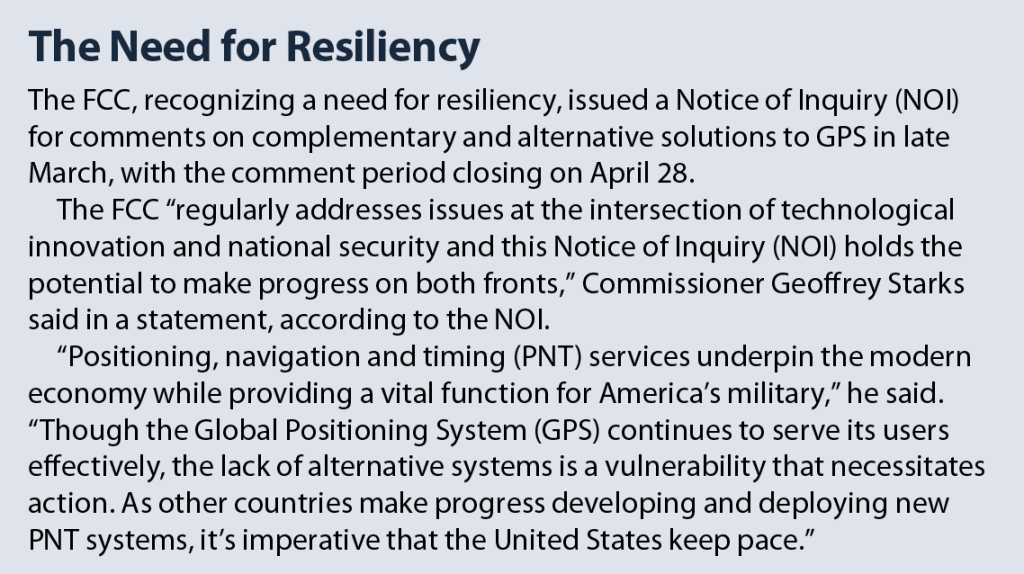
At about the same time as these two government outreach efforts were paused, the FCC, an agency technically independent of the administration, became very interested in national PNT issues. This interest was likely at least partially fueled by two petitions, one from NextNav and the other from the National Association of Broadcasters (NAB), seeking to establish terrestrial PNT systems. The one from NextNav asks for approximately $5 billion worth of spectrum to fund the system, while NAB is just asking for adoption of a new television signal format to be accelerated.
At the FCC’s March open meeting, each of the commissioners, led by Chair Brendan Carr, expressed their concern about America’s over-dependence on GPS and the need for complementary and alternative systems. This led to a 27-page Notice of Inquiry (NOI) soliciting public input on a wide range of technical and policy issues. As of this writing, more than 80 individuals and organizations submitted responses.
While many members of the PNT community are heartened by the FCC’s interest, some have observed that the agency’s authorities and responsibilities are not well positioned to address national PNT resilience on its own. They have urged for a whole-of-government approach in concert with the administration and Congress.This and other recommendations were included in a response to the NOI submitted by the Resilient Navigation and Timing Foundation.
Loss of Government Expertise and Experience
In addition to changes in government outreach, the last few months have seen the retirement of several long-serving full-time experts. They represent a wealth of government PNT expertise and experience that will be difficult to replace. They include:
Mike Dunn, Technical Director GPS Wing, Space and Missile Systems Center. Dunn has been involved in space systems for more than 50 years and supported the GPS program at Los Angeles Air Force Base for the last 27.
Larry Hothem, Senior Physical Scientist, U. S. Geological Survey. Hothem was the Department of Interior’s lead for GPS and GNSS issues. A past president of ION, he pioneered the use of GNSS in remote sensing.
Rick Hamilton was a U.S. Coast Guard hands-on navigator for 25 years before serving another 17 years as the Executive Secretariat for DOT’s Civil GPS Service Interface Committee.
Dr. A.J. Oria supported government PNT programs from 1998 until this year as an aerospace engineer with Overlook Systems Technologies Inc. Oria’s advice and support to NASA over the last 22 years were essential to the success of the National Space-Based PNT Advisory Board.
James J. Miller was the Designated Federal Officer for both the PNT Advisory Board and the National Space Council’s User Advisory Group. Miller left a technology job with United Airlines for a senior PNT position with the Department of Transportation in 2003. In 2005, he became the PNT policy lead for NASA.
Jason Kim has served the government in a variety of PNT roles since 1994. He supported NASA, the White House Office of Science and Technology Policy, and the Department of State, and joined the Department of Commerce in 1998. Before retiring, he served as the Chief of Staff for the Office of Space Commerce.
Karen Van Dyke became the Department of Transportation’s (DOT) Volpe National Transportation Systems Center’s Principal Technical Advisor for GPS in 1988. After serving 20 years at Volpe, she became DOT’s Director of PNT and Spectrum Management in 2008. DOT leads national policy for civil GPS and PNT. Van Dyke was the senior-most official with in-depth GNSS technical and policy expertise for most of her career.
Moving Forward
The changes in how the federal government interacts with the public are concerning but may not turn out to be exceptionally detrimental to the nation’s overall PNT efforts. On the other hand, people matter. They matter a lot. While we are sure dedicated government personnel will make every effort, the loss of these highly experienced PNT experts in critical roles will be difficult to overcome.
We send our best wishes to those who recently retired, along with our thanks for their decades of service and good work. We also send best wishes to those who will take their places—along with our offer of whatever help and support we are able to provide.