



DHS Best Resilient PNT Practices

March 4, 2025

Written by Editor

Image: Old DHS HQ Sign – RNT Foundation

What’s new: We discovered this document from September.

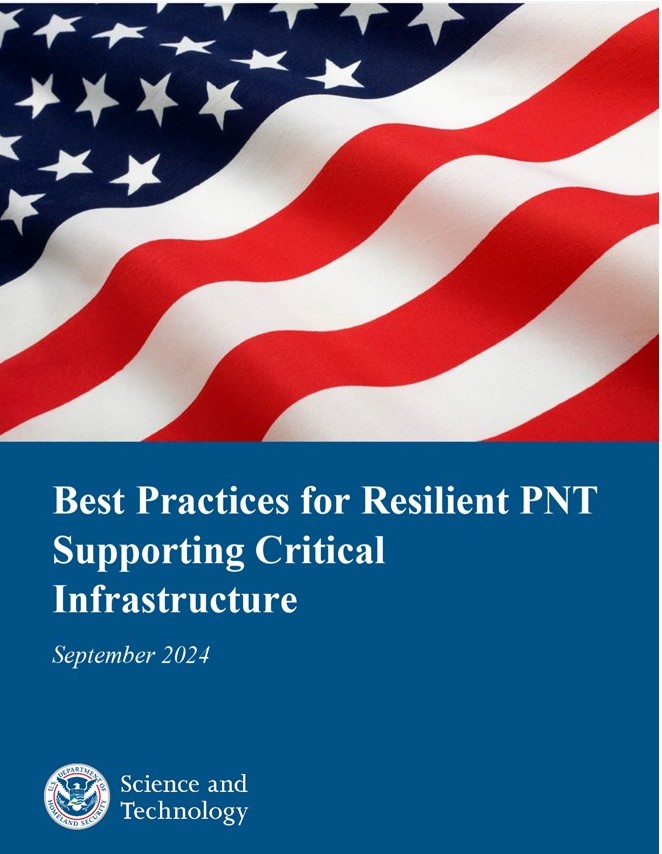
Why it’s important: This is good info from DHS. Though a bit generic, it is important to “think about how to think about” this topic.

What else to know: Interesting that the document does not talk much about alternatives , perhaps because there are not a lot that are widely and easily accessible. It does say:

1.2 Transitioning from Reliance Solely on GPS

The unmatched capability of GPS has led to its widespread dependence as a PNT source in the U.S. critical infrastructure and its resulting national security. The ongoing legacy of directly consuming the GPS solution from unsophisticated user equipment (UE) creates fragile reliance, however, which motivates the need for better practices and broader sources. One such recommended practice, known as “The Flip” (5), found in competent UE, uses the GPS solution only to discipline internally integrated components at chosen intervals. A disciplined architecture logically divides PNT sources into external aiding and local reference categories, the latter of which accumulates error continuously absent the former. Notably the local frequency references, such as Cesium-beam standards, are highly immune to jamming or spoofing and can provide uninterrupted service that bridges aiding gaps during these adversities. If these local refences have been previously disciplined, the resulting holdover mode of operation can achieve a defined level of performance depending on the initial state of the reference, the duration of the event, and the quality of the local reference. Though GPS remains widely used across the nation, alternative PNT sources are available. The U.S. Department of Transportation continuously evaluates complementary PNT sources and GPS backup technologies (6) and other technologies continue to emerge. This best practices document applies to all current and emerging technologies that provide PNT solutions. 
READ MORE

What Can YOU Do? How Can YOU Help?

PNT is the quiet backbone of everything but too many leaders still don’t see the risk.

But you do. You understand the systems, the dependencies, the failure chains. That insight is rare — and it’s exactly what your country needs right now. Contact your government leaders and industry decision-makers and tell them resilient PNT isn’t a feature — it’s the foundation everything else depends on.

Start the Conversation

Use our Resilient PNT Key Talking Points to make the case.

U.S. Advocates

Find your representatives at Congress.gov, then use our email template to reach them in minutes.

When you get a response, let us know. Every conversation strengthens the mission.

More PNT News

New Company for Broadcast Positioning System – NAB

New Company for Broadcast Positioning System – NAB

Image: Shutterstock What's new: The National Association of Broadcasters (NAB) has formed a separate company to develop, advocate for, and deploy the Broadcast Positioning System (BPS). Why it's important: NAB has put increasing effort behind BPS since its inception...

Standalone Magnetometry Is the New GPS – IEEE Spectrum

Standalone Magnetometry Is the New GPS – IEEE Spectrum

Image: Shutterstock What's new: An article about forms of navigation using aspects of the earth's magnetic field.  Why it's important: Autonomous navigation is becoming more interesting for a number of applications in a world where interference with GNSS is becoming...

Munich 9 Years On: Same Message, More Urgency – Inside GNSS

Munich 9 Years On: Same Message, More Urgency – Inside GNSS

Image: Shutterstock What's new: RNTF President Dana Goward's column for the May/June edition of Inside GNSS+. Why it's important: It discusses a PNT example of how concern within the tech community does not necessarily turn into action by political leaders. Or at...

US Congress hearing on PNT –  June 4th

US Congress hearing on PNT – June 4th

Image credit: House Energy and Commerce Committee What's new: A congressional hearing titled Where Are We?: Examining Positioning, Navigation, and Timing Capabilities in the United States. Why it's important:  The hearing is being held by the Communications and...

Get PNT News in Your Inbox