



Image: ESA
What’s New: A fairly extensive report on what the future of PNT in Europe should look like.
Why It’s Important: It recognizes that PNT can’t be all about GNSS or even space, but must be a system of systems.
What Else to Know:
- The vision was developed by an committee of external advisors to the European Space Agency’s (ESA) Navigation Director.
- ESA has been very active exploring and fostering non-space systems, interference detection networks, etc.
- There is a lot of meat in this report. Look for more on this in the August edition of GPS World.
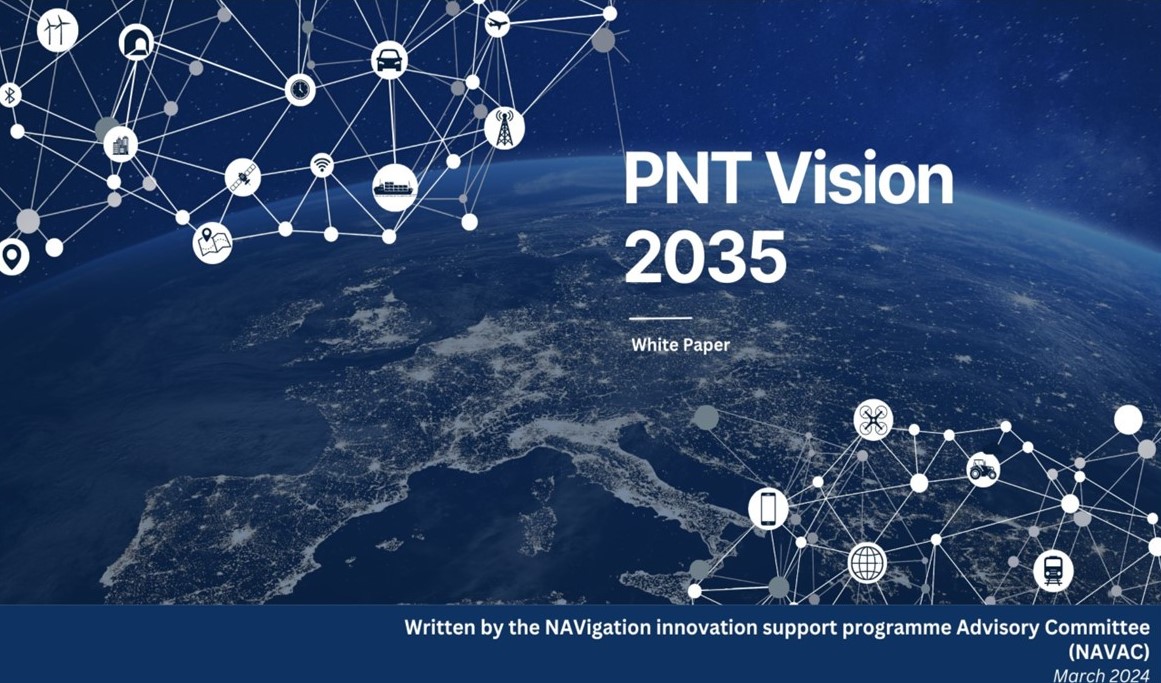
The Navigation Innovation and Support Programme Advisory Committee (NAVAC) has released a comprehensive whitepaper outlining its vision for the evolution of Positioning, Navigation, and Timing (PNT) technology, applications, and services until 2035. Established by the European Space Agency (ESA) in October 2018, NAVAC comprises senior external experts who provide independent advice on strategic priorities for ESA’s Directorate of Navigation.
The whitepaper emphasizes the critical role of PNT services in modern society, noting that with 6.5 billion GNSS devices in use worldwide, these services underpin crucial aspects of business, infrastructure, government, and daily life. An estimated 10% of the EU GDP depends on PNT services, highlighting the economic and social importance of reliable and accurate positioning and timing.
Key findings from the whitepaper include:
- Increasing Dependence on PNT Services: The reliance on PNT services is set to grow as new applications emerge, particularly in consumer solutions and autonomous systems. Accurate timing remains a critical use case, especially for infrastructure such as communication and power distribution networks.
- Geopolitical and Technological Challenges: Rising geopolitical tensions present challenges for PNT services. Cyber-attacks, jamming, and spoofing are on the rise. Technological advancements in AI, ML, and quantum computing are poised to significantly impact PNT systems and their societal applications. New regulations to address these challenges are anticipated.
- Technological Trends Driving PNT Demand: The proliferation of connected devices (IoT), autonomous driving, advanced air mobility, smart grids, and autonomous vehicles will drive the demand for resilient and robust PNT. Low Earth Orbit (LEO) constellations offer new methods of providing PNT services, potentially complementing traditional Medium Earth Orbit (MEO) systems.
- System Architecture Evolution: Future PNT systems will utilize a combination of data sources, including multiple GNSS constellations, cellular networks (5G/6G), terrestrial systems, augmentation systems, and autonomous sensors. This “system of systems” approach will enhance performance and ensure independence from single points of failure.
- Emerging Technologies and Sensor Integration: Advances in space segment technologies, receiver designs, and sensor integration are poised to enhance PNT services. New signal designs, flexible payloads, advanced clocks, inter-satellite links, and higher power amplifiers are among the innovations highlighted. The integration of multiple sensors, such as inertial, magnetic, and imaging systems, will further improve accuracy and resilience.
NAVAC’s whitepaper underscores the need for continued investment in future PNT systems. The economic dependence on GNSS, coupled with growing security and defense concerns, necessitates the development of alternative and complementary resilient systems. ESA is advised to prepare for potential loss of access to existing systems and to remain engaged in technological advancements, ensuring that Europe maintains its leadership in GNSS.
The whitepaper also calls for proactive measures to address evolving threats, including jamming, cyber-attacks, and environmental risks. Continuous risk assessment and the implementation of mitigation programs are essential to safeguard the PNT environment.
Furthermore, the whitepaper identifies new market opportunities driven by emerging applications and services, such as IoT, autonomous vehicles, air mobility, and space exploration. Accurate timing will continue to be a critical requirement, driving the demand for resilient PNT services.
In conclusion, NAVAC’s whitepaper provides a strategic roadmap for the future of PNT technology, emphasizing the importance of resilience, continuous innovation, and strategic investment. These efforts are crucial for enhancing Europe’s market position in the global PNT industry and ensuring the reliable provision of essential services.
The whole report can be accessed here.