



Image: Shutterstock
What’s new: The annual “Global Counterspace Capabilities Report” from our friends at the Secure World Foundation (SWF)
Why it’s important:
- More and more things depend upon space. This means that adversaries have more and more reasons to interfere with space.
- The U.S. is the most dependent on space and has the most satellites by far.
- More and more countries are developing counterspace capabilities.
What else to know:
- The Center for Strategic and International Studies (CSIS) also reports on space threats. Their 2026 Space Threat Assessment will be published soon.
- An incredibly interesting CSIS / SWF webinar on this was held last week. A recording is available here.
- Interesting note that ESA’s mandate has changed to include ‘security.” We had missed that.
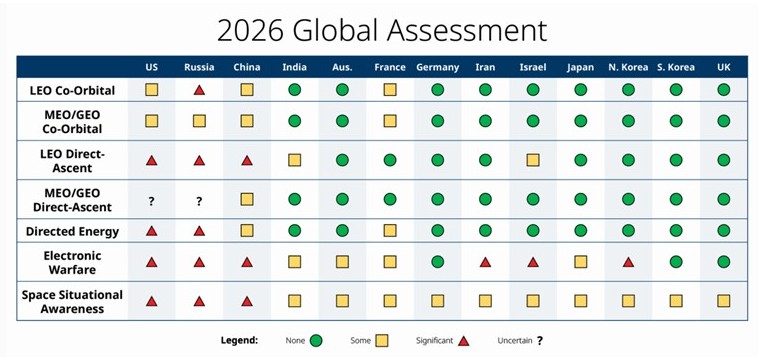

2026 Global Counterspace Capabilities Report
Background
Space security has become an increasingly salient policy issue. Over the last several years, there has been growing concern from multiple governments over the reliance on vulnerable space capabilities for national security, and the corresponding proliferation of offensive counterspace capabilities that could be used to disrupt, deny, degrade, or destroy space systems. This in turn has led to increased rhetoric from some countries about the need to prepare for future conflicts on Earth to extend into space, and calls from some corners to increase the development of offensive counterspace capabilities and put in place more aggressive policies and postures.
We feel strongly that a more open and public debate on these issues is urgently needed. Space is not the sole domain of militaries and intelligence services. Our global society and economy is increasingly dependent on space capabilities, and a future conflict in space could have massive, long-term negative repercussions that are felt here on Earth. Even testing of these capabilities could have long-lasting negative repercussions for the space environment, and all who operate there. The public should be as aware of the developing threats and risks of different policy options as would be the case for other national security issues in the air, land, and sea domains.
The 2026 Report
Edited by SWF Chief Director, Space Security and Stability, Victoria Samson, and SWF Program Analyst, Space Security and Stability, Kathleen Brett, the 2026 edition of the report compiles and assesses publicly available information on counterspace capabilities being developed by 13 countries across five categories: co-orbital, direct-ascent, electronic warfare, directed energy, and cyber. It assesses the current and near-term future capabilities for each country, along with their potential military utility, and discusses their space situational awareness capabilities as well. The countries covered in this report are: the United States, Russia, China, India, Australia, France, Germany (added this year), Iran, Israel, Japan, North Korea, South Korea, and the United Kingdom.
Major Updates in 2026:
- The 2026 edition documents the continued development of counterspace capabilities by 13 countries. While we see a proliferation of R&D into counterspace capabilities, only non-destructive counterspace capabilities are being used in active military conflicts.
- We are seeing an increase in the number of countries interested in developing “bodyguard” satellites and spaceplanes, both of which have co-orbital capabilities.
- China’s likely on-orbit refueling experiment which took place for most of the second half of 2025 is examined, as are reports that it may have a new DA-ASAT interceptor.
- The end of Russia’s Luch satellite’s travel around the GEO belt is documented, as well as its significant other RPO activities.
- The United States released a lot of policies and doctrinal strategy documents in 2025, with a heavy emphasis on dynamic space operations. What is known about Golden Dome’s continued evolution is included.
- The UK and France both conducted cooperative RPOs with the United States.
- Jamming in Iran has increased extensively; its spoofing of Starlink is discussed (NB: this report has an information cut-off of Feb. 28, 2026).
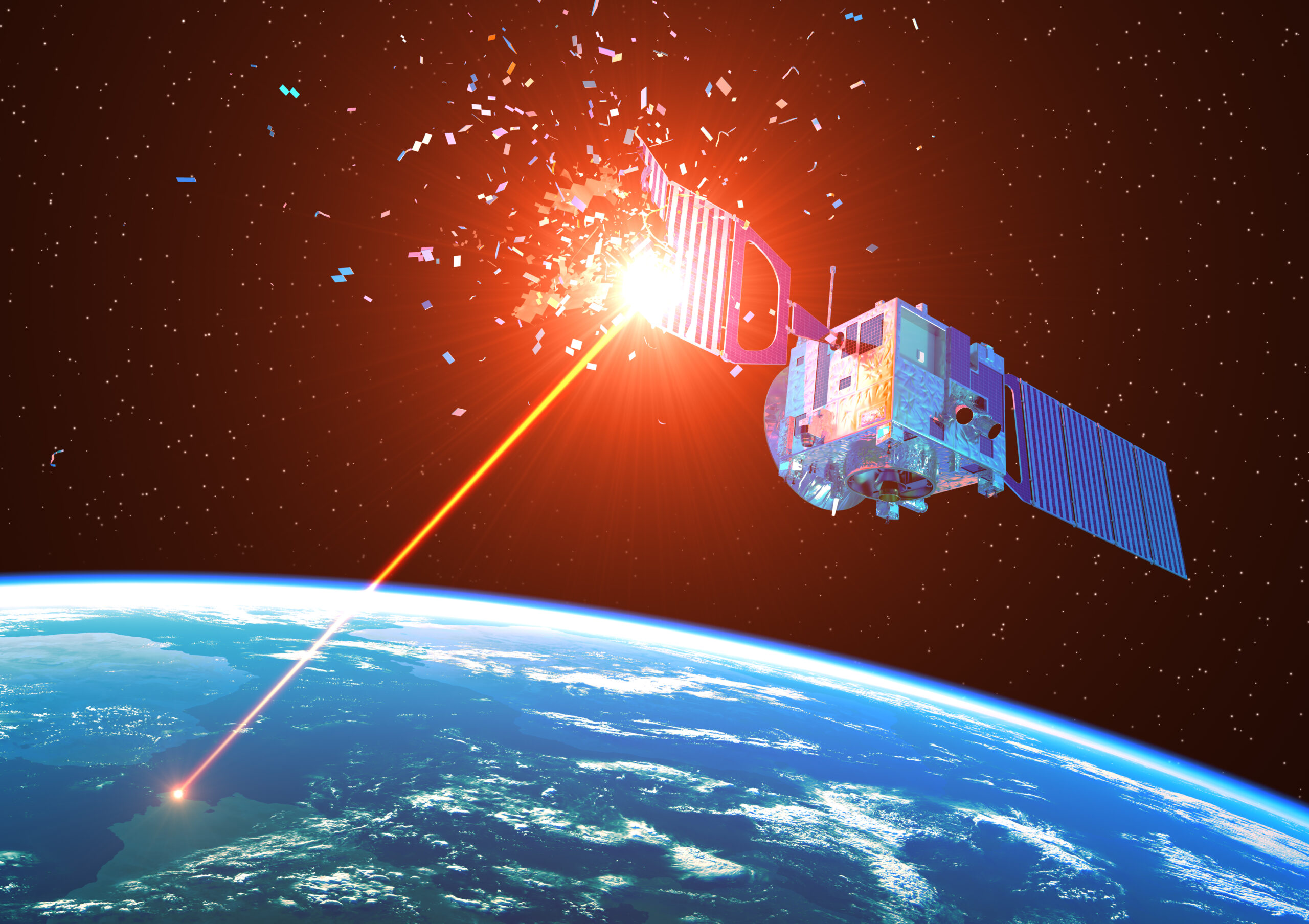
- France and Germany have both expressed interest in lasers for non-destructive ASAT capabilities.
- Japan published space domain defense guidelines, while North Korea changed its policies to allow for military use of space.
- The cyber counterspace chapter documented major breaches of ESA’s computer systems, GEO communications satellites not encrypting their data, the possibility of cyberattacks of satellites through open-source software, and the extent that cyber has become part of the Russian-Ukrainian conflict.
- The 2026 report updated the amount of space debris created by the United States, Russia, China, & India from their counterspace testing: there were 6904 cataloged pieces of debris from tests, of which 2773 are still on orbit.