



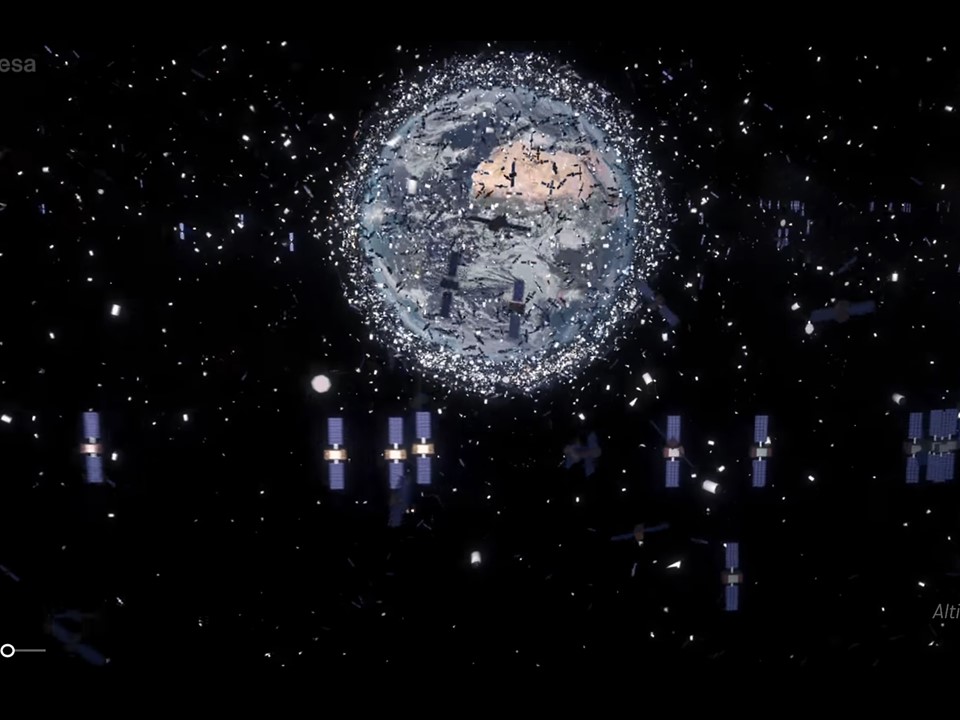
Image: European Space Agency
What’s new: An interesting article about how climate change is reducing number of satellites that can safely co-exist in Low Earth Orbit (LEO).
Why it’s important:
- Humanity is becoming increasingly dependent on satellite services from LEO.
- The United States has more satellites and is more dependent than any other nation.
- If the Kessler Syndrome becomes a reality, LEO will become unusable and it could be impossible to transit LEO to higher orbits. Humanity would be denied the use of space.
What else to know: Some have suggested the syndrome has already begun, but it is not yet noticeable.

Sorry, SpaceX: It’s Getting Too Crowded Up There
Elon Musk wants to launch a million satellites, but researchers say global warming is changing the upper atmosphere in ways that makes space junk linger.
Elon Musk’s space technology company, SpaceX, recently asked the U.S. government for permission to launch one million satellites. The idea is to put solar-powered data centers into orbit, an ambition shared by other tech giants.
But Earth orbit is already packed with spacecraft and space junk. And greenhouse gas emissions are affecting the upper atmosphere in ways that could significantly increase the clutter in space.
By the end of the century, half as many satellites might safely fit in Earth orbit, researchers have found.