




Images: Public Domain & Wikimedia Commons
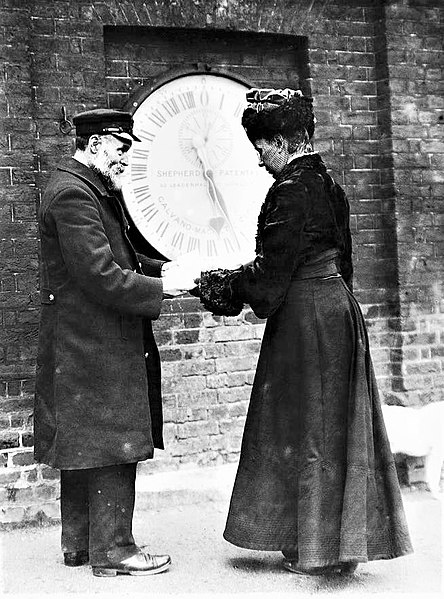
What’s new: A good friend pointed out a LinkedIn post about Elizabeth “Ruth” Naomi Belville and her time distribution business. We really enjoyed it. So we thought we would post about her also as a lighter weekend item.
Why it’s important: It shows that sharing authoritative time as a commercial enterprise has roots going back over 100 years. There are companies that do it today, clearly with more efficient methods using fiber, or RF, or space.
What else to know:
- Ruth’s method was to take her pocket chronometer to the Greenwich Observatory once every week or two and manually synchronize it with the master chronometer. She would then make the rounds of about 40 customers so they could synchronize their clocks and chronometers with hers.
- Until the 1980’s a similar method was used for some U.S. government time distribution. For example, several times a year the US Coast Guard would transport two, and sometimes three, atomic clocks to the U.S. Naval Observatory, synchronize them with the master time signal. – Three was considered best because, as a friend once explained, ‘If you have one clock, you know what time it is. If you have two, you have no idea what time it is. If you have three, you have a good approximation.’ The clocks would then be transported to Loran sites around the world to ensure the system was synchronized to UTC (USNO). Most of the Loran sites were operated for the US DOD by the US Coast Guard and/or host nation representatives.
- Today users can synchronize to UTC (USNO or NIST for the U.S.) by fiber, Two-Way Satellite Time Transfer (TWSTT), common-view GPS/GNSS, other space-based services, or WWVB, depending upon the level of precision needed. It is also possible for most terrestrial networks to obtain UTC once at one node, self-synchronize, and then maintain sufficient sync with UTC for long periods using sophisticated clocks.
- Over the last several hundred years we have seen how it is important for citizens of nation to use the same time standard, and for it to be endorsed by the government.

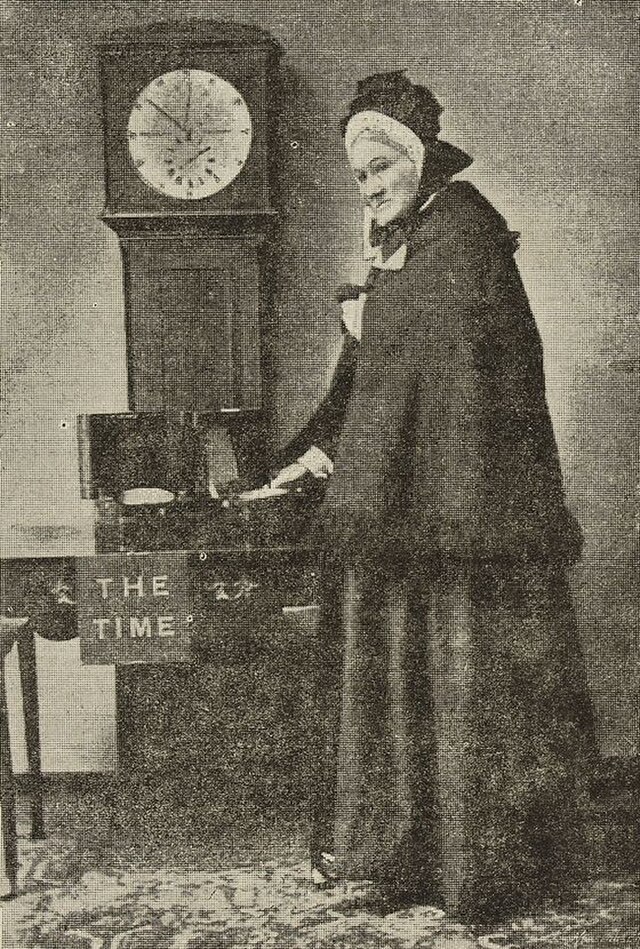
Ruth Belville – She Sold Time!
When the sun is at its highest in the sky we call it midday or noon but the earth spins on a slightly inclined axis so the point closest to the sun is constantly changing. This change means that a person in London will have their midday at a different time to a person in New York and that will be different to a person in Beijing Until the early 1800s most people stayed in their local neighbourhood so their clocks were set to the local midday and the relative difference in time had little significance. This changed with the invention of railways. If the train driver was using London time, but the passenger Penzance time the passenger could miss their train. Additionally as there were numerous trains on the system, possibly run by different companies, several railways accidents occurred due to the confusion over which time was being used. So the railway companies introduced the concept of standard or Railway Time. Here all the timetables and station clocks used the local mean time for London set by the Royal Observatory in Greenwich. This eventually lead to Greenwich Mean Time becoming the standard throughout the country.
In 1833 James Pond, the Astronomer Royal, introduced the Greenwich Time Ball. At 12.55pm, the time ball rises half way up its mast. At 12.58pm it rises all the way to the top. At 1pm exactly, the ball falls, and so provides a signal to the ships in the river, and anyone looking could set their watches to the right time.
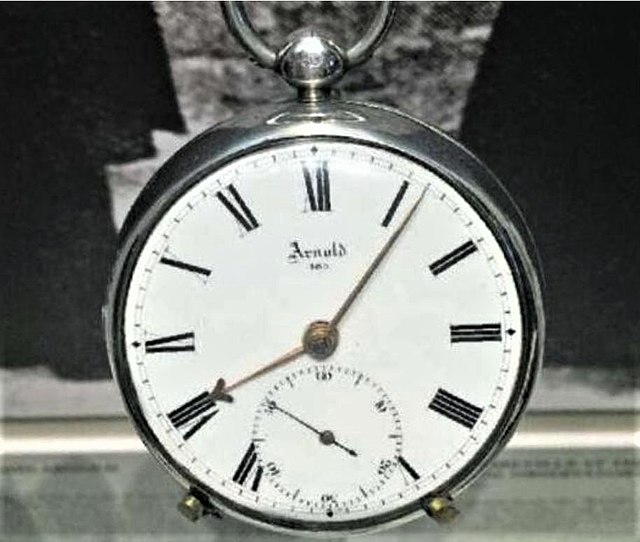
“Mr. Arnold” Ruth’s Chronometer