




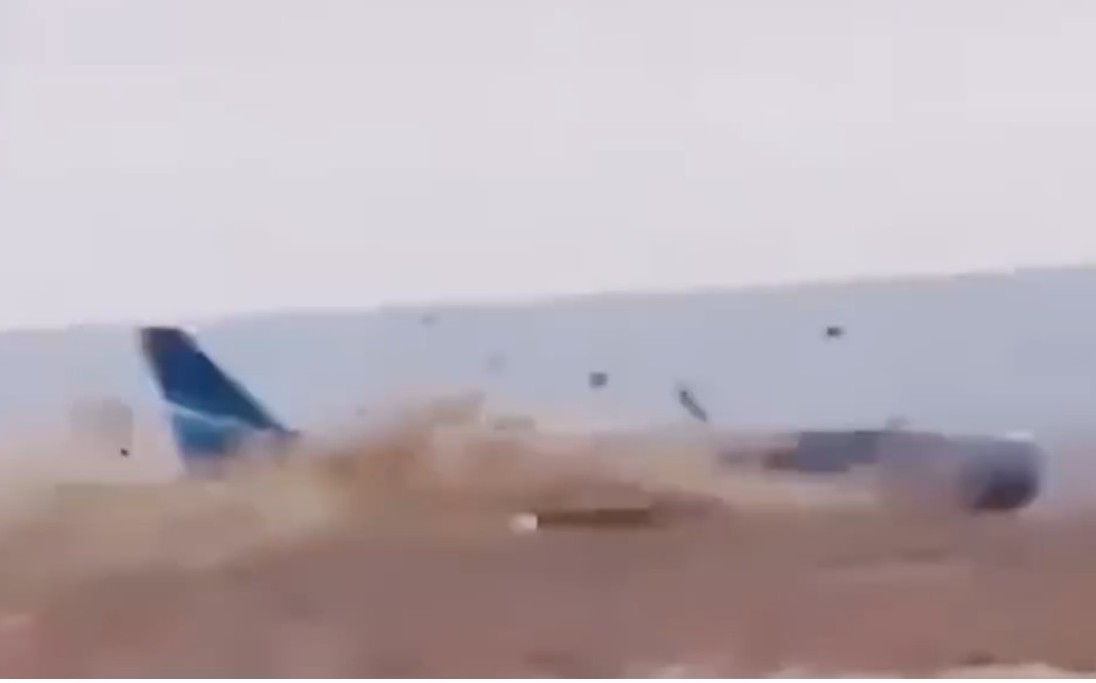
Image: Youtube – Fatal Azerbaijan Air crash after being shot at by Russian forces due to GPS jamming and no ADS-B identification
What’s new: The Secretary General of the International Civil Aviation Organization addressed the World Overflight Risk Conference in Vallarta, Malta, on 21 April 2026 and cited GNSS disruptions as a significant threat. He called for stronger measures to protect civil aircraft from military threats.
Why it’s important: GNSS disruptions increase workload in cockpits, cause pilots to distrust their instruments (exactly the opposite of their training), and can result in fatal mishaps.
What else to know:
- There are many reasons for nation states and others to interfere with GNSS, and few real penalties when they do. Until aircraft are outfitted with real protections like CRPA antennas and wide-area alternative navigation systems, interference will continue.
- 38 people died when Russia shot at an unidentified Azerbaijan Air flight on Christmas Day, 2024.
- The below posting discusses GNSS jamming, but GPS is the only system currently authorized for commercial aircraft.
- The Secretary General also cited threats from missiles and drones.
Drones, missiles, and jamming: UN aviation chief calls for urgent action to protect civil aircraft operating near or over conflict zones
The International Civil Aviation Organization (ICAO) is calling for stronger measures to protect civilian aircraft from military threats, revealing that the risk of weapons targeting civilian planes grows worldwide.
ICAO Secretary General Juan Carlos Salazar informed delegates at the 2026 World Overflight Risk Conference in Vallarta, Malta, that emerging military technologies—including long-range weapons systems, unmanned aircraft systems (UAS), global navigation satellite system radio frequency interference, and advanced air defence systems—pose risks to civilian aviation.
“We must now reach beyond the boundaries of aviation as we have known it,” Salazar said, emphasizing that new sophisticated weaponry capabilities are creating an environment where civilian aircraft face a heightened risk of being targeted or caught in crossfire.
While praising the aviation industry’s ability to reroute flights and maintain operations during the recent Middle East crisis, Salazar stressed that operational flexibility alone cannot address the fundamental security threat posed by weapons systems.
Salazar commended States and airspace users for the measures implemented to mitigate the safety and security risks posed due to the escalated situation in the Middle East. He noted that more than 10 States had partially or fully closed their airspace, which also significantly impacted international air transport.
“This commitment to resilience, adaptation, safety and security, is the foundation of our industry,” he said, calling for concrete measures to prevent civil aviation facilities, airports and aircraft from being targeted in the first place.
Salazar pointed to ICAO Assembly Resolution A42-4 and Article 3 bis of the Chicago Convention, which explicitly prohibits the use of weapons against civilian aircraft, as the legal foundation for demanding better protection. However, he acknowledged that international law alone has proven insufficient as regional conflicts intensify.
Following ICAO’s provisions and guidance, the Secretary General urged States to take three immediate steps: share threat intelligence rapidly when activities pose risks to civilian aircraft, strengthen risk assessment mechanisms and timely decision making, and improve coordination between military and civilian authorities to prevent misidentification of civilian aircraft as military targets.
ICAO is finalizing a Global Crisis Management Framework to coordinate responses when civilian aviation faces threats, but Salazar emphasized that this reactive framework must be paired with proactive measures to prevent attacks on civilian aircraft.
The organization is also updating its Manual Concerning Safety Measures relating to Military Activities and its Risk Assessment Manual for Civil Aircraft Operations Over or Near Conflict Zones, focusing on how authorities and airlines and air navigation services providers can better assess threats from malicious activities.
The massive flight disruptions during the recent Middle East crisis have demonstrated both the aviation industry’s adaptability and the economic impact of operating in an increasingly militarized airspace environment. ICAO regional contingency frameworks have helped coordinate rerouting when airspace becomes dangerous, but the Organization’s officials stress these operational measures are costly, temporary measures rather than solutions to the underlying security threats.
The two-day Malta conference, which opened with Salazar’s remarks on 21 April, drew aviation officials and security experts from multiple regions to discuss the implementation of safety protocols and information-sharing mechanisms. The “Safer Skies” initiative, launched earlier, also serves as a framework for these discussions.
The Secretary General’s speech marked one of ICAO’s most recent direct acknowledgement of growing risks to civilian aviation arising from conflict zones, coming from the organisation’s core mission of maintaining safe and secure international air travel amid increasing geopolitical and armed conflicts.
Following his participation in the conference, the Secretary General met with H.E. Myriam Spiteri Debono, President of Malta. With Europe currently being among the most affected regions, their discussions focused on recent global and regional developments affecting aviation, with particular emphasis on the critical role of multilateralism in addressing emerging challenges, including risks related to conflict zones. The Secretary General also commended Malta for the dynamism of its aviation sector.
The Secretary General was accompanied through his mission by Mr. Nicolas Rallo, Director of the ICAO European and North Atlantic Regional Office.
22 April 2026