



DoT GPS Adjacent Band Compatibility Study Released

April 26, 2018

Written by Editor

Radio Signal Uses

Blog Editor’s Note: The release of this study has been much anticipated. We don’t know why it is only being released now, even though it is dated December 2017. It has already been referenced by the NPEF’s published Gap Analysis report. 
EXECUTIVE SUMMARY

The goal of the U.S. Department of Transportation (DOT) Global Positioning System (GPS)
Adjacent Band Compatibility Assessment is to evaluate the maximum transmitted power levels
of adjacent band radiofrequency (RF) systems that can be tolerated by GPS and Global
Navigation Satellite System (GNSS) receivers. The results of this effort advance the
Department’s understanding of the extent to which such adjacent band transmitters impact
GPS/GNSS devices used for transportation safety purposes, among numerous other civil
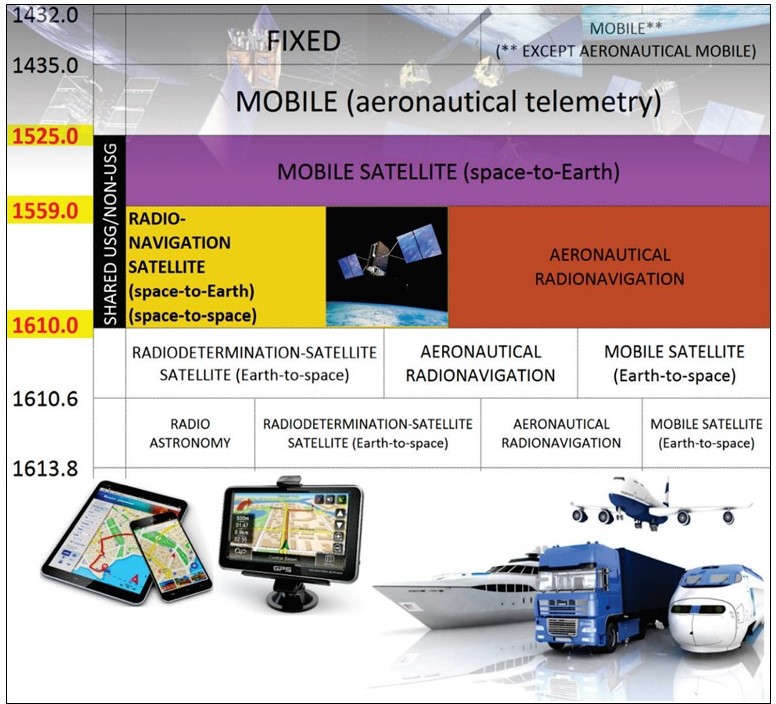
applications. The assessment described in this report addresses transmitters in bands adjacent to
the 1559-1610 MHz radionavigation satellite service (RNSS) band used for GPS Link 1 (L1)
signals that are centered at 1575.42 MHz.

The assessment includes two primary components:

• One component, led by the DOT Office of the Assistant Secretary for Research and
Technology (OST-R), focused on all civilian GPS devices and their applications, apart
from certified aviation. Through this component of the Study, categories of receivers were
evaluated that included aviation (non-certified), cellular, general location/navigation, high
precision, timing, and space-based receivers. An element of this effort was to determine
equipment susceptibility to adjacent band interference to support analyses for deriving
compatible power levels.

• The other component, led by the Federal Aviation Administration (FAA), focused on
certified GPS avionics, and was conducted by analysis to determine the adjacent band
power levels that conform to existing certified GPS aviation equipment standards.


Read More

What Can YOU Do? How Can YOU Help?

PNT is the quiet backbone of everything but too many leaders still don’t see the risk.

But you do. You understand the systems, the dependencies, the failure chains. That insight is rare — and it’s exactly what your country needs right now. Contact your government leaders and industry decision-makers and tell them resilient PNT isn’t a feature — it’s the foundation everything else depends on.

Start the Conversation

Use our Resilient PNT Key Talking Points to make the case.

U.S. Advocates

Find your representatives at Congress.gov, then use our email template to reach them in minutes.

When you get a response, let us know. Every conversation strengthens the mission.

More PNT News

Canada Ending Radio Time Signals (accuracy

Canada Ending Radio Time Signals (accuracy <1ms)

Image: Shutterstock What's new: Canada has announced it is cancelling its short wave time signals as of the 22nd of June 2026. Why it's important: The other sources of official time from the Canadian government (National Research Council, or NRC) are less accurate...

“We can track Starlink users…” – Fast Company

“We can track Starlink users…” – Fast Company

Image: Shutterstock What's new: A report that multiple companies are offering governments the ability to geolocate Starlink terminals.  Why it's important: Security concerns - an adversary could target, kidnap, kill, etc. users. Privacy concerns - user location data...

Honeybees teach drones how to navigate without GPS – Cybernews

Honeybees teach drones how to navigate without GPS – Cybernews

Image: Shutterstock What's new: An interesting form of autonomous navigation based on nature. Why it's important: Autonomous systems have an important place in an overall PNT architecture. For some applications they are the best/only method. This system uses just 42...

PNT cyber guidance update – NIST wants your input

PNT cyber guidance update – NIST wants your input

Image: RNT Foundation What's new: Draft updated PNT cyber guidance from NIST. They are seeking public comment and input. Why it's important: PNT and cyber are well intertwined. PNT is an essential tech infrastructure so protecting it from malicious cyber effects is...

Get PNT News in Your Inbox