



Image: Shutterstock
What’s new: Canada has announced it is cancelling its short wave time signals as of the 22nd of June 2026.
Why it’s important: The other sources of official time from the Canadian government (National Research Council, or NRC) are less accurate that the less-than-one millisecond achievable with their short wave system.
- The talking clock (we are guessing accuracy of about one second) and
- NRC’s Web Clock and NTP. Since both of those provide time over the internet, the accuracy to UTC should be between <10ms and <100ms.
What else to know:
- The U.S. proposed terminating radio time signals in the president’s budget submitted in 2018. Congress did not include that reduction in the final budget.
- Users, especially those in Canada, who are concerned about this should contact the Canadian government https://www.canada.ca/en/contact.html

NRC shortwave station broadcasts (CHU)
As of June 22, 2026, the shortwave radio broadcast of the NRC’s official time signal will no longer be available.
The NRC’s official time can still be found in the following ways:
- The NRC’s web clock
- The telephone talking clock
- The NRC’s Network Time Protocol
For those looking for shortwave radio time signals, they are available from the Bureau International des Poids et Mesures.
Time accuracy superior to telephone time accuracy is available throughout Canada and in many other parts of the world by means of the NRC’s radio time signals broadcast continuously from shortwave radio station CHU. If corrections are made for the propagation delay from CHU to the user, and for delays in the user’s receiver, an accuracy of better than 1 ms can be obtained. Signal availability at a user’s location depends on ionospheric conditions. CHU also broadcasts a time code which can be decoded with common computers and modems.
Three frequencies are used: 3330, 7850, and 14 670 kHz. The transmission mode, upper single sideband with carrier re-inserted, provides time signal service without requiring a special SSB radio, and also provides three standard frequencies. The frequencies are derived from one of a trio of atomic clocks located at the transmitter site. Three clocks are employed to permit majority logic checking. CHU time signals are also derived from these clocks. The clocks at the CHU transmitter site, about 20 km from the NRC’s time laboratory, are compared daily with the NRC’s primary cesium clocks.
Normally the time broadcast by CHU is accurate to 10-4 s and any offsets of the carrier frequency from UTC(NRC) are less than 5×10-12. UTC(NRC) is the version of Coordinated Universal Time (UTC) that is realized at the NRC. It is maintained to within 100 ns of UTC and has a frequency offset of less than 1×10-13.
UTC is the international official time reference. It is constructed by the Bureau International des Poids et Mesures (BIPM), based on the average of laboratory and commercial atomic clocks located in laboratories around the world. It is steered in frequency using primary cesium clocks located at some of the major time laboratories.
UTC was defined to coordinate atomic clocks so that they could all agree and still loosely follow the irregularities of the astronomical time scale UT1, which is needed in astronomical observations and in celestial navigation. Since 1972, leap seconds have been used to keep UTC within 0.9 s of UT1.
The difference [UT1- UTC] is called DUT1, and this fraction of a second [-0.8 s to +0.8 s] is broadcast by means of an internationally accepted code. To decode the size of DUT1, in tenths of a second, a user counts the number of emphasized seconds markers in one minute. For CHU, the emphasized seconds pulses are split, so that a double tone is heard. When the emphasis is on seconds 1 through 8, DUT1 is positive; and when DUT1 is negative, seconds 9 through 16 are used.
The first minute of each hour commences with a full 1 s pulse of 1000 Hz tone, followed by 9 s of silence, and then the normal pattern of 0.3 s pulses of 1000 Hz at one-second intervals. The normal pattern for each of the next 59 minutes starts with a 0.5 s 1000 Hz pulse, followed by the DUT1 code employing split 0.3 s pulses where required, and normal 0.3 s pulses up to and including that at 28 seconds. The pulse at 29 seconds is omitted. Following the normal pulse at 30 seconds, for a 9 s period, 1000 Hz pulses of 0.01 s occur, each followed by the CHU FSK digital time code described in CHU broadcast codes. The pulses between 40 and 50 seconds are of normal length. In the final 10 s period of each minute a bilingual station identification and time announcement is made, with the 1000 Hz seconds pulses shortened to “ticks”. Each minute’s announced time refers to the beginning of the pulse which follows. Since April 1, 1990, the announced time is always UTC.
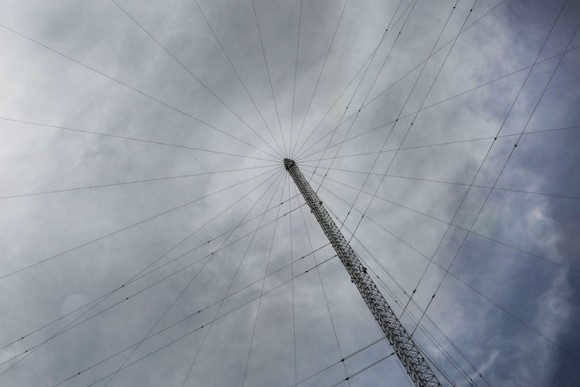
The CHU station is located 15 km southwest of Ottawa at 45° 17′ 47″ N, 75° 45′ 22″ W. Main transmitter powers are 3 kW at 3330 and 14 670 kHz, and 5 kW at 7850 kHz. Individual vertical antennas are used for each frequency. The electronics systems feeding the transmitters are duplicated for reliability, and have both battery and generator protection. The generator can also supply the transmitters. The announcements are made by a talking clock using digitally recorded voices. The digital voice announcements entered into service in 1990. The voice in English is that of Harry Mannis (a former CBC announcer) and the voice in French is that of Simon Durivage (of Radio-Canada).