




Image: Shutterstock
What’s new: Discussion of system “resilience,” especially in the context of PNT.
Why it’s important: We sometimes hear folks ask for a definition of “resilience.”
- Many are genuinely seeking to define terms to help in identifying solutions.
- Others are trying to avoid discussion of the real problem.
- Understanding and being ready with a definition or short discussion helps build credibility and can move discussions on to actionable options.
What else to know:
- Before 9-11 “resilience” was mostly discussed in terms of individuals’ abilities to withstand adverse events and trauma.
- Post 9-11, Hurricane Katrina, and other events, the Department of Homeland Security began focusing on resilience as:
- Adapting to changing conditions,
- Withstanding disruptions,
- Ensuring rapid recovery, and
- Individual preparedness
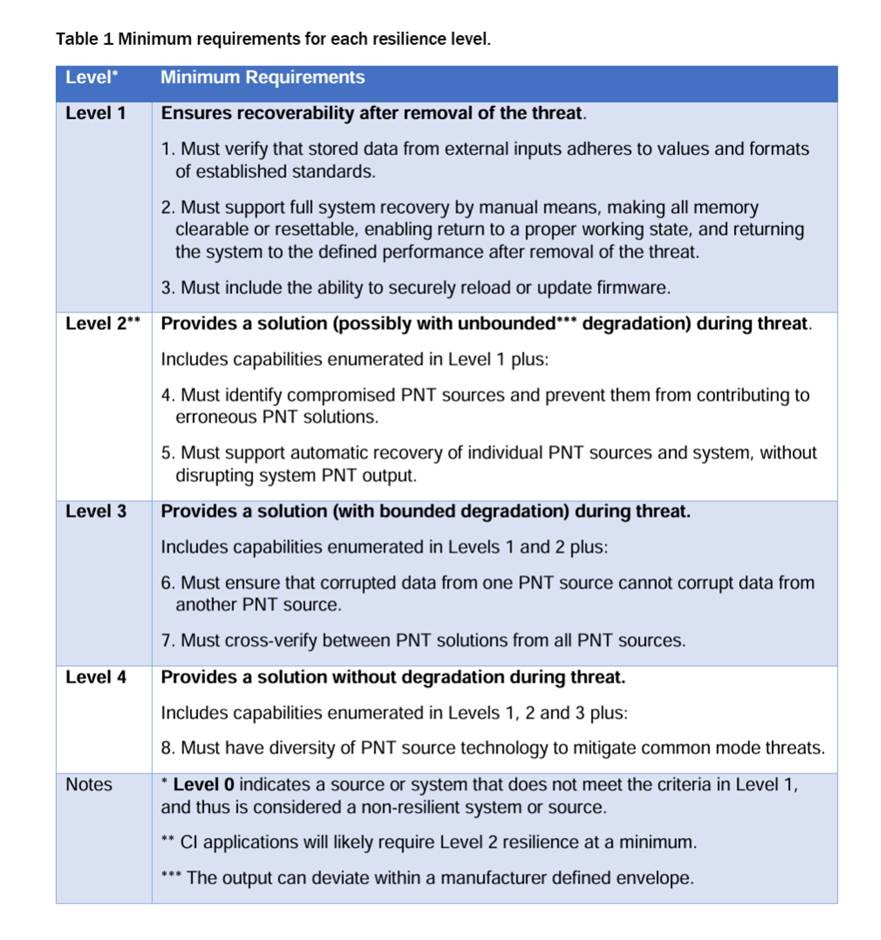
- In the context of PNT, DHS has published a resilience conformance framework for user equipment (consumer side).
- For the supply side of PNT resilience, RNT Foundation and DOT have some thoughts we describe below about what a resilient national PNT architecture looks like.
Defining Resilient PNT User Equipment

Resilient PNT Conformance Framework 2.0, April 2022
Summary table
LINK TO DHS PNT CONFORMANCE FRAMEWORK 2.0
Defining Resilient National PNT Architectures
Every nation has a national PNT architecture. It may only consist of GNSS operated by other nations and some hold over clocks and not be very resilient, but every nation has one.
What does a resilient national PNT architecture look like?
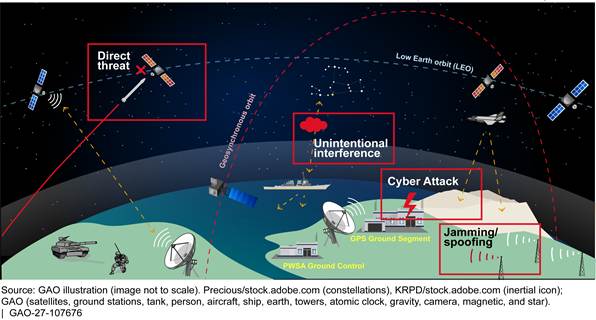
It is one that can adapt to changing conditions, withstand disruptions, and recover quickly if it is disrupted.

Complementary PNT and GPS Backup Technologies Demonstration Report, January 2021
No US government effort, that we know, of has been made and define what the supply-side of resilient PNT looks like.
However, the Department of Transportation in its January 2021 “Complementary PNT and GPS Backup Technologies Demonstration Report” (page 195) said that owners and operators of critical infrastructure should access “a plurality of diverse PNT technologies” to become PNT resilient:
“Based on this demonstration, those technologies are LF and UHF terrestrial and L-band satellite broadcasts for PNT functions with supporting fiber optic time services to transmitters/control segments.” (emphasis added)

A Resilient National Timing Architecture
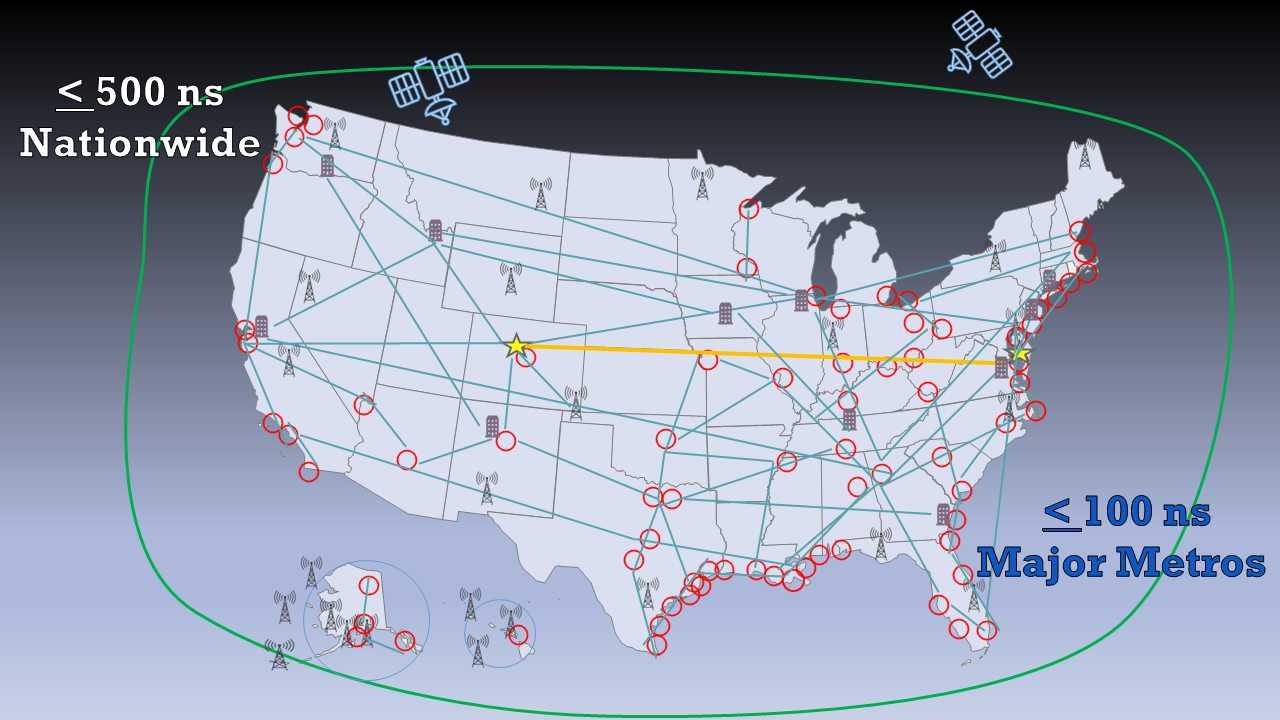
A 2020 paper by Dr. Marc Weiss and Dr. Pat Diamond, described a resilient national timing architecture. This paper postulated a three phased approach with timing from GNSS, LEO PNT, eLoran, and a fiber national clock network.
We have since summarized our paper and the subsequent DOT findings into a general policy statement that a resilient national PNT architecture can be had by accessing signals from space and terrestrial broadcast, and fiber-based time.
The idea of course is that a threat vector that could imperil one part of the triad is very unlikely to impact the other two.
Such a minimal resilient PNT architecture could be built upon by others and evolve into a more refined and complex system of systems.
Note: The governments of the United Kingdom, France, Republic of Korea, Saudi Arabia, China, and Russia have de facto determined what the supply side of resilient PNT looks like. Each provides, or is in the process of implementing a national PNT architecture that includes signals from space and terrestrial broadcast (eLoran) supported by fiber-distributed time.

System Resilience
Taxonomy Layer 1: The Fundamental Objectives of Resilience
Fundamental objectives are the first level decomposition of resilience objectives. They establish the scope of resilience. They identify the values pursued by resilience. They represent an extension of the definition of resilience. They are ends in themselves rather than just means to other ends. They should be relatively immutable. Being resilient means achieving three fundamental objectives:
- Avoid adversity: eliminate or reduce exposure to stress
- Withstand adversity: resist capability degradation when stressed
- Recover from adversity: replenish lost capability after degradation
These fundamental objectives can be achieved by pursuing means objectives. Means objectives are not ends in themselves. Their value resides in helping to achieve the three fundamental objectives.