




Image: FAA
What’s new: An FAA guide for pilots we just heard about. It was first published in December, but was recently updated
Why it’s important: Aircraft are the platforms most impacted by GNSS interference at the moment. Signals travel line-of-sight so aircraft can see more interfering transmitters.
What else to know: This is a pretty good guide, in our humble opinion. We especially like that it addresses human factors at length. Pilots can be both the weakest link and strongest link in an aircraft. Sometimes pilot error results in disaster. Other times a pilot in the loop can overcome massive system and equipment failures and bring the aircraft to a safe landing. So… humans and human factors are important.
The guide discusses the following possible pilot performance impacts from GNSS interference:
- Increased workload
- Increased fatigue
- Increased stress
- Reduced situational awareness
- Mistrust in flight deck systems
- Delayed or inaccurate responses to alerts
- Degraded crew resource management
- Communications challenges
What could possibly go wrong?

GNSS Interference Resource Guide
Section 1: Introduction 1.1
Purpose
The Federal Aviation Administration (FAA) Flight Technologies and Procedures Division (AFS-400) developed this resource guide to provide United States (U.S.) operators and pilots with the most current information regarding Global Positioning System (GPS)/ Global Navigation Satellite System (GNSS) jamming and/or spoofing. This resource guide refers to any interruption to the GPS/GNSS signal-in-space (SIS) as “GNSS interference”.
The GPS is a U.S. satellite constellation nominally consisting of 21 satellites and 3 operational spares orbiting the Earth in six orbital planes. In contrast, GNSS is a term covering any satellite constellation and satellite augmentation system providing positioning, navigation, and timing (PNT) services. Other than the GPS constellation, there are a number of other satellite constellations, e.g., Galileo from Europe, BeiDou from China, and GLONASS from Russia. There are also various regional GNSS augmentation systems.
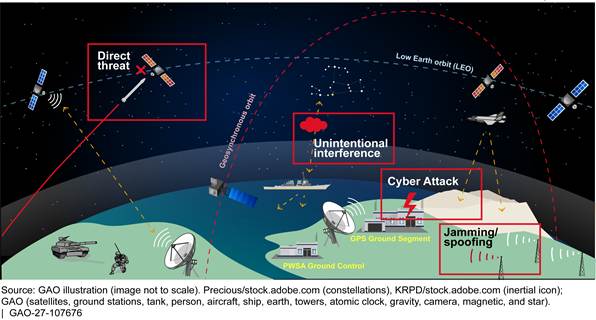
Jamming. Emissions that do not mimic GNSS signals (e.g., GPS and Wide Area Augmentation System (WAAS)), but rather interfere with the civil receiver’s ability to acquire and track GNSS signals. Jamming can result in denial of GNSS navigation, positioning, timing and aircraft dependent functions.
Spoofing. Emissions of GNSS-like signals that may be acquired and tracked in combination with or instead of the intended signals by civil receivers. The onset of spoofing effects can be instantaneous or delayed, and effects can persist after the spoofing has ended. Spoofing can result in false and potentially confusing, or hazardously misleading, position, navigation, and/or date/time information in addition to loss of GNSS use.
Note: The above definitions of jamming and/or spoofing match those in the Pilot/Controller Glossary of the Aeronautical Information Manual/Publication (AIM/AIP). Appendix D of this document contains a glossary and acronym list of terms this guide uses.
The impacts of safety hazards from GNSS interference rapidly spread over the past few years and is persistent. As the threat of GNSS jamming and spoofing is constantly changing, the FAA will update this resource guide to provide the best guidance in the rapidly changing environments.