



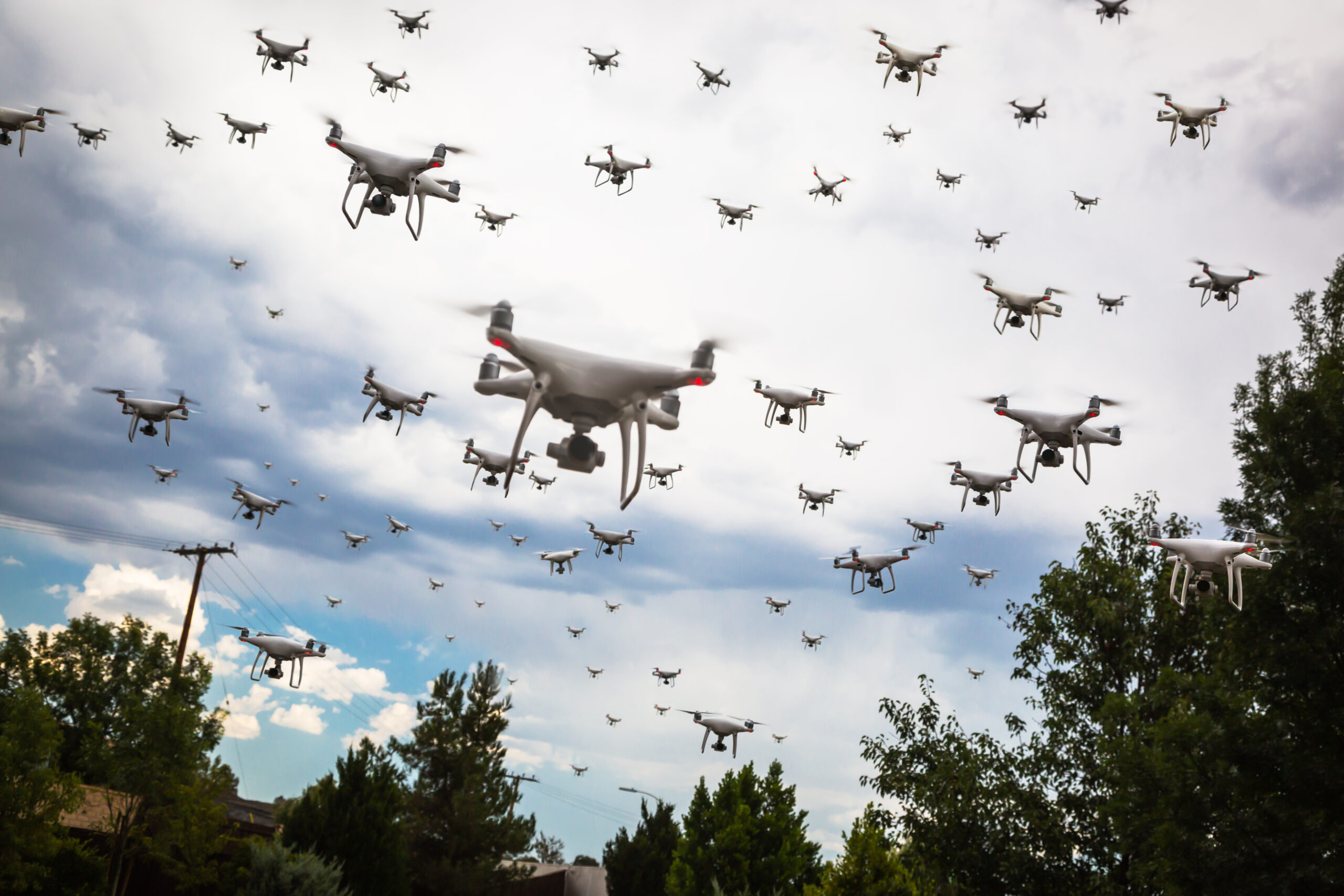
Image: Shutterstock
What’s new: An article about UAS governance by RNTF President Dana A. Goward.
Why it’s important:
- UAS and Counter-UAS are great use cases for why the U.S. needs a multi-layered resilient national core PNT architecture.
- It is important for governments to take a holistic and systematic approach to such things as UAS and PNT.
- For the UAS industry to continue to grow and make money, we must have greatly improved governance and all the support systems.
What else to know: It is often difficult for people, especially people in government, to be motivated enough to act and prevent bad things from happening. Psychologically, it is much easier to wait and then react/ respond when something bad happens. There are lots of reasons for this, including the difficulty of justifying a budget request when reviewers scoff at estimates of threats and risks.
Two examples of threats and risks being ignored and the U.S. paying a horrible price:
- New Orleans levees – Authorities in Louisiana and the federal government long knew the levees could not withstand a 100-year storm like Katrina. But rather than improve the levees at a cost of approximately $100M, upgrades were only made after the storm, the loss of 3,000+ lives, and $125B in damage.
- 9/11 – Over 140 commercial airliners had been hijacked around the world before the 9/11 attacks. In two instances the hijackers threatened to fly airplanes into nuclear power plants if their demands were not met. Yet U.S. airline cockpit doors were not hardened, passenger screening and airport security was not upgraded, and few other security measures were implemented until after the world changed. Countless lives were lost in the incident and the two+ wars that were spawned. It is impossible to quantify the massive harm done.
Getting our UAS and National Security Act Together
To keep pace with modern UAS and C-UAS threats, the U.S. needs a durable framework that unifies rules, shared awareness, and operational capabilities across every level of government.

Across Ukraine and the Middle East, weaponized drones race toward their targets while defenders scramble to counter them. Some intercepts work. Many don’t. Every failure inflicts real consequences: destroyed equipment, disrupted operations, and casualties.
Domestic incidents reflect the same trend. In 2023, unauthorized drones flew directly over a Virginia Air Force Base, and similar airspace violations occurred months later at U.S. Air Force sites in the U.K.
These events make one thing clear: the United States is not yet postured to manage the speed, scale, and unpredictability of modern UAS activity.
We are fortunate the current administration has recognized that and committed to making America safer. This can’t be a one-shot effort. It must result in a long term governance structure that supports safety, security, and industry development.
JIATF 401
Joint Interagency Task Force 401 (JIATF 401) was established by the Department of Defense in 2025. At first glance, the order establishing the task force appears very DoD focused. It says, “DoD must enhance its C-sUAS capabilities to protect personnel, equipment, and facilities at home and abroad.” Fortunately, reports of JIATF 401’s recent kick off meeting show recognition that the department can’t do it alone, and that infrastructure and civilian assets must be protected.
To do this JIATF 401 director Army Brig. Gen. Matt Ross described the need for “…a whole-of-government effort to be able to protect our critical infrastructure against the threat of unmanned systems. We’ve got to partner closely with our local law enforcement and other federal, state, local, tribal and territorial law enforcement to be able to counter this threat, see it before it starts to manifest and then to defeat it before an attack is successful.”
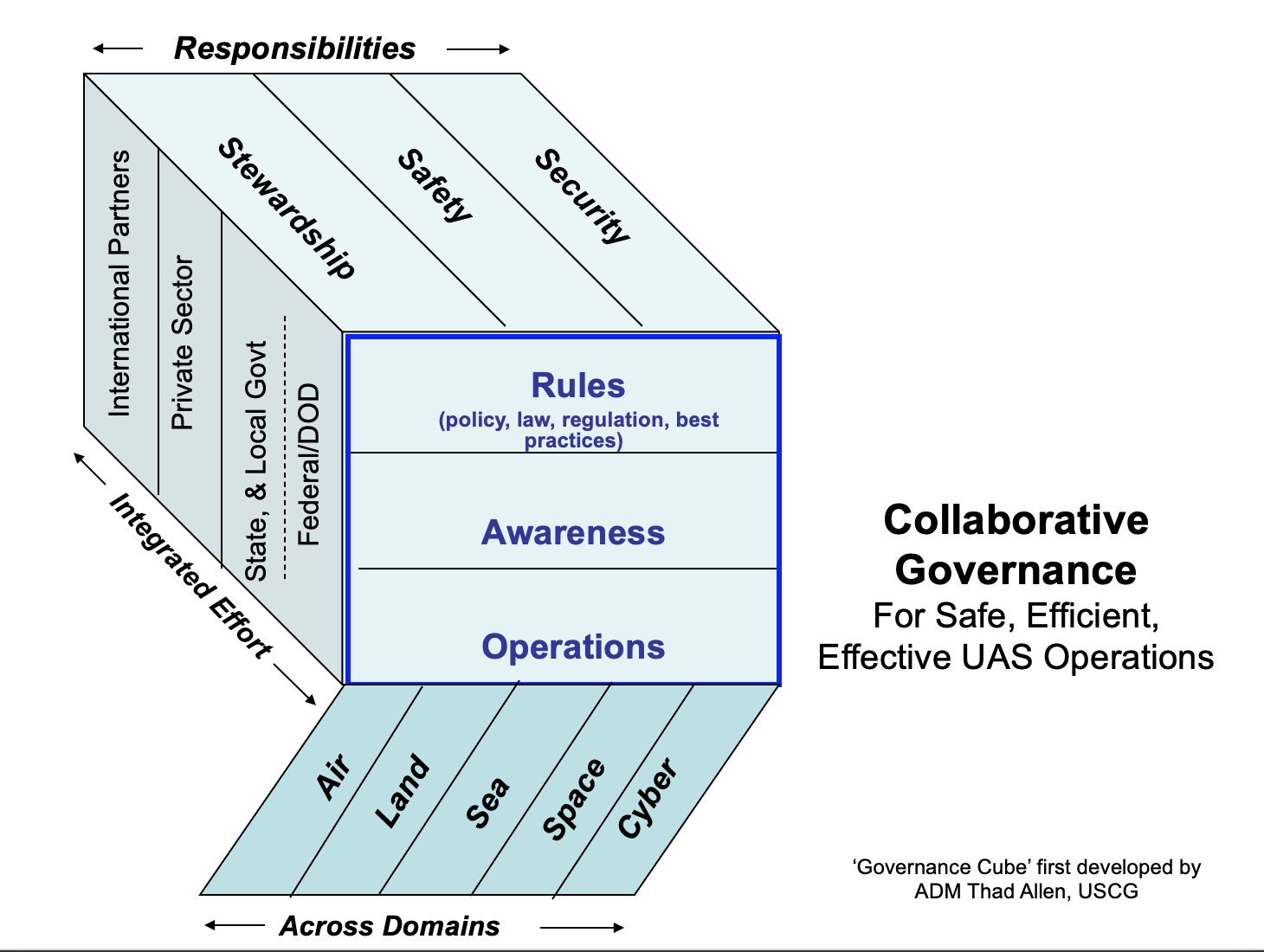
Collaborative Governance
Ross’ biggest challenge will be how to make the nation safer without stifling UAS innovation, development, and operation. A dangerous, wild west environment is not in the best long-term interests of industry. Neither is one with security measures that are so restrictive development slows to a crawl or is stopped altogether.
America’s goal must be to realize the great potential benefits of UAS while guarding against their potential for great harm.
To strike the appropriate balance and include all the players in a whole-of-government approach (which in a democracy includes industry and others in the private sector), development and implementation are needed in three general areas:
- Rules – Coherent rule sets to establish and articulate normative behavior,
- Awareness – Sufficient and shared awareness of the operational environment, and
- Operations – The capability to interact with the UAS environment.
Rules
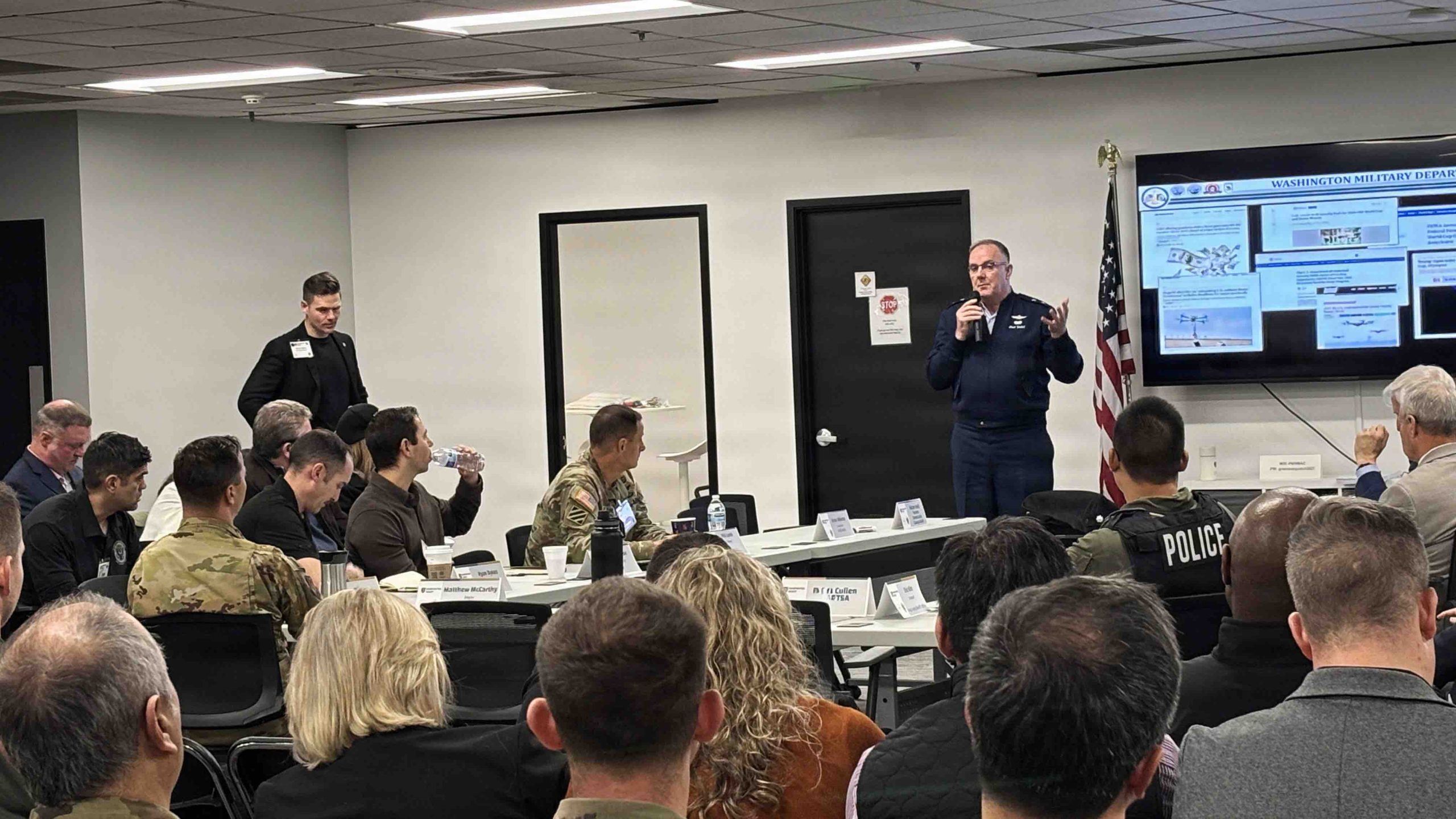
Laws, regulations, standard of behavior, and best practices are structures of orderly and productive societies. While many have been developed and are in progress for UAS, undoubtedly more are needed. Complete and coherent rules are needed for things such as:
- Technical standards for platforms including construction, communications, resilient navigation, and data retention.
- Rules of the road – Where, when, and how UAS are to safely operate and interact.
- Consequences for rule violations – Rules are intended to shape future behavior but can be ineffective if motivations to ignore them outweigh sanctions. Civil penalties, for example, can quickly become seen as “the cost of doing business” and not be a deterrent.
- Who can act against UAS and where – In the United States only the Department of Defense, Department of Energy, Department of Justice, Department of Transportation, and Department of Homeland Security have the authority to operate Counter-UAS systems. This addresses a relatively small portion of the nation’s infrastructure and population, and excludes most of the nation’s law enforcement resources
- Authorized Counter-UAS (C-UAS) situations and actions – Some C-UAS actions in some cases could do more harm than good. A device that disrupts a drone’s GPS navigation used near an airport could have tragic consequences. Kinetic devices could inadvertently send projectiles into schoolyards.
Awareness
Both users and authorities need to be keenly aware of the UAS operational environment and their place in it. This includes:
- Constantly updated mapping and weather– Uncrewed platforms, at least initially, are likely to be less adaptable to the unexpected that traditional manned or remotely operated platforms. This will require a constantly and rapidly updated picture of the physical environment, including weather.
- Resilient, redundant, and robust navigation and timing information – Over-reliance on vulnerable, easy to jam and spoof GPS and other satnav signals will be entirely insufficient. Multiple sources of location and time information must be used to ensure safety of navigation enroute. New systems to guarantee precise approach to and landing at operational nodes will be needed.
- A common operating picture appropriately shared. Knowing the location and status of all platforms, crewed and uncrewed, is essential to deconfliction and safety. Knowing which platforms are blue force, which are authorized users, and which are potential bad actors is fundamental to protecting UAS operations and the public.
- Intelligence. Information about threats, vulnerabilities and risks across all forms of malicious activity must be generated and shared appropriately.
Operations
All the conceivable rules about and awareness of the operational environment will matter little if users and authorities are unable to interact with it and intervene when necessary. Among the capabilities needed are:
- Communications and Coordination – Secure and reliable communications between operators, assets, government agencies, first responders – every player within the space.
- Counter-UAS – Intercept and interdiction assets for UAS must be added to the capabilities of first responders in many locations. These must be effective, in place, and able to be quickly activated.
- Forensics – While perhaps not traditionally considered “operational,” the ability to analyze the effectiveness of operations and then feedback requirements to improve rule sets, awareness, and operational capabilities is essential to keeping any system vital and effective.
Continuing Whole-of-Government Unity of Effort
Establishing and maintaining a coherent and effective UAS governance structure with the needed rule sets, awareness, and operational capabilities will be a long-term, on-going, and iterative effort. One that must be coordinated across federal, state, local, industry and other stakeholders.
JIATF 401 is chartered for 36 months before its “sunset” review to see if it should be stood down. While other JIATFs have been in force and protecting the nation for decades, this might not be the best choice, or not something the Defense Department wants to continue to support in this case.
Yet so many federal departments now touch unmanned aviation that assigning a single lead agency or effective mechanism will be far from straightforward.
The Department of Transportation, through the FAA, is advancing foundational elements such as Remote ID, UTM maturation, and security frameworks emerging under the new Part 108 authorities. The Department of Homeland Security is expanding its infrastructure-protection posture and has been central to the ongoing debate in Congress over broadening C-UAS authorities for state and local partners.
The Department of Commerce, through NIST and NTIA, continues to shape cybersecurity, spectrum, and communications standards that underpin safe and secure unmanned operations.
Any of these agencies could reasonably serve as the coordinating lead, but the choice matters less than ensuring the selected office is properly resourced, staffed, and empowered to drive a unified national approach across civil, commercial, and security domains.
Regardless, the Department of Defense will remain a critical partner. Protecting national security assets from unmanned threats is now one of DoD’s most urgent operational challenges. JAITF 401’s predecessor organization, the Joint Counter-UAS Office (JCO), has already demonstrated the value of centralized doctrine and acquisition guidance.
For example, even if DOD is not the lead, it may be appropriate for NORTHCOM or the National Guard to host or make major contributions to a federated common operating picture. It might be appropriate for one to host and support national-level C-UAS coordination consistent with existing legal authorities.
A governance framework of this magnitude is complex, but the building blocks already exist across FAA rulemaking, DHS security initiatives, DoD’s JCO/JIATF and JADC2 efforts, and multiple Congressional proposals.
Over the next 36 months it will be essential to designate a long-term federal lead and a mandate to integrate these parallel efforts—including C-UAS policy, authorities, and operational standards—into a coherent national strategy and implement an on-going mechanism and process for UAS governance.
The Need is Now
At first glance, building a unified national framework for UAS governance may appear overwhelming. But the United States has done this before. We have successfully integrated complex transportation systems—aviation, maritime, rail, highways—and we now have more advanced technical tools, data systems, and operational models than at any point in history. The work will be complex, but postponing it will only make the challenge harder and the consequences sharper.
A coherent governance structure that supports today’s operations while enabling tomorrow’s expansion is in the best interest of industry, government, and the public. The alternative is to wait for the predictable: crashes, security breaches, and disruptive incidents that force hurried, politically driven responses. Those are the moments when we get fragmented policy and sub-optimal solutions.
The reality is already in front of us. Unknown drones probing military bases, hovering over critical infrastructure, or appearing in restricted areas are not hypothetical risks—they are happening now, and they are unacceptable.
The United States must move with urgency to establish a clear, coordinated approach to UAS governance and C-UAS preparedness. The longer we delay, the more we expose our airspace, our institutions, and our citizens to unnecessary risk. Now is the time to act.