



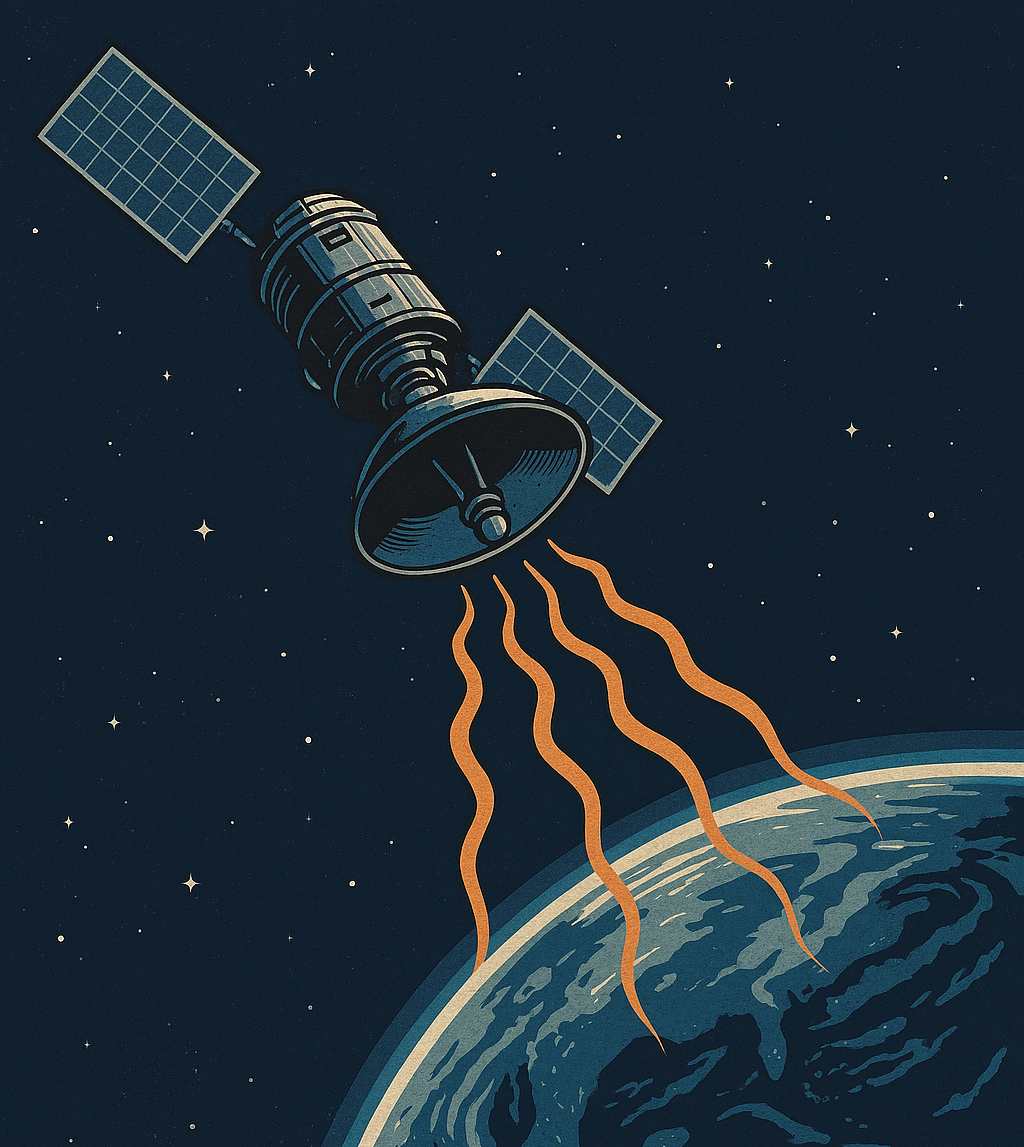
Image: Co-pilot AI
What’s new:
- A paper by Zach Clements and Todd Humphreys detailing 72 days in the last six years when interference with GPS L1 signals has been detected coming from space.
- “The observed timing patterns, which often coincide with business hours during weekdays, suggest a human-in-the-loop component, though the intent behind the interference remains unclear.”
Why it’s important:
- PNT is essential. Most people and systems get it from GPS/GNSS.
- Interfering with space-based PNT signals is a part of warfare around the world.
- These incidents demonstrate not only can it be done from space and impact very broad areas, it is being done from space.
- Interference with GPS and other GNSS across broad areas could cripple the U.S. and/or Europe as neither have readily available, easy to access alternative PNT systems for their infrastructure and population.
- Just a hostile power’s threat of widespread interference with GPS/GNSS could influence policy and actions by the U.S. and Europe.
What else to know:
- In November 2021, as it was preparing to invade Ukraine, Russia destroyed one if its defunct satellites with a ground-based missile. The next day state media claimed that if NATO crossed Russia’s ‘red line,’ Moscow would shoot down all 32 GPS satellites and blind the alliance. This may or may not have influenced U.S. policy and subsequent actions. Shortly after Russia’s public statement, though, the U.S. administration announced it would not send certain types of aid to Ukraine to ‘avoid provoking a Russian invasion.’
- This paper was presented last month at the ION GNSS+ Conference in Baltimore.

Transient Space-Based GNSS Interference: Observations and Analysis
Zachary L. Clements and Todd E. Humphreys, University of Texas at Austin
ABSTRACT
This paper presents the analysis of a space-based Global Navigation Satellite System (GNSS) interference source responsible for multiple transient wide-area GNSS outage over Europe, Greenland, and Canada. Within the past decade, there has been a sharp increase in GNSS outages due to deliberate GNSS jamming and spoofing. An overwhelming majority of these cases can be traced to accidental leakage into the GNSS frequency bands, personal privacy devices, or electronic warfare spillover from nearby conflict zones. In contrast to the terrestrial or near-terrestrial sources responsible for most GNSS outages, this paper investigates GNSS interference source emanating from a spaced-based source. GNSS observables from a network of terrestrial-based GNSS reference stations are used to characterize the interference from 2019 to 2025. This paper offers three main contributions. First, it presents a detection framework for this type of interference. Second, it details the spatial and temporal patterns of wide-area GNSS outage events from the space-based interference source. Third, it presents satellite identification strategy to narrow down the number of candidate satellites.
Conference Attendees Access Paper Here Until November 30, 2025