





Image: Shutterstock
Vol 35 No 1
Winter 2025

2024’s PNT Advisory Board
U.S. endangered, leadership needed
Massive increases in threats and disruption of GPS services over the last four years, advances by America’s competitors, and little progress on improving national PNT capabilities. These disturbing trends pose a danger to the United States. Improved leadership and governance are needed to reverse them.
Variations on this message were the primary outcomes from both of last year’s meetings of the president’s National Space-based Positioning, Navigation, and Timing Advisory Board.
The board also made much more specific recommendations, many of which demonstrated the government’s seeming inability to coordinate and execute PNT improvements that required action by multiple departments.
Results of April meeting
In a memo summarizing the outcomes from the board’s spring meeting, chairman ADM Thad Allen observed that GPS was falling behind BeiDou and Galileo, and that the provisions of Space Policy Directive 7 governing PNT have largely gone unexecuted. Citing the need for “greater involvement by the EXCOM principals” (the two deputy secretaries), it also called for a re-boot of how administrations look at and deal with PNT.
“Simply put, the Board believes that the 20-year-old framework for GPS governance and the current policy statements establish neither the priority that the system deserves nor sufficiently clear accountability for its performance.
The Board believes it is time to take a fresh look at our approach to PNT governance and establish a clear strategy for reestablishing an unquestioned position of leadership for the U.S. To be successful, such a strategy requires a governance structure characterized by clearer authority and accountability.”
The memo also included specific recommendations that, in many ways, were emblematic of leadership neglect and a failure to take a whole-of-government approach. These included:
- Set L-5 healthy for non-safety of life uses.
L-5 is being broadcast by 17 GPS satellites, but Space Force does not plan to set the signal healthy until the much-delayed OCX ground control segment is operational. One reason given is that without OCX, Space Force will be unable to monitor the health of the signal. Some advocates say that this could be done without OCX by cooperating with NASA’s Jet Propulsion Laboratory. However, this would require senior leadership to bridge the gap between Space Force/ DoD and NASA, and that does not seem to be a priority. Alternatively, the Space Force could set the signal healthy with the “not for safety of life/use at your own risk” proviso until OCX is operational.
- Modify the International Trade in Arms Regulations (ITAR) to greatly reduce or eliminate restrictions on sales of multi-element antennas for GPS receivers.
For years government representatives have seemed to agree with the board that this is a good idea. A lack of leadership focus and support, though, has kept resolving this issue from being a priority. Thus, while there seems to be no opposition, the schedule for the needed bureaucratic process has yet to include a formal discussion. Decision, and action.
- Assign a lead agency and single individual with clear responsibility and authority for the end to-end prompt detection, characterization, and removal of significant sources of interference to GNSS in the U.S.
One of the administrative challenges here might be that the Federal Communications Commission (FCC) seems to have the authority and mandate to do this, but it is an independent agency, not part of the executive branch. Thus, a responsible federal official within the executive branch would need to work with the FCC to either encourage the commission to improve its capabilities and capacities, or share some of its authorities with others so they can do this work. At the moment, there does not seem to be an executive branch official that has the authority, mandate, and resources to engage the FCC on this issue.
Note: The explanatory text following each of the recommendations above represents the views of this author, not those of the Advisory Board.
As a way of demonstrating how leadership inattention has resulted in America falling behind, the memo also included this graphic:
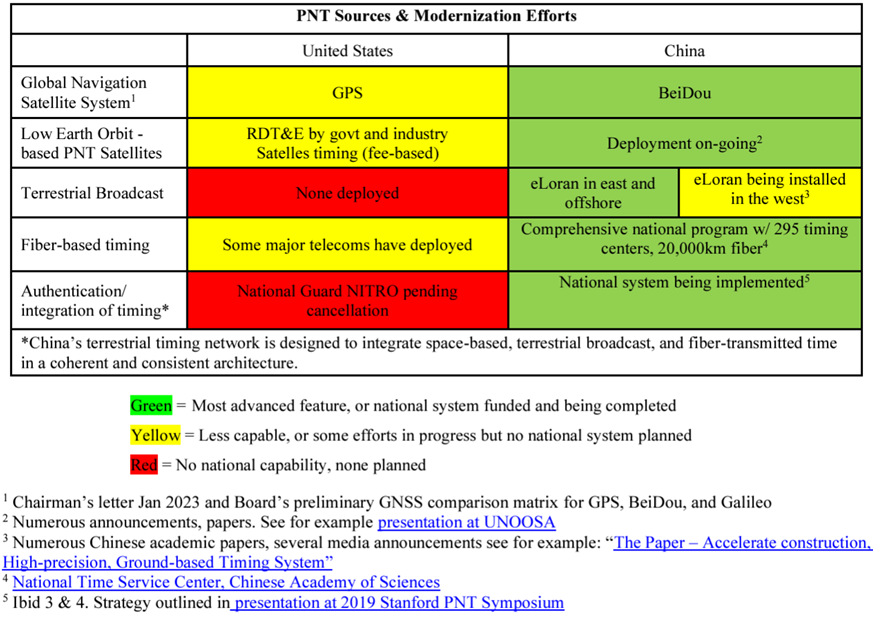 Note: Commercial PNT services available in the U.S. are not listed in the table as they are not national capabilities. Also, in October GPS World reported completion of China’s eLoran system.
Results of December meeting
The most significant product of the Advisory Board’s December meeting was a draft Presidential Transition Issue Paper with the working title “Lack of Attention to PNT Challenges Endangers U.S.”
While the document has yet to be signed and posted on the group’s website, a consensus final draft was displayed, discussed, agreed upon, and submitted to the chair for final smoothing and signature. *
The draft paper discusses:
- The criticality of PNT, the ubiquity of GPS, and the incredible benefits it has brought the U.S. and the world,
- The rise in disruptions over the last four years and that, if it were to happen in the U.S., the damage to America’s national defense, public safety, economic security, and global standing could be significant,
- That GPS’s capabilities are being surpassed by other national satnav systems,
- That the first Trump administration established policies to address this, but there has been little progress fielding improved PNT capabilities, and
- The need for high-level leadership attention to ensure PNT for civil and military capabilities.
The board also intends to include a note that, while government has long been the source for authoritative time and navigation, private enterprise is now able to add value and assist in distribution. Going forward the roles of government and commercial entities should be carefully considered.
A list of recent Advisory Board recommendations concerning specific technology and policy issues appended to the two-page issue paper is also planned.
*A recording of the discussion about the paper on day two of the December meeting is available through: https://www.gps.gov/governance/advisory/ or directly on YouTube at https://www.youtube.com/watch?v=zWwuq6jIIE4&t=968s
Mr. Dana A. Goward is founder and president of the Resilient Navigation and Timing Foundation, a public benefit charity advocating for policies and systems to protect GPS satellites, signals, and users. A life-long navigator, he learned orienteering as a scout, celestial navigation on a tall ship crossing the Atlantic, was navigator for an offshore patrol ship, and piloted Coast Guard helicopters for decades. He served as commanding officer of Coast Guard Air Station New Orleans, and as Chief, Office of Boat Forces before retiring from uniformed service as a Captain. As a member of the federal Senior Executive Service he served as the maritime navigation authority for the United States with 12 different business lines budgeted at over $1.3B/yr, and represented the United States at the International Maritime Organization, International Assn. of Lighthouse Authorities, U.N. anti-piracy working group, and other international forums. He is the recipient of Helicopter Association International’s Igor Sikorsky Humanitarian Service Award for his rescue of two fisherman at the height of Hurricane Chantal, the Institute of Navigation’s Hays Award for inspirational leadership, the John Harrison Award from the International Association of Institutes of Navigation for outstanding contributions to navigation, and is a Fellow of the Royal Institute of Navigation.
Follow us on BlueSky @GPSBackup.bsky.social