



Image: European Commission
What's New: Another move by Europe reaffirming their assertion that PNT from space-based is not enough.
Why It's Important: Implementing such a system will make participants much more resilient, safer, and support economic (especially tech) development. See the mentions about "economy," "autonomy," and "global standing."
What Else to Know:
- We are going to respond to the survey. One of the things we are going to say is that PNT contributing to 10% of Europe's economy is a gross underestimate.
- You should respond also and tell them what a good idea it is.
- See our papers on Resilient National Timing Architecture in our library.

Europe moving toward a “timing backbone” and looking for input
Citing a need for better “positioning, navigation and timing (PNT) resilience, availability and continuity,” a market consultation document from the EU’s Joint Research Center (JRC) says establishing a resilient PNT ecosystem is essential for “…EU autonomy, the economy’s overall resilience and EU global standing.” Therefore, creating this system-of-system ecosystem “… should be considered a critical priority for the EU.”
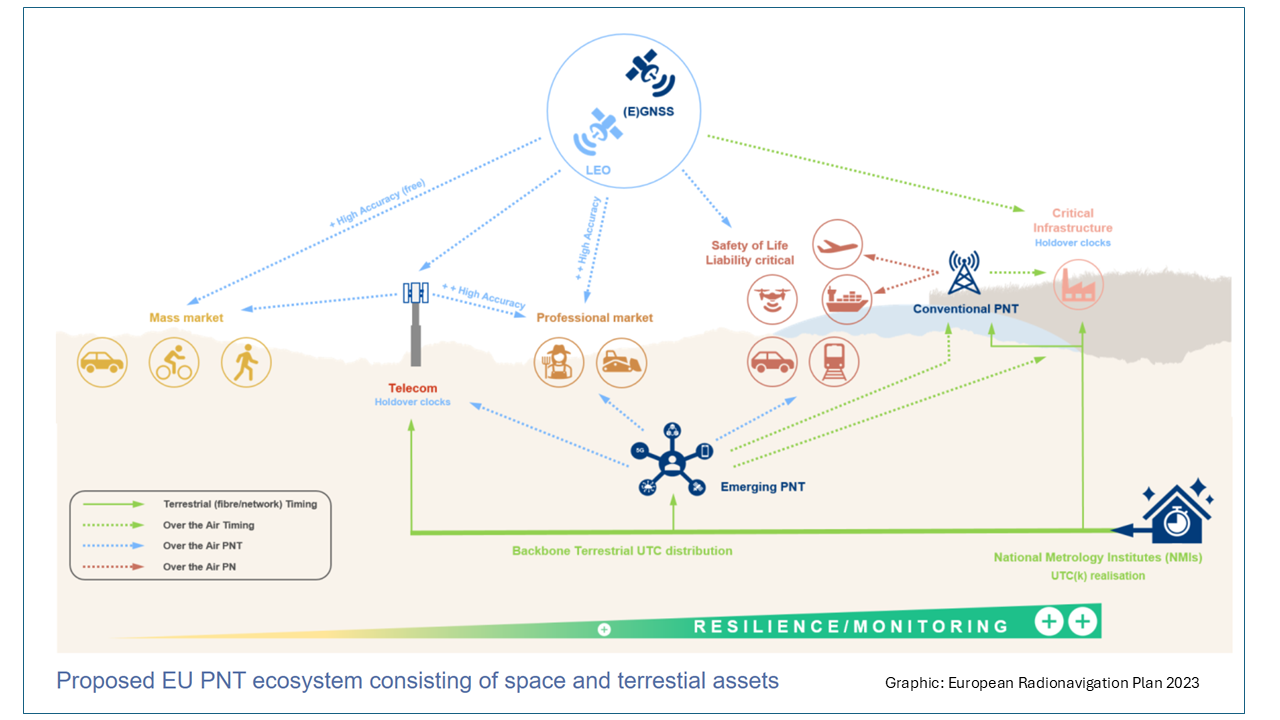
Such an approach to PNT and resilience is a major feature of the 2023 European Radio Navigation Plan.
According to the JRC, complementary (or continuous) PNT, or C-PNT, is the combination of existing space assets (GNSS) and future services that can work together in the multi-system ecosystem. This extends the service to areas where GNSS is not available and increases overall resilience.
The JRC document goes on to say, “The first step towards the creation of such a C-PNT ecosystem is the deployment of the terrestrial timing backbone.”
Such a backbone would:
- Interconnect existing Member States (MS) National Metrological Institutes (NMI) and National Research and Education Networks (NREN) architectures into a pan-European network.
- Maintain and (if possible) enhance the existing use cases (NMI, NREN and their existing commercial customers) and enable time connections to critical entities (CE), as regulated by the directive on the resilience of critical entities, while also promoting GNSS for additional resilience.
- Enable the commercial utilization of timing backbone to enhance EU competitiveness and enable further growth.
Responsibility for navigation issues with the European Union is somewhat dispersed. The European Radio Navigation Plan is developed as a staff working document published by the European Commission’s Director General for Defense, Industry and Space (DG DEIFS). This directorate implements the EU Space Programme, which is, in turn, managed by EUSPA, an EU executive agency.
At the same time the European Space Agency’s Navigation Directorate is responsible for “…positioning, navigation, and timing services of the European satellite navigation system Galileo and the augmentation system EGNOS” under agreement with EC. It is also responsible for ”…exploring future applications of navigation technologies for science and daily life.”
This latter includes the Navigation Innovation and Support Program (NAVISP). And while space is an important consideration in NAVISP, the program has funded some decidedly non-space projects such as the UK’s MarRINav effort which focused on terrestrial PNT, and development of an eLoran antenna for handheld devices.
The Joint Research Center supports a wide range of EU stakeholders for PNT efforts including DG DEFIS, ESA, member states, and pan-European organizations.
A “market consultation” may not seem to many as an affirmative step toward establishing a timing backbone for Europe. Experienced observers, though, point to the wealth of documentation both ESA and DG DEFIS have produced on the need for PNT resilience and the benefits that will accrue to member nations.
“The EU is very consultation and consensus-driven,” says timing expert Magnus Danielson at Net Insight. “So, you are not going to see the kind of top-down orders to do things as you might for a single state. Some of these decisions are made by each member state, as they should be. I am sure (European) Commission and ESA officials have seen what Sweden has done with distributed timing clocks operated by Netnoed, what the U.K. NPL is doing with its clock network, and are concerned about Russian jamming and spoofing in Ukraine and the Baltic. It’s pretty easy to connect the dots and make reinforcing PNT for Europe’s critical infrastructure and applications a priority. Working with the EC-JRC to develop this has been rewarding. Here’s hoping they move quickly enough. Several member states and friendly neighbors have already responded positively, and I sure the market consultation feedback will aid in moving decisions forward.”
The concept of a system-of-systems approach to resilient PNT that is underpinned by network timing is not a new one. The 2008 U. S. National PNT Architecture articulated such an approach, though it was never implemented. In 2020 the RNT Foundation expanded on this idea in a paper advocating a U.S. national resilient timing architecture using signals from space, fiber, and terrestrial broadcast. China’s National Timing Service Center adopted a similar strategy. Media reports indicate China has completed or will soon complete its High Accuracy, Ground-based Timing System with 20,000km of fiber, 295 timing stations, and nation-wide eLoran service.
The EU is asking for input about a European Timing Backbone and is interested in hearing from anyone, whether or not they are EU citizens.
Visit the EU Science Hub page before Dec. 9 and take the survey.