


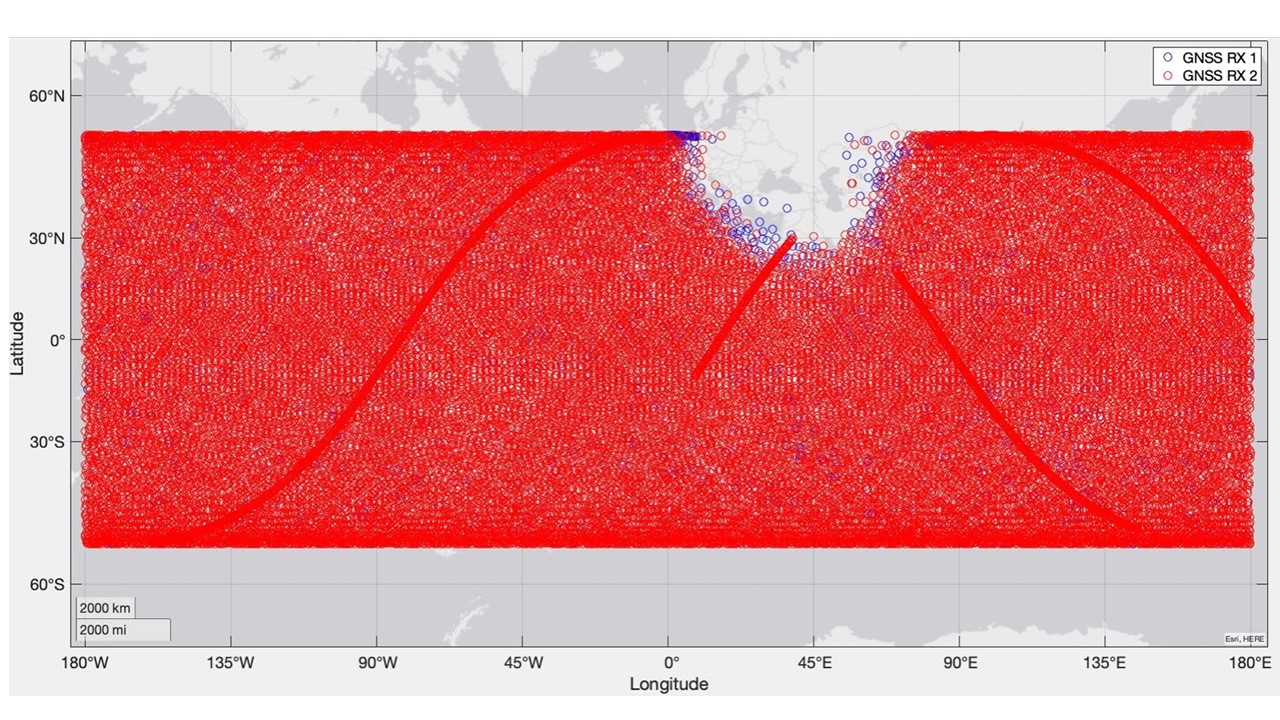
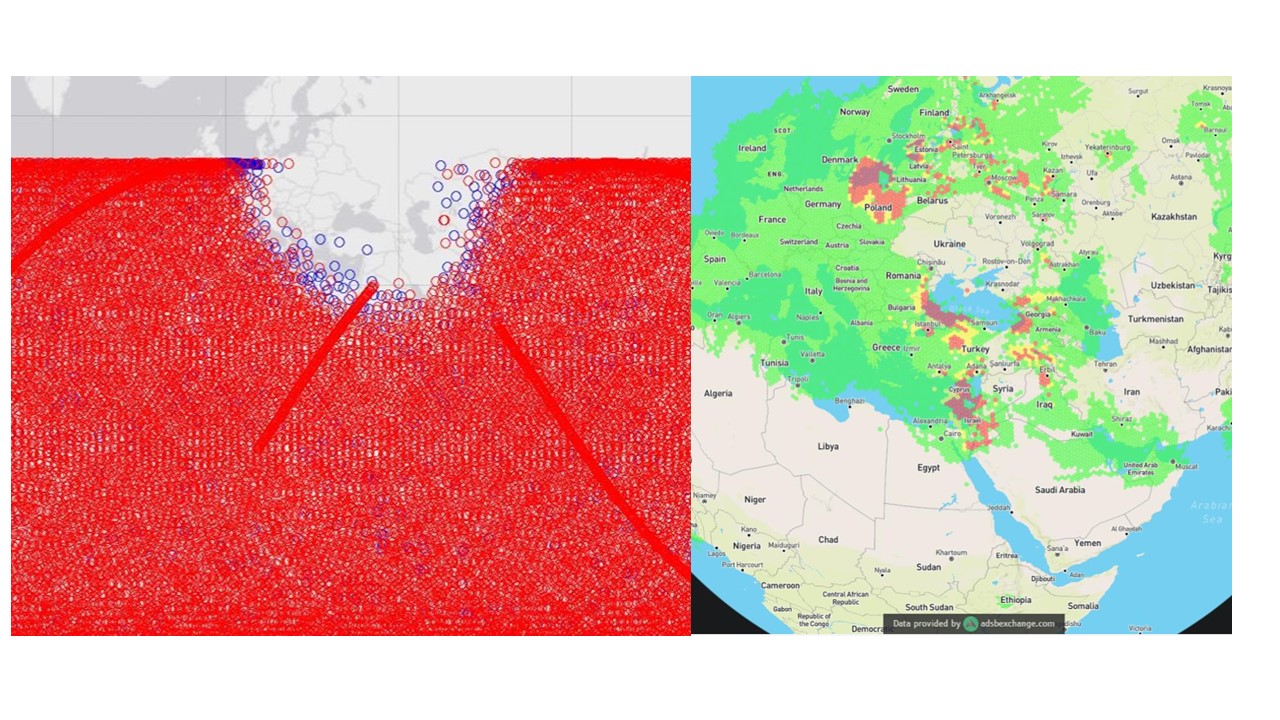
Conflict GPS jamming impacting LEO satellites

October 14, 2024

Written by Editor

Image: Prof Todd Humphreys, Univ Texas Radionavigation Lab

What’s New: A graphic from Prof. Todd Humphreys showing loss of GPS/GNSS signals by satellites in Low Earth Orbit (LEO) because of jamming on the ground.

Why It’s Important:

  • :Most LEO satellites use location and timing data from GPS or another GNSS to synchronize operations, and so they know where they are, when and how to broadcast.
  • While most of the satellites are able to carry-over valid time and location as they pass through the area of interference, the more interference they see, the more their operations can be degraded.

What Else to Know:

  • GPS/GNSS signals, and therefore jamming and spoofing signals, are line-of-sight. This is why aircraft across a large are can be impacted by jamming and spoofing, but receivers on the ground much less so. Satellites can be impacted over an even greater area.
  • Some LEO satellites get their time from suites of clocks on the ground and are a bit more resilient to interference.

This slide was part of a presentation to CGSIC 2024 in Baltimore by Professor Todd Humphreys. Our thanks to Todd for his on-going insights!

Civil PNT Threats and Countermeasures

Todd Humphreys

The University of Texas at Austin
SEE MORE OF THE PRESENTATION

What Can YOU Do? How Can YOU Help?

PNT is the quiet backbone of everything but too many leaders still don’t see the risk.

But you do. You understand the systems, the dependencies, the failure chains. That insight is rare — and it’s exactly what your country needs right now. Contact your government leaders and industry decision-makers and tell them resilient PNT isn’t a feature — it’s the foundation everything else depends on.

Start the Conversation

Use our Resilient PNT Key Talking Points to make the case.

U.S. Advocates

Find your representatives at Congress.gov, then use our email template to reach them in minutes.

When you get a response, let us know. Every conversation strengthens the mission.

More PNT News

New Company for Broadcast Positioning System – NAB

New Company for Broadcast Positioning System – NAB

Image: Shutterstock What's new: The National Association of Broadcasters (NAB) has formed a separate company to develop, advocate for, and deploy the Broadcast Positioning System (BPS). Why it's important: NAB has put increasing effort behind BPS since its inception...

Standalone Magnetometry Is the New GPS – IEEE Spectrum

Standalone Magnetometry Is the New GPS – IEEE Spectrum

Image: Shutterstock What's new: An article about forms of navigation using aspects of the earth's magnetic field.  Why it's important: Autonomous navigation is becoming more interesting for a number of applications in a world where interference with GNSS is becoming...

Munich 9 Years On: Same Message, More Urgency – Inside GNSS

Munich 9 Years On: Same Message, More Urgency – Inside GNSS

Image: Shutterstock What's new: RNTF President Dana Goward's column for the May/June edition of Inside GNSS+. Why it's important: It discusses a PNT example of how concern within the tech community does not necessarily turn into action by political leaders. Or at...

US Congress hearing on PNT –  June 4th

US Congress hearing on PNT – June 4th

Image credit: House Energy and Commerce Committee What's new: A congressional hearing titled Where Are We?: Examining Positioning, Navigation, and Timing Capabilities in the United States. Why it's important:  The hearing is being held by the Communications and...

Get PNT News in Your Inbox