




Image: Shutterstock
What’s New: The European Aviation Safety Agency (EASA) updated its formal advisory about GNSS interference. The last one was November 2023, before Russia’s expansion of jamming and spoofing into the Baltic region.
Why It’s Important: This seems to be official acknowledgement that the expanded interference is here to stay.
What Else to Know:
- When thinking about the acceptability of navigation systems, analysts usually consider accuracy, integrity, availability, continuity, and coverage. When taken together “integrity, availability, and continuity” would seem to describe “resilience.” Maybe resilience should be added to the list anyway, just to keep it top of mind.
- See our recent posts about a paper on the importance of backup systems and Europe’s aviation tech directors’ concerns.
- Check out the new list of FIRs (Flight Information Regions) impacted. And that’s just Europe. Wow.
Global Navigation Satellite System Outages and Alterations
The European Union Aviation Safety Agency (EASA) issued the third revision of Safety Information Bulletin (SIB) 2022-02R3 on July 5, 2024, addressing the increasing issues related to global navigation satellite system (GNSS) outages and alterations. This bulletin, targeted at competent authorities (CAs), providers of air traffic management (ATM), air navigation service providers (ANSPs), air operators, and aircraft and equipment manufacturers, highlights the growing severity and sophistication of GNSS jamming and spoofing incidents.
Check out the SIB for the full information, except for the affected flight information regions (FIRs) listed below.
On this page, you can also find the following:
- Overview of GNSS interference
- Types of interference
- Effects and symptoms of GNSS interference
- FIRs affected by jamming and spoofing (updated on July 5, 2024)
- Recommendations and mitigating measures
- Reporting and further information
- Related Content — SIB 2022-02R3
Overview of GNSS interference
Since February 2022, there has been a notable increase in GNSS jamming and spoofing, particularly in regions surrounding conflict zones and other sensitive areas such as the Mediterranean, Black Sea, Middle East, Baltic Sea, and the Arctic. These interferences disrupt the accurate reception of GNSS signals, leading to various operational challenges for aircraft and ground systems.
Types of interference
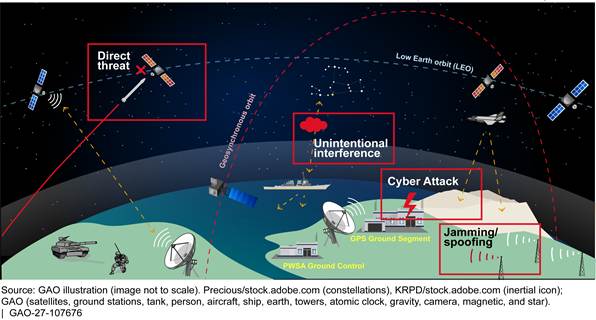
- Jamming: This intentional radio frequency interference prevents GNSS receivers from locking onto satellite signals, rendering the system ineffective or degraded.
- Spoofing: This involves broadcasting counterfeit satellite signals to deceive GNSS receivers, causing incorrect position, navigation, and timing data.
Effects and symptoms of GNSS interference
Interference can occur during any phase of flight, leading to re-routing or diversions to ensure safety. Common symptoms of GNSS spoofing include:
- discrepancies in navigation positions;
- abnormal differences between ground speed and true airspeed;
- time shifts;
- spurious terrain awareness and warning system (TAWS) alerts; and
- potential deviations in hybrid positions (inertial reference system (IRS) / GNSS).
FIRs affected by jamming and spoofing (updated on July 5, 2024)
Although GNSS jamming or spoofing can be encountered anywhere in the world, according to the data collected so far, the mainly affected FIRs to date are the following:
- The southern and eastern Mediterranean, and the Middle East:
- FIR Nicosia LCCC,
- FIR Beirut OLBB,
- FIR Damascus OSTT,
- FIR Tel-Aviv LLLL,
- FIR Amman OJAC,
- the north-eastern part of FIR Cairo HECC,
- the eastern part of FIR Athinai LGGG,
- FIR Baghdad ORBB,
- FIR Kuwait OKAC,
- FIR Bahrain OBBB,
- the north-western part of FIR Tehran OIIX, and
- the northern part of FIR Tripoli HLLL.
- The Black Sea:
- FIR Istanbul LTBB,
- FIR Ankara LTAA,
- the eastern part of FIR Bucuresti LRBB,
- FIR Sofia LBSR,
- FIR Tbilisi UGGG,
- FIR Yerevan UDDD, and
- FIR Baku UBBA.
- Eastern Europe:
- FIR Bratislava LZBB,
- FIR Budapest LHCC, and
- FIR Chisinau LUUU.
- The Baltic Sea:
- FIR Helsinki EFIN,
- FIR Tallin EETT,
- FIR Riga EVRR,
- FIR Vilnius EYVL,
- the eastern part of FIR Warszawa EPWW, and
- the southern part of FIR Sweden ESAA.
- The Arctic:
- the northern part of FIR Helsinki EFIN, and
- the northern part of FIR Polaris ENOR.
Recommendations and mitigating measures
To address these issues, EASA recommends several measures for different stakeholders:
Competent authorities (CAs)
- Establish contingency procedures with providers of ATM and ANSPs.
- Implement proactive mitigating measures and issue Notices to Airmen (NOTAMs).
- Facilitate information collection on GNSS degradations and notify air operators promptly.
- Avoid unauthorised transmitters that cause interference.
Providers of air traffic management (ATM) and air navigation service providers (ANSPs)
- Collect and communicate information on GNSS degradations.
- Ensure that ground navigation infrastructure (instrument landing system (ILS), distance-measuring equipment (DME), VHF Omnidirectional Range (VOR)) remains operational.
- Provide timely information to airspace users through appropriate channels.
- Develop contingency plans for GNSS jamming/spoofing events.
Air operators
- Train flight crews to recognise and respond to GNSS interferences.
- Report any observed GNSS anomalies promptly.
- Include GNSS jamming/spoofing scenarios in crew training.
- Assess operational risks and limitations due to GNSS loss.
- Ensure the availability of alternative non-GNSS-based procedures.
Specific recommendations for air operators
- For jamming:
- verify aircraft position using non-GNSS means;
- check critical navigation aids; and
- report irregularities.
- For spoofing:
- monitor aircraft position using non-GNSS navaids;
- closely follow air traffic control (ATC) frequencies;
- apply manufacturer instructions on detecting and dealing with suspected GNSS spoofing; and
- report irregularities.
Aircraft and equipment manufacturers
- Assess the cumulative effects of jamming/spoofing on their products.
- Provide guidance to air operators on detecting and dealing with spoofing.
- Offer instructions on operating and maintaining products during GNSS interference.
Reporting and further information
All stakeholders are reminded to report safety-impacting events according to EU regulations. Air operators should report GNSS alterations to aircraft manufacturers and support their investigations with relevant data.
For more information, contact the EASA Safety Information Section at [email protected].
By following these recommendations and maintaining vigilant monitoring, the aviation industry can mitigate the risks associated with GNSS jamming and spoofing, ensuring continued safety and reliability in air navigation and operations.