



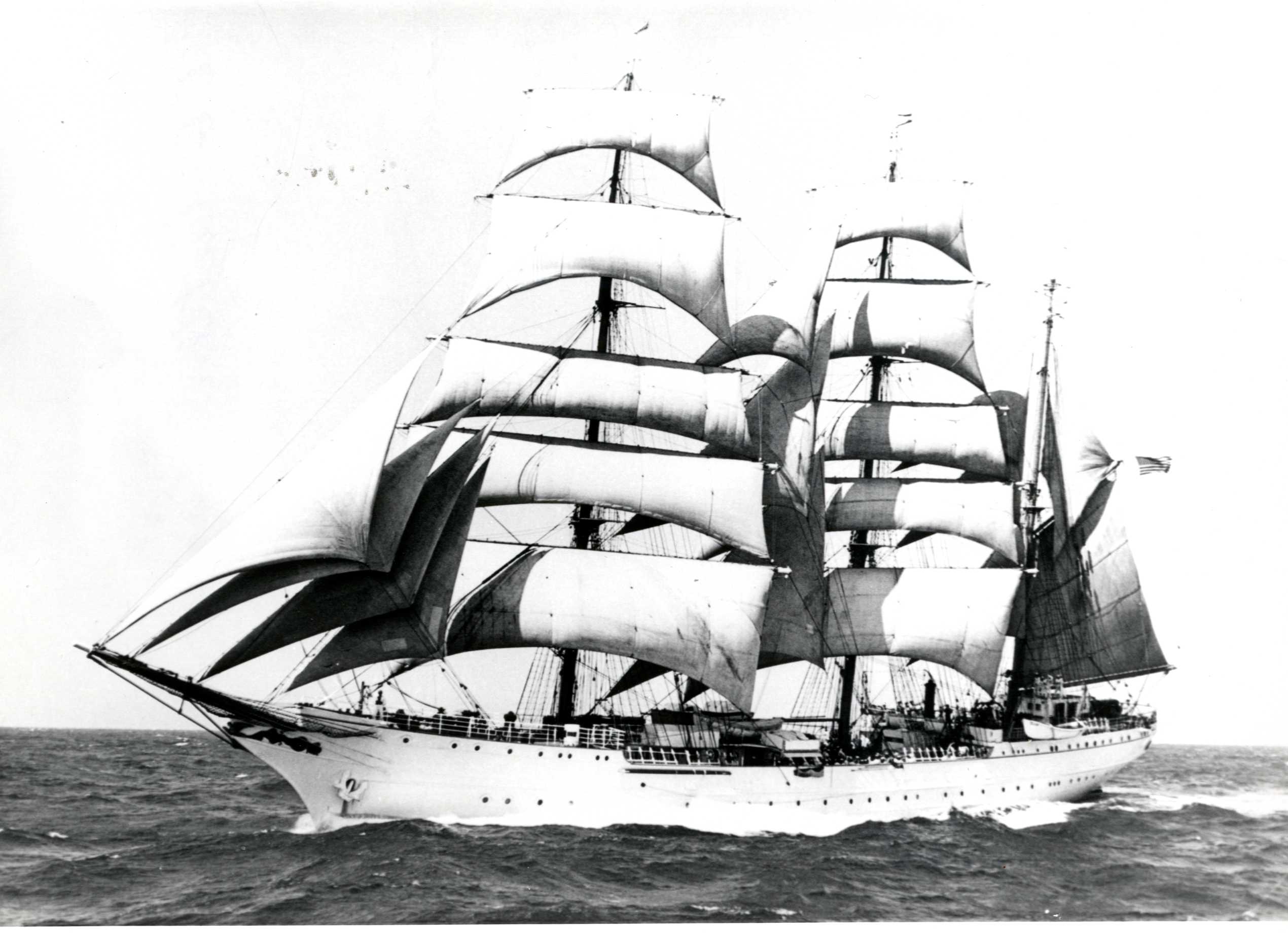
Image: USCGC Eagle circa 1972, National Archives
What’s new: An engaging article by our friend Doug Taggart about his experiences over the decades as a navigator.
Why it’s important:
- It is always good to remember where we have come from (and where we might have to return) as professional navigators.
- Doug’s article has an anecdote that shows how embedded and invisible GPS has become. During his recent trip on CGC Eagle, cadets were practicing “GPS-free” celestial navigation. But they were getting the time hack needed from the Electronic Chart Display System (ECDS) which gets its time from… you guessed it, GPS!
- Being GPS-free is often a lot of extra work, if you can even do it. Example – Back in the day, time for celestial navigation was obtained from chronometers mounted on gimbals to dampen out some of the ship’s movements. Ships typically carried three, and they were regularly checked against low frequency time hacks broadcast by NIST. A daily log was maintained for each chronometer to document how much ahead or behind the NIST time hack it was, and the chronometers were periodically adjusted (again with a log entry) to bring them more in align with NIST. – Much more complex and labor intensive than pushing an ECDS button.
What else to know: Another navigation tool that now uses GPS inputs is the gyrocompass. Latitude effects how gyrocompasses precess. As we sailed Eagle across the Atlantic, for example, it was my responsibility to periodically descend to the depths of the ship where movement was the least and the gyrocompass was mounted to dial in the setting for our current latitude. Now gyrocompasses typically have a GPS feed that does it automatically (and hopefully the GPS signal has not been spoofed).

National Security Matters
Doug Taggart
The Art and Science of Navigation
The Institute of Navigation’s mission is to be the world’s premier professional society advancing the art and science of positioning, navigation, and timing (PNT).
The reference to advancing the art and science of navigation has been the foundation of the Institute since its inception. Navigation has always required rigorous science and engineering, but it also depends on a prudent navigator’s ability to factor experience, intuition, and multiple sources of information into sound decisions. The art of navigation is knowing when to trust the instruments, when to question them, and how to adapt when the unexpected occurs.
Today, we may be experiencing one of the most dynamic periods in the history of navigation. From the proliferation of global navigation satellite systems (GNSS) to the pursuit of resilient PNT architectures, the field is undergoing a profound transformation. Precision timing networks, inertial navigation, modernized celestial navigation, visual navigation systems, terrain matching, signals of opportunity, low-Earth-orbit constellations, quantum sensing, artificial intelligence (AI), and other emerging technologies are collectively reshaping how we determine position, velocity, and time.
But amid this technological revolution, it is worth asking a simple question: Are we placing enough emphasis on preserving the art of navigation? In preparing this newsletter, I will share three of my own experiences that have shaped my appreciation for both the art and science of navigation.
A Sloop Named Touché