



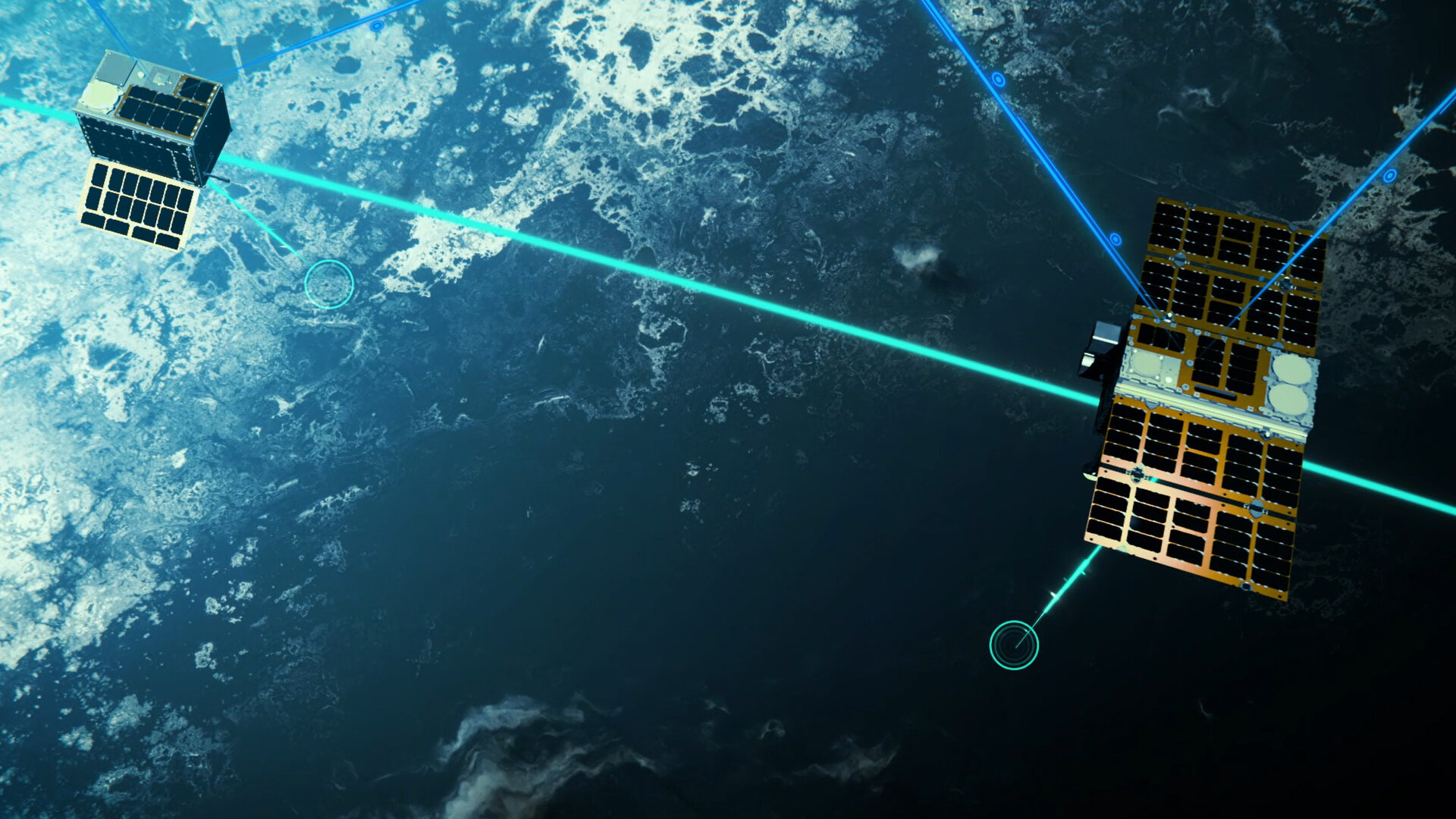
Image: European Space Agency
What’s new: An article about the European Space Agency’s LEO PNT demonstrator, Celeste, and how it complements Galileo adding resilience.
Why it’s important: Celeste adds a number of upgrades and advantages for accuracy and resilience making it more useful and reliable. Trust is becoming a bigger and bigger issue for satnav.
What else to know:
- Two Pathfinder demonstration Celeste satellites were launched this year. Eight larger satellites are planned to be launched in 2027 along with another satellite to test miniaturized clocks and “other technology” will complete an 11 satellite demonstration constellation.
- Based on the demonstration, Europe plans to build out a full LEO PNT constellation (retaining the name “Celeste,” it seems).
- “The name Celeste is a symbolic wink to the scientific past on which satellite navigation is founded. Maria Celeste was Galileo Galilei’s daughter, and the two shared a strong emotional and intellectual bond. She also honoured her father’s love for astronomy. Based on historic letters between father and daughter, we know how much Galileo valued his daughter and trusted her judgement.” From ESA website.

Space Missions
LEO-PNT Signals Aren’t Just Closer GNSS: Inside CELESTE’s Four-Band Plan
LEO-PNT signals are not simply louder copies of current GNSS. ESA’s CELESTE demonstrator broadcasts Positioning, Navigation and Timing (PNT) across four frequency bands (L, S, UHF and C), splits each signal into pilot, data and acquisition components, and deliberately mixes Frequency Division Multiple Access (FDMA) with the Code Division Multiple Access (CDMA) that Global Navigation Satellite Systems (GNSS) rely on. The design goal is not one better band but a testbed for many.
For receiver and signal-processing engineers, the interesting part of Low Earth Orbit PNT (LEO-PNT) is not only closer satellites. It is the signal plan: what is transmitted, how satellites are told apart, and what a receiver has to do to acquire and track it. CELESTE is the clearest public example to reason from, so this walks through its signal design band by band.