



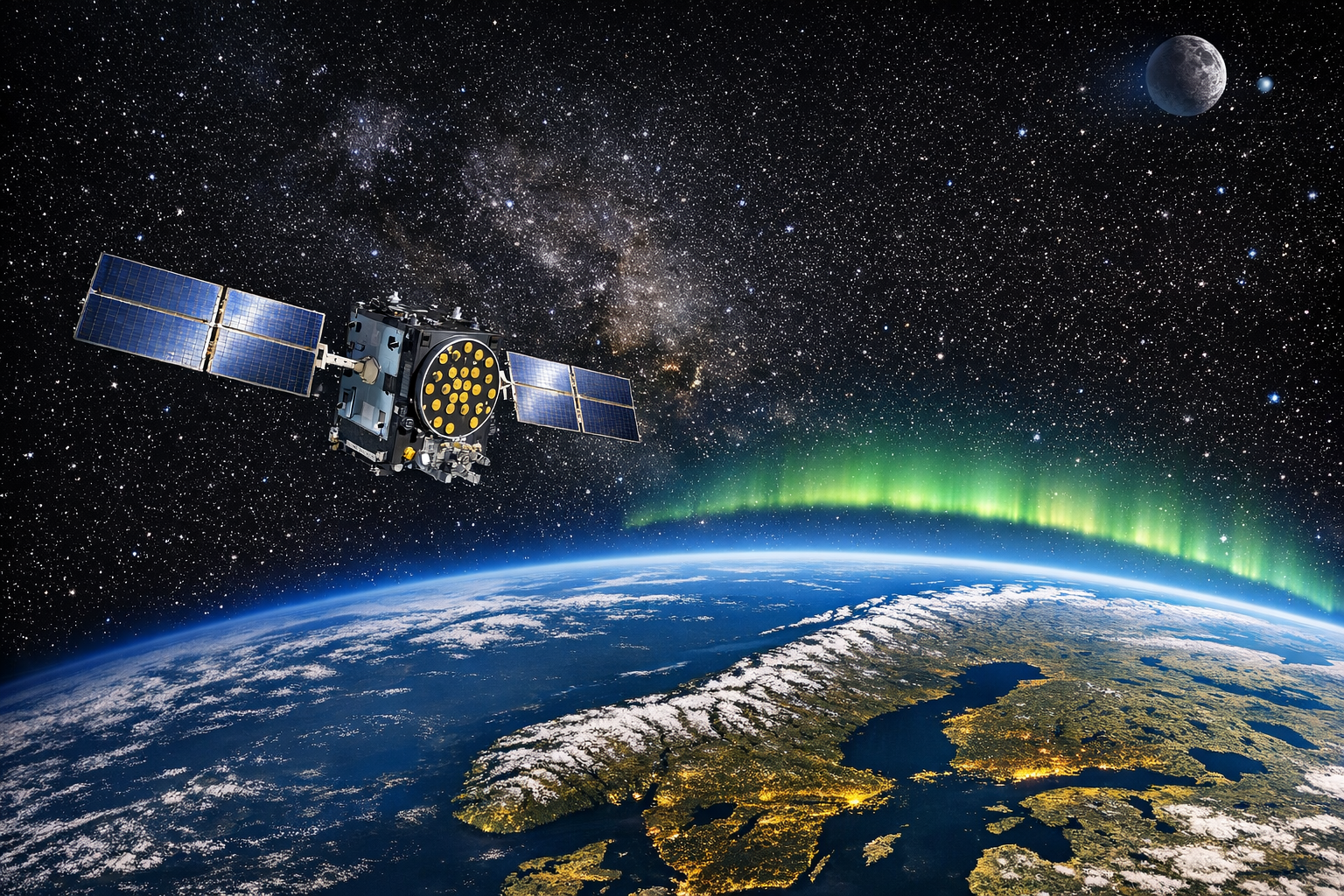
Image: Copilot AI
What’s new: A report commissioned by the Norwegian government on the nation’s dependence on GNSS.
Why it’s important: Understanding the nature of their dependence is key to making their national PNT resilient.
What else to know:
- Norway has experienced interference from Russia, especially in the northern parts of the country, for years. This can be very impactful as Norway has more airports that depend on GPS-only approaches than any other nation.
- The Norwegian administration has proposed establishing a terrestrial, fiber-based timing network similar to the ones in Sweden and U.K.
- Much of Norway will also be able to access timing from the UK’s eLoran network.
- The report acknowledges that estimates of economic impact, including its own, are only partial impacts as they do not incorporate the impacts on defense and the impacts of degradations of other infrastructures that rely on PNT.

English Translation by Copilot AI
Socio‑Economic Analysis of Satellite‑Based PNT Services
An analysis of the socio‑economic costs associated with the loss of satellite‑based PNT services (GNSS)
REPORT
By
Per Fredrik Johnsen
Torgeir Dahl Jørgensen
Andreas Becker Cappelen
Marius Berge Eide
Kristoffer Midttømme
Magnus Utne Gulbrandsen
Menon publication no. 31, 2026
Foreword
On behalf of the Ministry of Trade, Industry and Fisheries, Menon Economics has conducted a socio‑economic analysis of satellite‑based services for positioning, navigation and timing (PNT). The analysis highlights how satellite‑based PNT services are used across different sectors in Norway, and the importance they have for value creation and the functioning of society. A central purpose has been to examine the socio‑economic consequences that the loss or disruption of such services may entail, as well as to identify vulnerabilities and possible measures to reduce dependency.
The project at Menon was led by Magnus Utne Gulbrandsen, with Per Fredrik Johnsen as project manager. Andreas Becker Cappelen, Marius Berge Eide and Torgeir Dahl Jørgensen were project team members. Kristoffer Midttømme acted as quality assurer.
We would like to thank the Ministry of Trade, Industry and Fisheries for an engaging and interesting assignment. We also thank all interviewees for their valuable input throughout the process. Menon is responsible for all content in the report.
March 2026
Magnus Utne Gulbrandsen
Project Owner
Menon Economics
March 2026
Per Fredrik Johnsen
Project Manager
Menon Economics
Executive Summary
Satellite‑based services for positioning, navigation and timing (PNT) have today become a fundamental part of the infrastructure of the digital society. This report analyses how PNT services are used in Norway, which sectors depend on them, and the socio‑economic consequences that may result from a loss of these services. Based on sector‑specific analyses, the priced direct costs of a seven‑day loss are estimated at approximately NOK 3.4 billion. This estimate does not include the defence sector.
A comprehensive assessment of the consequences cannot be limited to the sum of direct losses within individual sectors. Several of the sectors most dependent on PNT services also constitute critical societal infrastructure upon which other sectors depend. The greatest vulnerabilities are therefore not necessarily found where the direct costs are highest, but rather in cross‑sectoral functions such as power supply, finance and electronic communications.
Although these sectors typically have built‑in redundancy, the risk associated with the infrastructure is nonetheless increased in the event of loss or manipulation of satellite‑based PNT services. Overall, the analysis shows that increasing use of satellite‑based signals delivers significant efficiency gains, but may also increase societal vulnerability if robustness and alternative solutions are not developed in parallel.
Satellite‑based services for positioning, navigation and timing (PNT) have become an integral part of the infrastructure of modern society. The technology is used in everything from aviation and maritime navigation to mobile networks, financial transactions and the operational systems of emergency services. At the same time, dependence on satellite‑based signals is often largely invisible. Many organisations do not use the technology directly but rely on systems and infrastructure that do.
This makes it difficult to gain an overview of where dependencies lie and what consequences loss or disruption may have. This report analyses how satellite‑based PNT services are used in Norwegian society and what consequences loss or disruption may entail. The analysis maps both the use of PNT services and the consequences at sector level and at the level of society as a whole.
The purpose of the analysis is to strengthen the knowledge base on society’s dependence on PNT services, highlight vulnerabilities, and provide a holistic picture of the technology’s importance for value creation and societal functioning.
Satellite‑based PNT services rely on signals from global navigation satellite systems (GNSS). These signals are freely available, have global coverage and high precision, and have therefore become an attractive technological solution across many sectors. Usage has increased sharply over the last two decades, meaning that an increasing number of systems and processes are dependent on GNSS signals—either directly or indirectly through digital infrastructure and automated systems.
In recent years, documented disruptions to GNSS signals have occurred in Norway, including in Northern Norway. Such incidents show that the risk of loss or disruption is not merely theoretical. In a digitalised and interconnected society, failures in fundamental technological references such as position and time can have consequences far beyond the systems that directly use the technology.
Link to the Norwegian language version of the report is HERE.