




Image: Shutterstock
What’s new: A press release about the latest step in the UK’s timing project.
Why it’s important:
- If you are a regular reader, you know timing is a critical enabler for all IT and most technologies.
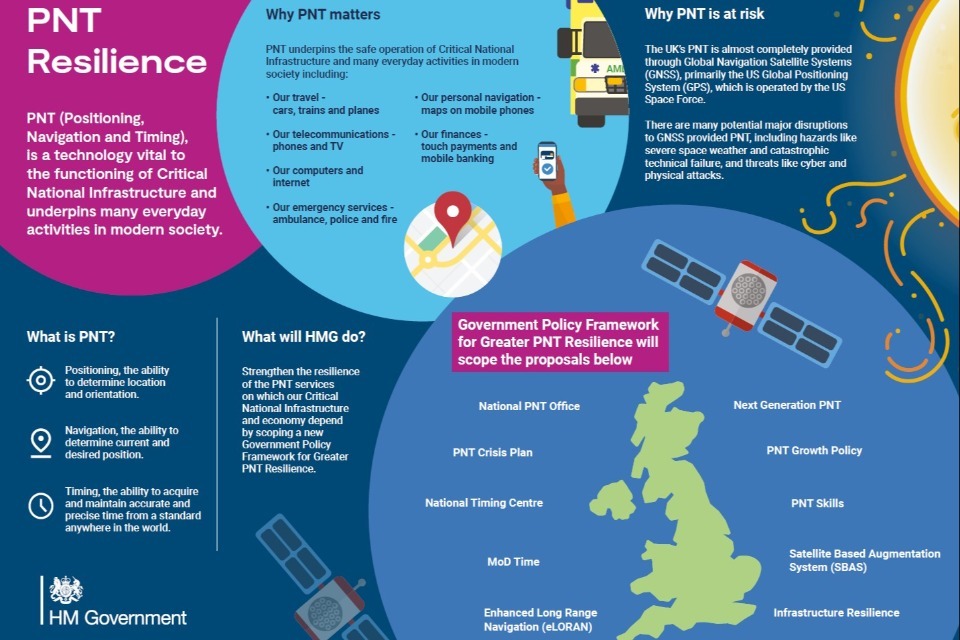
- The UK is happy to use vulnerable GNSS when it is trustworthy. As a matter of national and economic security, they are adding resilient timing with a clock network and terrestrial broadcast (eLoran).
What else to know:
- The UK is building a ‘resilient PNT triad‘ combining signals from space, terrestrial broadcast, and time/timing over fiber. An attack on one source is highly unlikely to impact the other two making the combination exceptionally resilient.
- UK eLoran time will be freely available to much of northern Europe. France is joining the project and combined coverage area has yet to be estimated publicly.

UK Invests £180 Million in National Timing Centre to Back Up GNSS
The UK government has launched a £180 million programme to harden its national timing infrastructure against disruptions to GNSS, funding a new phase of the National Timing Centre (NTC).
It will distribute highly accurate time signals from atomic clocks over terrestrial networks as a complement and backup to space-based systems.
Terrestrial timing to complement GNSS
Announced by the Department for Science, Innovation and Technology, the investment will support the next phase of the NTC programme, led by the National Physical Laboratory (NPL). Two dedicated sites equipped with advanced atomic clocks will generate an independent national time scale and distribute it via fibre and satellite links, providing a terrestrial timing source alongside GPS, Galileo and other GNSS constellations.
The government’s statement frames the goal clearly: reduce the UK’s reliance on satellite-delivered timing that can be “targeted and disrupted,” and ensure that critical services – including telecom networks, online banking, transport systems and emergency services – continue to function even during GNSS outages.
Free timing over air, internet and fibre
A key feature of the NTC build-out is wide distribution. The timing signal will be provided free over the air, via the internet and through fibre networks, giving operators multiple ways to access resilient time.
When existing timing sources fail or are degraded, the NTC infrastructure is intended to act as a safety net for “vital digital infrastructure,” from mobile base stations and financial trading platforms to energy networks and data centres.
According to NPL, the programme is also designed to support emerging high-precision, low-latency applications such as 5G/6G networks, smart cities and connected autonomous vehicles, all of which require tightly synchronised time across distributed nodes.
What can you do? How can you help?
PNT is the quiet backbone of everything — power, finance, transportation, defense. Too many leaders still don’t see the risk.
But you do.
You understand the systems, the dependencies, the failure chains. That insight is rare — and it’s exactly what your country needs.
So speak up.
Reach out to government leaders, industry decision‑makers, and your fellow citizens.
Show them why resilient PNT isn’t a feature — it’s the necessary foundation.
And when you get a response, tell us. Every conversation strengthens the mission.