



Image: RNT Foundation
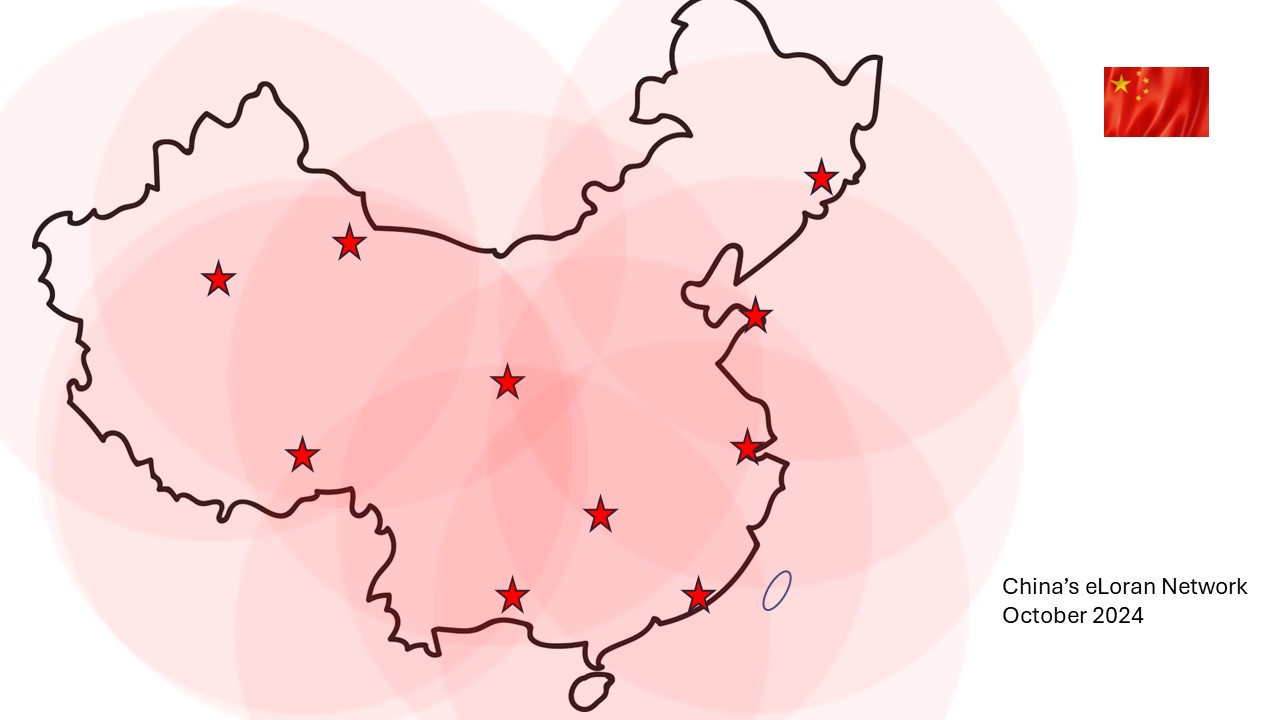
What’s New: A Chinese newspaper article that their national eLoran network is complete.
Why It’s Important: This completes China’s “PNT resilience triad” of getting signals from space, terrestrial broadcast and fiber. Three highly diverse methods such that a threat to one is very unlikely to impact the other two.
What Else to Know:
- In addition to an eLoran network, China has a 20,000km fiber timing network that includes 294 ‘timing stations.” This network not only delivers time, but it also integrates and synchronizes space and terrestrial broadcast signals.
- China is far less dependent on space for PNT than is the U.S. and other western nations. This gives them a strategic advantage.
- Note the claim in the article to have achieved 20 nanoseconds accuracy with differential eLoran.

The high-precision ground-based timing system Dunhuang long-wave timing station was completed and successfully tested
The Dunhuang long-wave time station of the high-precision ground-based time system, a major national scientific and technological infrastructure undertaken by the National Time Service Center of the Chinese Academy of Sciences, was announced to have been completed and successfully tested on the 30th, marking a step forward in the construction of my country’s three-dimensional cross-timing system between the air, space and land.
The Dunhuang Long-wave Timing Observatory is located in the northeast of Dunhuang City, Gansu Province. It is an important part of the high-precision ground-based timing system, a major national scientific and technological infrastructure during the 13th Five-Year Plan period.
Zhang Shougang, director of the National Time Service Center of the Chinese Academy of Sciences, introduced that the high-precision ground-based timing system utilizes the high reliability and high precision characteristics of enhanced Loran radio long-wave timing technology and fiber-optic timing technology to build a ground-based timing system that is independent of satellite navigation timing, and backs up each other, complements each other, and enhances each other. Together with other existing timing systems, it builds a national-level timing system with three-dimensional cross-over, unified traceability, safe and controllable, and advanced performance, which will better support economic and social operations and related scientific and technological development, and better safeguard national security.
It is reported that long-wave timing is the most reliable ground-based timing method at present. my country has built three additional long-wave timing stations in Dunhuang, Gansu, Korla, Xinjiang and Nagqu, Tibet, and combined them with existing long-wave timing stations to achieve nationwide coverage of long-wave timing signals.
During the construction of the Dunhuang long-wave time station, researchers made breakthroughs in high-precision transmission control and pulse time reference feedback modulation technology, as well as high-stability high-power pulse signal generation technology, achieving a megawatt-level Loran timing transmission accuracy of 20 nanoseconds, ahead of the current international level of 50 nanoseconds. Using differential enhancement information, users can increase the timing accuracy from microseconds to tens of nanoseconds.
The national timing service needs to provide high-precision national standard time signals to users in different spaces, different states and with different needs through various technical means 24 hours a day, continuously, safely and reliably. Zhang Shougang said that after nearly 60 years of development, my country has built the most technically complete national timing system in the world. The timing accuracy has increased from milliseconds (one thousandth of a second) to hundreds of picoseconds (one billionth of a second), an increase of 7 orders of magnitude, which is at the world’s leading level and has better met national needs.