



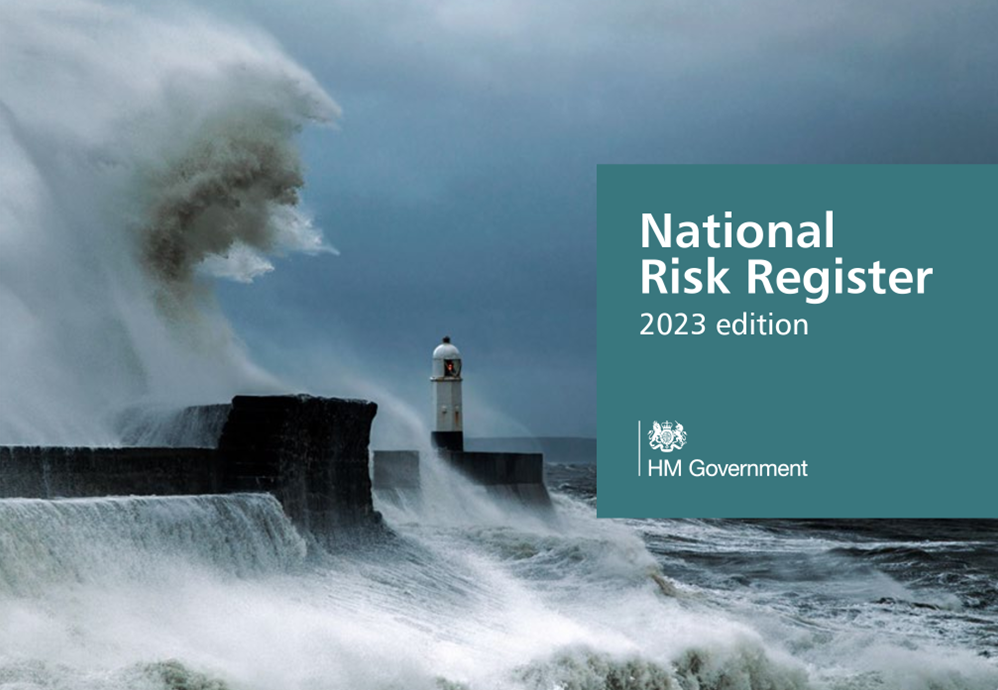
What’s New: The newest edition of the United Kingdom’s National Risk Register includes loss of PNT.
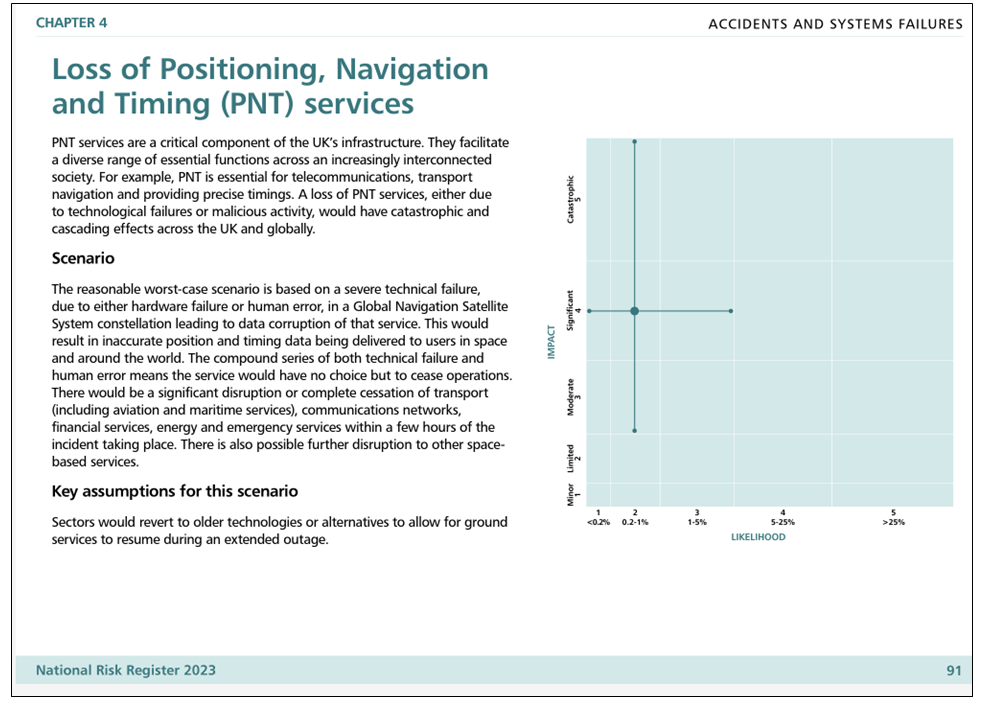
- The intro to the PNT section says: “A loss of PNT services, either due to technological failures or malicious activity, would have catastrophic and cascading effects across the UK and globally.”
- Yet the assessment that follows does not say “catastrophic.” And it lists the probability of it happening as vanishingly small.
Why It’s Important:
- In a Good Way – Official recognition of PNT as critical and its loss as a problem is important to making things better. – Per the Alcoholics Anonymous 12 step recovery program – Step One: “Admit you have a problem.”
- In a Bad Way – Massive underestimation of impact and probability puts mitigating the risk of PNT loss way too far down the list of important things to do.
What Else to Know:
- The Risk Register assesses the chance of a loss of PNT at .2 to 1% . And the impact of such a loss as “significant” but not “catastrophic.” These assessments are far too low.
- The risks evaluated were only “human error” and “equipment failure.”
- The time period examined was only over the next five years.
- It assumes “Sectors would revert to older technologies or alternatives to allow for ground services to resume during an extended outage.”
- And those “older technologies” would be…? Many no longer exist.
- How long would it take to revert? Other equipment would be needed, systems and processes changed.
- Would reverting be even possible?
Important Questions: There are so many! Some of the ones that come to mind immediately –
- Why choose a period of only 5 years to evaluate risk?
- There is a 40% chance of a Carrington Event or worse in the next 25 years. The probability approaches 100% as we go further into the future. It will happen sometime. Could happen tomorrow.
- Mitigations will take years, decades likely, to implemented and fully adopted.
- Why choose the least likely scenarios to evaluate?
- Space debris wasn’t mentioned
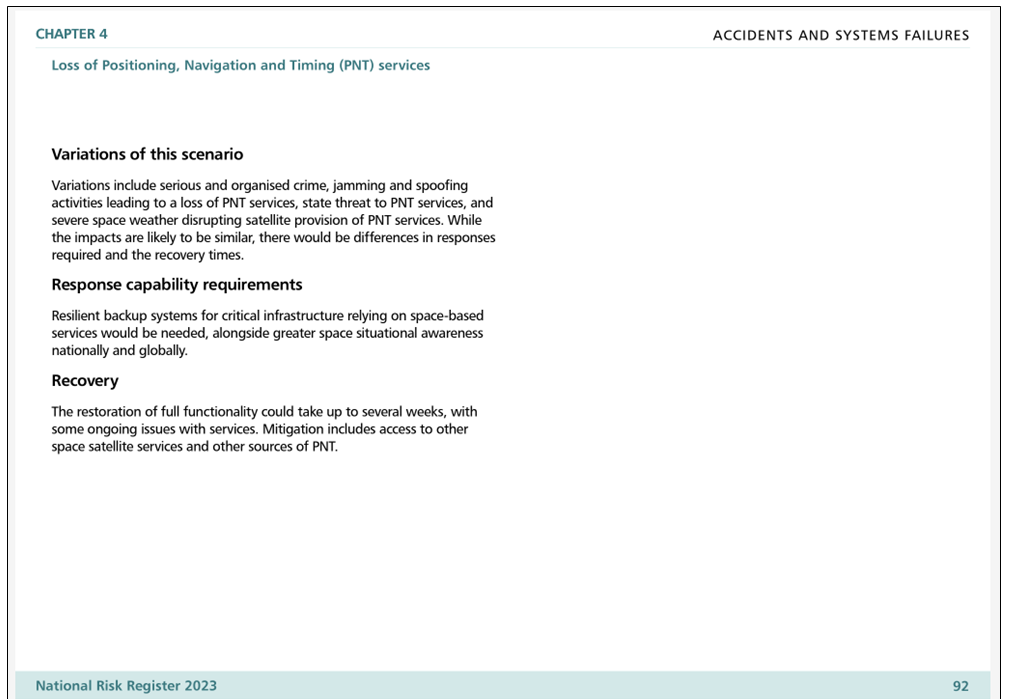
- Solar activity, criminal and nation-state attacks were listed as “other scenarios” but seemingly not part of the assessment.
- On-going threats from Russia, China, Iran, and North Korea would seem to make nation-state attack “most likely.”
- Why admit it would be catastrophic in the intro and then have the analysis say something else?
- Did the analysis use the bogus $1B/day loss figure that has since been shown to be ridiculously low?
- Did the UK government intentionally choose assumptions and structure the analysis to make the risk score lower? If so, why would they do that?
- The UK government has had a National PNT Strategy ready to publish for several years. The only hang up seems to be which ministry will be responsible for PNT leadership. There does not seem to be any additional budget or staff being offered, so no one wants to get stuck with it.
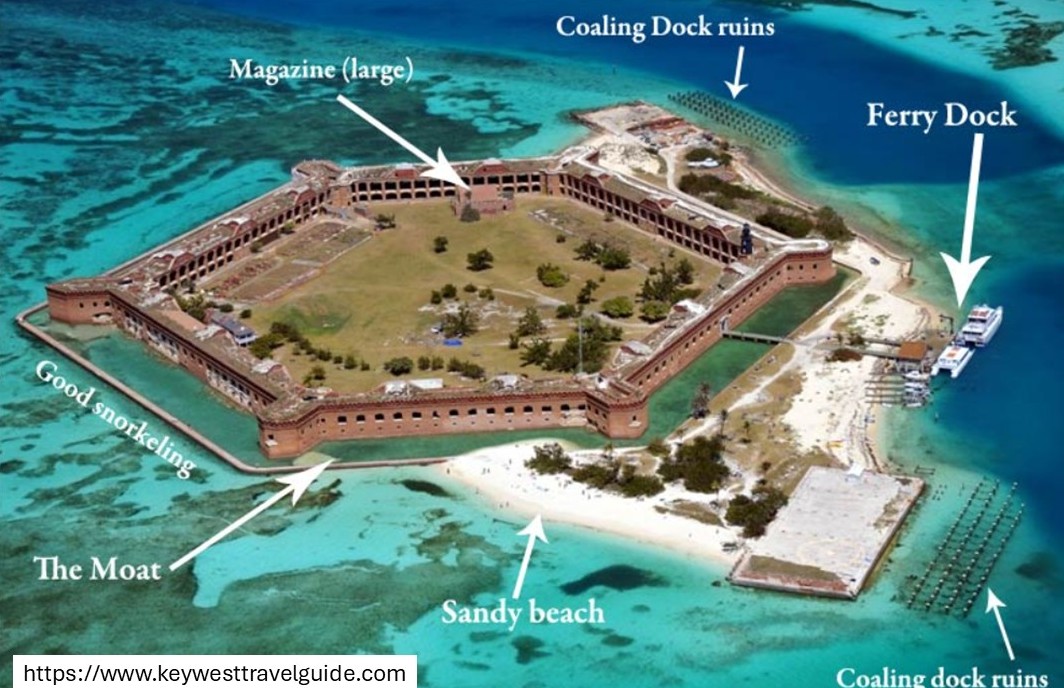
Blog editor’s note: Interesting they chose a lighthouse, the earliest form of government-provided PNT, for the risk register’s cover.
LINK TO UK NATIONAL RISK REGISTER 2023