


A large solar storm could knock out the power grid and the internet – an electrical engineer explains how – The Conversation

March 21, 2022

Written by Editor

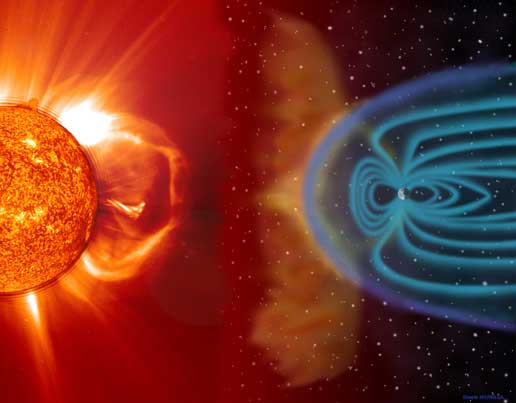
Image: NASA & Shutterstock

Blog Editor’s Note: An interesting article with more background on the history of huge Coronal Mass Ejections than we normally see.

While many claim GPS satellites are constructed to withstand the rigors of space weather, it is unlikely they would be able to survive the most severe events described.

But then would any electrical or electronic system on the ground be able to survive?  Who knows?

A new terrestrial navigation and timing system, though, would certainly have a better chance of surviving or being restored to operation than a space-based system. Let’s think of some advantages:

  • More natural protection than systems in space – further away, more shielding from Earth’s magnetic field
  • Fewer size and weight constraints for shielding, isolation, reset equipment
  • New system design can incorporate latest insulation and protection techniques
  • More easily accessed and repaired if damaged 

Scientists estimate that in the next 10 years there is a 35% to 45% chance of a CME large enough to disrupt GPS service for several days, and a 4% 12% chance for a much worse Carrington-like event that could damage satellites.

Don’t get us wrong. We recognize that everything is connected to everything. And a catastrophic CME would be … catastrophic. But the way to make our interconnected world stronger and more resilient is for each of us to do the best we can in our own areas of influence. 

So let’s move US PNT from “a single point of failure” to “as strong as it can be.”

 

A large solar storm could knock out the power grid and the internet – an electrical engineer explains how

David WallaceMississippi State University

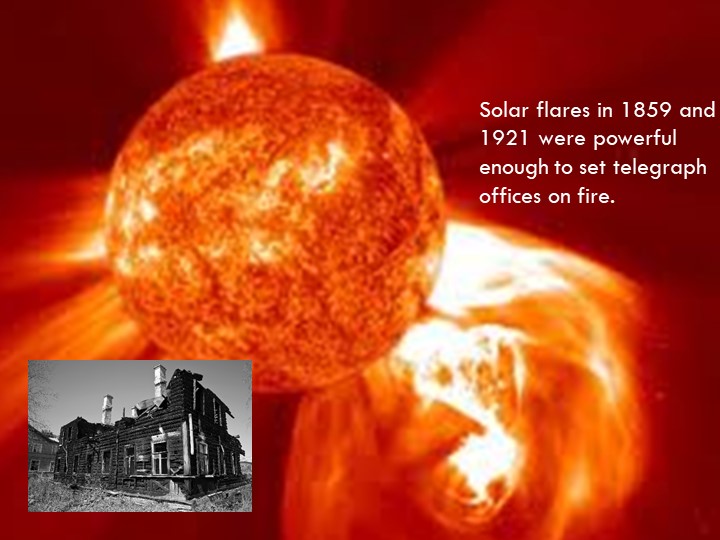
On Sept. 1 and 2, 1859, telegraph systems around the world failed catastrophically. The operators of the telegraphs reported receiving electrical shocks, telegraph paper catching fire, and being able to operate equipment with batteries disconnected. During the evenings, the aurora borealis, more commonly known as the northern lights, could be seen as far south as Colombia. Typically, these lights are only visible at higher latitudes, in northern Canada, Scandinavia and Siberia.


READ MORE

What Can YOU Do? How Can YOU Help?

PNT is the quiet backbone of everything but too many leaders still don’t see the risk.

But you do. You understand the systems, the dependencies, the failure chains. That insight is rare — and it’s exactly what your country needs right now. Contact your government leaders and industry decision-makers and tell them resilient PNT isn’t a feature — it’s the foundation everything else depends on.

Start the Conversation

Use our Resilient PNT Key Talking Points to make the case.

U.S. Advocates

Find your representatives at Congress.gov, then use our email template to reach them in minutes.

When you get a response, let us know. Every conversation strengthens the mission.

More PNT News

Inside GNSS, Inside LEO: LEO PNT – Why Now?

Inside GNSS, Inside LEO: LEO PNT – Why Now?

Image: Shutterstock What's new: A new recurring feature at Inside GNSS. Why it's important: LEO PNT has enormous potential to provide similar services as MEO PNT but with greater performance and greater resilience. What else to know: Xona, Trustpoint, (both RNT...

Why the FCC Must Reject Ligado’s Latest Plan – Broadband Breakfast

Why the FCC Must Reject Ligado’s Latest Plan – Broadband Breakfast

Image: RNT Foundation What's new: It has been six years since the FCC ruled in favor of Ligado. Now Ligado wants to change almost everything about the bargain it struck with the commission. Why it's important: Use of some of the frequencies Ligado was granted could...

New Company for Broadcast Positioning System – NAB

New Company for Broadcast Positioning System – NAB

Image: Shutterstock What's new: The National Association of Broadcasters (NAB) has formed a separate company to develop, advocate for, and deploy the Broadcast Positioning System (BPS). Why it's important: NAB has put increasing effort behind BPS since its inception...

Standalone Magnetometry Is the New GPS – IEEE Spectrum

Standalone Magnetometry Is the New GPS – IEEE Spectrum

Image: Shutterstock What's new: An article about forms of navigation using aspects of the earth's magnetic field.  Why it's important: Autonomous navigation is becoming more interesting for a number of applications in a world where interference with GNSS is becoming...

Get PNT News in Your Inbox