



Image: Space Development Agency
Blog Editor’s Notes: First and foremost, congrats to our friend, colleague, and award winning journalist Dee Ann Divis for standing up her new site and newsletter “Navigation Outlook.” She always has great insights and often exclusive stories you will find there first. We highly recommend signing up.
We were intrigued by the below article, some of which was reprinted in the Winter 2022 ION Quarterly Newsletter. Particularly that Space Development Agency (SDA) is looking for partners in its endeavor. At least two companies, Trustpoint and Xona Space Systems (an RNTF supporter), are already a ways down the road toward their own LEO PNT systems. We wonder if companies like these are what SDA is thinking about for partnering…
Also of note is that the constellation will initially rely on GPS for its operation, as is the case for most all comms/LEO constellations. PNT is slated for later in the program. We are thinking that schedule will allow SDA to keep its options open longer.

GPS-Independent Navigation at the Core of Space Development Agency’s New LEO Constellation
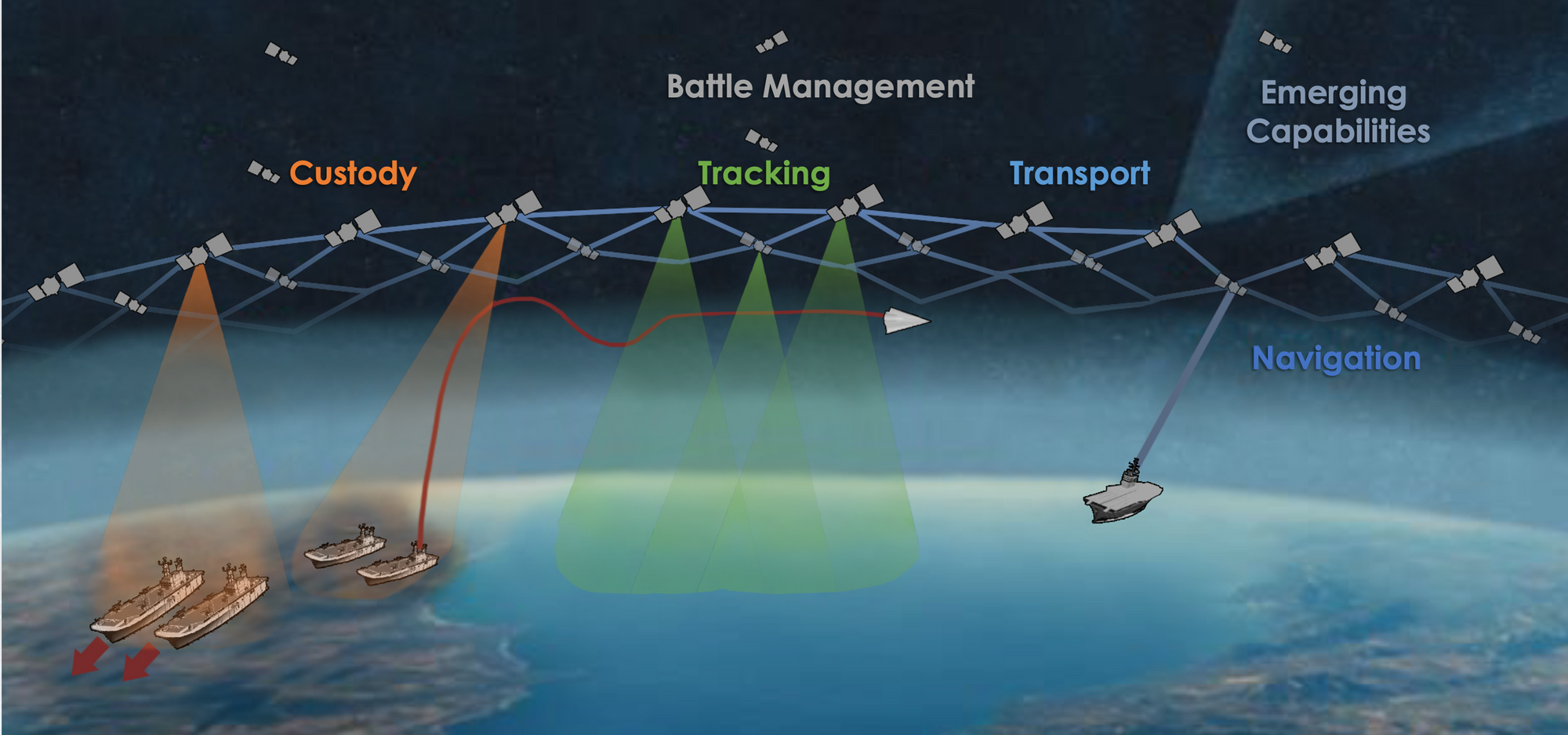
The Space Development Agency (SDA) is building a satellite constellation with a new, self-generated navigation capability that, if successful, will enable it to support the military with early warning and tracking information, even beyond-line-of-sight targeting, without input from GPS.
The still-unnamed web of Department of Defense satellites will use a proliferated architecture comprising hundreds of small spacecraft instead of dozens of larger, perhaps more-tempting-to-target satellites like those in the GPS constellation. Set in low Earth orbit (LEO), the relatively petite spacecraft will be far less expensive to build, launch and update and the signal latency from space to the ground will be less.
The SDA satellites will incorporate optical crosslinks creating a resilient, mesh network of connections that should enable the system to move information through the constellation from one side of the globe to another without interim downlinks to the Earth’s surface. The cross-links will also enable the satellites to share clock data and determine their position relative to each other. With this capability, and a link to the ground to add an Earth-centered reference frame, the constellation has the potential to self-generate its own positioning, navigation and timing (PNT) information and be truly independent of GPS.