




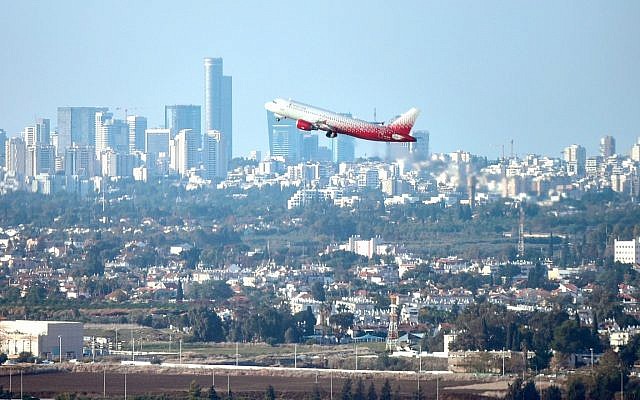
Image: Aircraft taking off Ben Gurion Airport Nov 2018 – Flash90
Blog Editor’s Note: While it seems like two months is a long time to have this problem, it is good to remember that it took US officials three months to resolve the first problem at Newark International Airport. That one was a delivery driver with a jammer irregularly using an adjacent highway. The most probable cause of the problem in Tel Aviv was the Russians next door in Syria. One might expect that to be an even more difficult problem to resolve.

Disruption of GPS systems at Ben Gurion Airport resolved after 2 months
No details given on how or why interference to planes’ navigation systems came to an end; Russian military in Syria blamed
Unexplained disruptions to the satellite navigation systems of airplanes flying around Ben Gurion International Airport have ended, the Airports Authority announced on Monday.
The authority did not say how the GPS interference was stopped, or whether Israel’s security establishment was involved in bringing an end to the disruptions to aircraft traffic for the last two months.
Israeli officials have pointed the finger at Russian forces in nearby Syria as the source of the GPS problems at the country’s largest airport. The Russian embassy in Israel dismissed the allegations as “fake news.”
The interference with the airplanes’ GPS reception appeared to stem from a form of electronic warfare known as “spoofing,” which Russia has been accused of doing in the past as a defensive measure, despite the disruptions it causes to nearby aircraft and ships.
The Israel Defense Forces refused to comment publicly on the source of the interference, but unnamed defense officials told media outlets that it originated in Syria, where Russian troops and aircraft are fighting on behalf of the Assad regime.
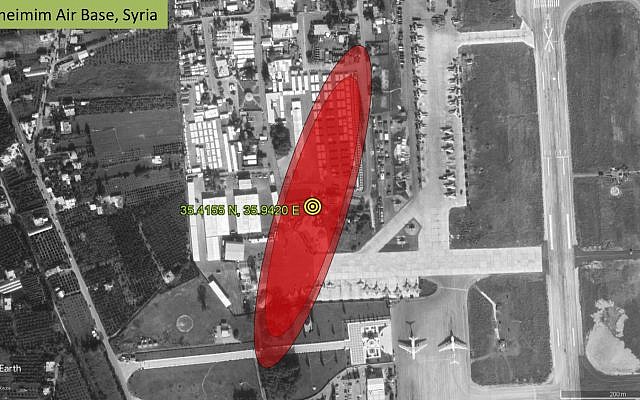
The source of a signal interfering with GPS reception for planes flying over Israel, located on Russia’s Khmeimim Air Base in western Syria, from a presentation by aerospace engineer Todd Humphreys to the US government in June 2019. (Courtesy)
Todd Humphreys, a professor at the University of Texas, told The Times of Israel in June that, based on his satellite data, he was 90 to 95 percent positive that Moscow was behind the interference.
Humphreys said he did not believe the disruptions were specifically directed at Israel, but were collateral damage in Moscow’s efforts both to protect its troops from drone attacks and to assert its dominance in the field of electronic warfare.
Humphreys and his team used sensors onboard the International Space Station to track the interference back to the Khmeimim Air Base, which was built by Russia in 2015 along Syria’s western coast, as one of Moscow’s permanent facilities in its support for Syrian dictator Bashar Assad in the country’s civil war.
Similar, GPS disruptions have been reported in recent years around the Black Sea, along Russia’s borders with Norway and Finland, and near the Kremlin and Russian President Vladimir Putin’s palace.
The Airports Authority said the interference did not cause any safety issues at Ben Gurion, and that pilots arriving at the airport over the last two months all safely used a “safe and professional” alternative method for landings.