



Guest Post by Mr. Charles Schue, CEO, UrsaNav, Inc.
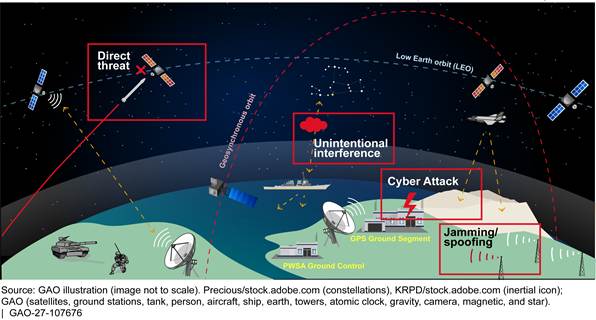
Over the past several days, North Korea has “reached across its borders” to jam GPS signals in South Korea. This had been a yearly occurrence for a while happening in 2010, 2011, and 2012. Its resurgence this year has been called a retaliation for new sanctions imposed on the regime by the US and its allies. Although reports are still coming in, it appears that the impact of the jamming is widespread, affecting maritime and aviation users, as well as mobile communications. According to the Yonhap News Agency:
“The Ministry of Science, ICT and Future Planning said the GPS disruptions that began Thursday have been repeating at intervals ever since, impacting Seoul’s adjacent city of Incheon, and the surrounding Gyeonggi and Gangwon provinces.
The ministry said 746 airplanes and 621 vessels experienced disruptions, but no significant damage has been reported so far. The disruptions can cause mobile phones to malfunction, and affect planes and ships that rely on GPS for navigation.”
A separate report indicated that 1,786 mobile telecommunication base stations have also been impacted.
It is very likely that, in addition to GPS signals, those of other Global Navigation Satellite Systems (GNSS) area also being affected. Europe’s Galileo, Russia’s GLONASS, China’s Beidou, Japan’s QZSS – all operate in the same frequency band as GPS, and all transmit very faint, easy to disrupt signals.
North Korea’s GPS jamming is not an event isolated in time or geography. Jamming over wide areas is happening all the time in the Middle-East and Ukraine. GPS jammers are in regular use by organized crime for theft of high value cargo, and terrorist have been captured with jamming devices. And they are used by otherwise law-abiding individuals who don’t wish to be followed. One sampling showed 25% to 30% of trucks in an industrial area having jammers in operation! This “citizen jamming” has resulted in disrupted aircraft landing systems, idled container terminals, and countless dropped cell phone calls.
What is unique about the North Korean incidents is that South Korea has been paying very close attention and documenting the impacts. Here are the statistics from the South Korean Central Radio Management Office for the events from 2010 to 2012, along with what we have seen reported in the press so far for the most current incidents:
| Dates | Jammer Locations | Affected Areas | Disruptions |
| 2010, Aug 23-26 (4 days) | Kaesong | Gimpo, Paju, etc. | 181 cell towers
15 airplanes 1 Battleship |
| 2011, Mar 4 – 14 (11 days) | Kaesong Mtn, Kumgang | Gimpo, Paju, Gangwon etc | 145 cell towers
106 airplanes 10 ships |
| 2012, Apr 28 – May 13
(16 days) |
Kaesong | Gimpo, Paju, etc. | 1,016 airplanes
254 ships |
| 2016, Mar 31 – ongoing | Mt. Geumgang
Haeju |
Easter Gagnwon
Seoul |
962 airplanes
700 ships 1,786 cell towers |
| 2010 – 2012 information from South Korean Central Radio Management Office | |||
| 2016 information as of 5 April and from from reports by Yonhap News Agency and KBS News | |||
Also unique is that North Korea’s jamming is high power, sustained and from fixed locations – so it’s easy to identify where it’s coming from and the impacts. How much more difficult is it when jammers are low power and are in a vehicle that quickly passes by? It took many months, and a concerted effort by several agencies, to locate the signal intermittently jamming an aircraft landing system at the Newark (EWR) airport in the United States. And who is to say if a dropped cell call or a glitch in an IT network is due to a jammer passing by or something else?
Jamming GPS and other satellite navigation systems is the classic asymmetric threat. It’s inexpensive, equipment is readily available and easy to use, and its effects are scalable from targeted local impacts to wide area strategic disruptions. At the same time it is very, very difficult to detect, especially when operated intermittently and/or from a moving platform, and its impacts are often attributed to other causes.
GPS is the gold standard for PNT. We should do everything possible to keep it that way. We at UrsaNav are strong proponents of fully funding GPS, building better receivers and antennas, for improving the signal structure, and for increasing signal power. We fully support Dr. Brad Parkinson’s idea that we should “Protect, Toughen, and Augment” GPS.
We think that augmenting is especially important, and we agree with the US government decisions in 2008 and 2015 that the right augmentation system is eLoran. Yet we have seen little progress in that direction.
Russia, China, South Korea, Saudi Arabia, the United Kingdom – all have some version of Loran to serve as a high-power difficult to disrupt augmentation to GPS and other satellite navigation systems.
So not only is the US at risk, it is at greater risk than some of our allies and adversaries.
Establishing a system would be relatively inexpensive. Including eLoran chips in next generation timing and navigation receivers would provide “proof of time” and “proof of position” for cybersecurity and other uses. It would help deter attacks on GPS satellites and signals by making them less attractive targets, and it would provide a unique one-way communications capability that could penetrate almost anywhere.
The time to fix the roof is when the sun is shining.
We need to protect GPS with eLoran now, before an attack or other major disruption does major damage to America and costs lives.